Close Menu
  • Homepage
  • News
  • Cloud & AI
  • ECommerce
  • Entertainment
  • Finance
  • Opinion
  • Podcast
  • Contact

Subscribe to Updates

Get the latest technology news from TechFinancials News about FinTech, Tech, Business, Telecoms and Connected Life.

What's Hot

Why Bitcoin and XRP Holders Are Rethinking Income in 2026—and What Comes Next

2026-01-23

How Local Leaders Can Shift Their Trajectory In 2026

2026-01-23

The EX60 Cross Country: Built For The “Go Anywhere” Attitude

2026-01-23
Facebook X (Twitter) Instagram
Trending
  • Why Bitcoin and XRP Holders Are Rethinking Income in 2026—and What Comes Next
Facebook X (Twitter) Instagram YouTube LinkedIn WhatsApp RSS
TechFinancials
  • Homepage
  • News
  • Cloud & AI
  • ECommerce
  • Entertainment
  • Finance
  • Opinion
  • Podcast
  • Contact
TechFinancials
Home»Opinion»How South Africa Can Address Digital Inequalities in e-learning
Opinion

How South Africa Can Address Digital Inequalities in e-learning

ContributorBy Contributor2020-04-29Updated:2020-05-04No Comments5 Mins Read
Share Facebook Twitter Pinterest LinkedIn Tumblr Email
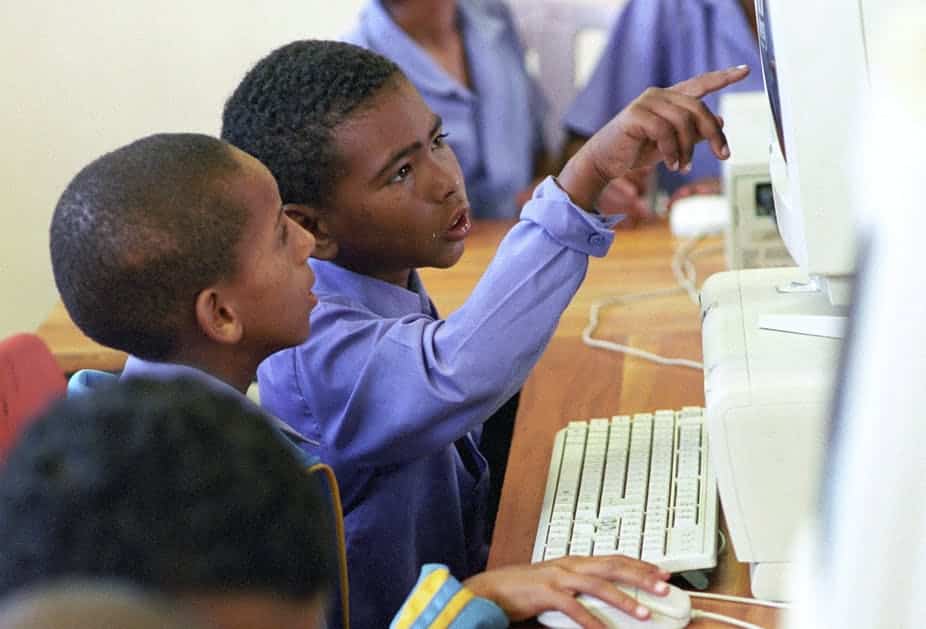
Many South African schools don’t have computer labs or other digital technology.
Many South African schools don’t have computer labs or other digital technology. Per-Anders Pettersson/Getty Images
Share
Facebook Twitter LinkedIn Pinterest Email Copy Link

by Mmaki Jantjies

South Africa’s education system is complex, with historical inequalities dating back to apartheid. Most of the country’s pupils come from disadvantaged backgrounds. Language is an issue; most pupils do not speak English as a mother tongue, yet English dominates in many classrooms. And, as the COVID-19 crisis has showed, there’s a huge digital divide at play.


Read more:
Five things South Africa must get right for tech in schools to work


The ongoing effects of the virus have kept pupils and teachers at home. This has necessitated a move to e-learning. In theory, this could be an important step towards a fairer education system. Digital platforms enable equitable access for learners to digital books, simulated science labs and related innovative learning resources.

Electronic and mobile learning can thus be seen as an additional learning resource that can also help enhance access to learning tools. Access to e-learning is not a panacea to the challenges in South African education. But it does provide an opportunity to make access to learning resources for all children more equitable.

But the reality in South Africa, as in most developing countries, is very different. Teachers have varying digital skills. Many families and teachers also cannot afford the data necessary to sustain some online learning activities.

COVID-19 has shown that technology is no longer a luxury but an important component of the education process. In presenting solutions, a wide range of factors must be considered. These range from access to computers, to teacher training, to the social and economic challenges faced by teachers, pupils and schools in their communities.

National focus

There are already some strategic policies and resources in place to help schools and teachers use technology as part of the teaching and learning process.

Information and Communications Technology is also taught as a school subject. But the government needs to consider an additional range of issues if it’s going to solidify a commitment towards e-learning. This includes policies and strategies surrounding connectivity, data costs, skills development, hardware access as well as contextual multilingual digital learning content.

Many schools have little or no technology facilities. Some have tablets and only a few have advanced computing laboratories. Formal training in applied technology skills is provided for teachers who want to teach a technology specialist subject in schools.

But all this needs to be extended. Adequate digital skills training should become a mandatory component of all teacher training programmes in universities, universities of technology and colleges. While there have been several digital training programmes for both in-service and trainee teachers in some provinces, it is time for a concerted national programme to ensure all teachers are skilled in digital teaching and technology.

Several studies have reflected on the innovative use of mobile phones and related applications to support learning in South Africa.

But South Africa has some of the highest data costs on the continent. This means that pupils can’t always easily access information on their mobile phones.


Read more:
Kids can keep learning even during a lockdown. Here’s how


In the wake of South Africa’s first COVID-19 cases, as schools closed, several educational sites were zero rated; this means they are now free to use.
This should be extended to support home schooling and any future returns to school, so that data costs don’t keep schools in poorer communities from accessing these resources. Policies to enable such beyond the pandemic should be considered.

Projects that work

As an educator who focuses on Education Technology research, I know there is enormous enthusiasm among teachers and pupils to become more digitally savvy. I have worked with a number of under-resourced schools, supporting the teaching of Science, Technology and Maths subjects through basic software applications, learning management systems and other free-to-use cloud-based education platforms.

When pupils and teachers receive the right support for digital learning, the response is often remarkable. I have met many teachers who willingly dedicate their weekends and school holidays to digital learning and teaching, with no financial incentives but a passion to equip pupils with digital skills.

I am particularly proud of a collaboration between computing students from the University of the Western Cape with teachers in a high school in an underprivileged part of Cape Town. Their work together has cultivated computing skills and sparked learners’ interest in other subjects like chemistry and astronomy.

A similar collaboration has been expanded to the North West province and convinces me that there are thousands of teachers who are keen to retrain to prepare their pupils for the digital era.

The COVID-19 crisis offers a unique opportunity to harness this enthusiasm. With the right support and training, digital teaching and learning can become ubiquitous even in resource-strapped environments.The Conversation

Mmaki Jantjies, Associate professor in Information Systems, University of the Western Cape

This article is republished from The Conversation under a Creative Commons license. Read the original article.

digital inequalities digital inequalities in e-learning e-learning South Africa
Share. Facebook Twitter Pinterest LinkedIn Tumblr Email
Contributor

Related Posts

How Local Leaders Can Shift Their Trajectory In 2026

2026-01-23

Directing The Dual Workforce In The Age of AI Agents

2026-01-22

The Productivity Myth That’s Costing South Africa Talent

2026-01-21

The Boardroom Challenge: Governing AI, Data And Digital

2026-01-20

Ransomware: What It Is And Why It’s Your Problem

2026-01-19

Can Taxpayers Lose By Challenging SARS?

2026-01-16

Science Is Best Communicated Through Identity And Culture – How Researchers Are Ensuring STEM Serves Their Communities

2026-01-16

Could ChatGPT Convince You To Buy Something?

2026-01-15

Stablecoins Are Gaining Ground As Digital Currency In Africa: How To Avoid Risks

2026-01-13
Leave A Reply Cancel Reply

DON'T MISS
Breaking News

Chery SA to Buy Nissan Rosslyn Plant, Save Jobs

In a major development for South Africa’s automotive industry, Nissan and Chery SA have reached…

Directing The Dual Workforce In The Age of AI Agents

2026-01-22

Huawei Says The Next Wave Of Infrastructure Investment Must Include People, Not Only Platforms

2026-01-21

South Africa: Best Starting Point In Years, With 3 Clear Priorities Ahead

2026-01-12
Stay In Touch
  • Facebook
  • Twitter
  • YouTube
  • LinkedIn
OUR PICKS

The EX60 Cross Country: Built For The “Go Anywhere” Attitude

2026-01-23

Why Legal Businesses Must Lead Digital Transformation Rather Than Chase It

2026-01-23

Mettus Launches Splendi App To Help Young South Africans Manage Their Credit Health

2026-01-22

Over R270M In Phuthuma Nathi Dividends Remain Unclaimed

2025-11-27

Subscribe to Updates

Get the latest tech news from TechFinancials about telecoms, fintech and connected life.

About Us

TechFinancials delivers in-depth analysis of tech, digital revolution, fintech, e-commerce, digital banking and breaking tech news.

Facebook X (Twitter) Instagram YouTube LinkedIn WhatsApp Reddit RSS
Our Picks

Why Bitcoin and XRP Holders Are Rethinking Income in 2026—and What Comes Next

2026-01-23

How Local Leaders Can Shift Their Trajectory In 2026

2026-01-23

The EX60 Cross Country: Built For The “Go Anywhere” Attitude

2026-01-23
Recent Posts
  • Why Bitcoin and XRP Holders Are Rethinking Income in 2026—and What Comes Next
  • How Local Leaders Can Shift Their Trajectory In 2026
  • The EX60 Cross Country: Built For The “Go Anywhere” Attitude
  • Why Legal Businesses Must Lead Digital Transformation Rather Than Chase It
  • Why Rezor’s Exchange Launch Sets a New Benchmark for Web3 Founders — Rahul Rohit Parikh Story of Determination
TechFinancials
RSS Facebook X (Twitter) LinkedIn YouTube WhatsApp
  • Homepage
  • Newsletter
  • Contact
  • Advertise
  • Privacy Policy
  • About
© 2026 TechFinancials. Designed by TFS Media. TechFinancials brings you trusted, around-the-clock news on African tech, crypto, and finance. Our goal is to keep you informed in this fast-moving digital world. Now, the serious part (please read this): Trading is Risky: Buying and selling things like cryptocurrencies and CFDs is very risky. Because of leverage, you can lose your money much faster than you might expect. We Are Not Advisors: We are a news website. We do not provide investment, legal, or financial advice. Our content is for information and education only. Do Your Own Research: Never rely on a single source. Always conduct your own research before making any financial decision. A link to another company is not our stamp of approval. You Are Responsible: Your investments are your own. You could lose some or all of your money. Past performance does not predict future results. In short: We report the news. You make the decisions, and you take the risks. Please be careful.

Type above and press Enter to search. Press Esc to cancel.

Ad Blocker Enabled!
Ad Blocker Enabled!
Our website is made possible by displaying online advertisements to our visitors. Please support us by disabling your Ad Blocker.