Close Menu
  • Homepage
  • News
  • Cloud & AI
  • ECommerce
  • Entertainment
  • Finance
  • Opinion
  • Podcast
  • Contact

Subscribe to Updates

Get the latest technology news from TechFinancials News about FinTech, Tech, Business, Telecoms and Connected Life.

What's Hot

Digitap ($TAP) Crushes NexChain with Real Banking Utility: Best Crypto to Buy in 2026

2026-02-06

Take Profit Trader Announces 40 Percent Discount on Evaluation with Fee-Free Activation

2026-02-06

ChatGPT Reveals 7 Top Altcoins for 2026: APEMARS Dominates as a High ROI Crypto Investment Project – $10K Could Grow to $1.18M

2026-02-06
Facebook X (Twitter) Instagram
Trending
  • Digitap ($TAP) Crushes NexChain with Real Banking Utility: Best Crypto to Buy in 2026
Facebook X (Twitter) Instagram YouTube LinkedIn WhatsApp RSS
TechFinancials
  • Homepage
  • News
  • Cloud & AI
  • ECommerce
  • Entertainment
  • Finance
  • Opinion
  • Podcast
  • Contact
TechFinancials
Home»Opinion»Instagram And Facebook Are Stalking You On Websites Accessed Through Their Apps. What Can You Do About It?
Opinion

Instagram And Facebook Are Stalking You On Websites Accessed Through Their Apps. What Can You Do About It?

The ConversationBy The Conversation2022-08-22No Comments5 Mins Read
Share Facebook Twitter Pinterest LinkedIn Tumblr Email
Facebook
Facebook. Photo by Glen Carrie on Unsplash
Share
Facebook Twitter LinkedIn Pinterest Email Copy Link

Social media platforms have had some bad press in recent times, largely prompted by the vast extent of their data collection. Now Meta, the parent company of Facebook and Instagram, has upped the ante.

Not content with following every move you make on its apps, Meta has reportedly devised a way to also know everything you do in external websites accessed through its apps. Why is it going to such lengths? And is there a way to avoid this surveillance?

‘Injecting’ code to follow you

Meta has a custom in-app browser that operates on Facebook, Instagram and any website you might click through to from both these apps.

Now ex-Google engineer and privacy researcher Felix Krause has discovered this proprietary browser has additional program code inserted into it. Krause developed a tool that found Instagram and Facebook added up to 18 lines of code to websites visited through Meta’s in-app browsers.

This “code injection” enables user tracking and overrides tracking restrictions that browsers such as Chrome and Safari have in place. It allows Meta to collect sensitive user information, including “every button and link tapped, text selections, screenshots, as well as any form inputs, like passwords, addresses and credit card numbers”.

Krause published his findings online on August 10, including samples of the actual code.

In response, Meta has said it isn’t doing anything users didn’t consent to. A Meta spokesperson said:

We intentionally developed this code to honour people’s [Ask to track] choices on our platforms […] The code allows us to aggregate user data before using it for targeted advertising or measurement purposes.

The “code” mentioned in the case is pcm.js – a script that acts to aggregate a user’s browsing activities. Meta says the script is inserted based on whether users have given consent – and information gained is used only for advertising purposes.

So is it acting ethically? Well, the company has done due diligence by informing users of its intention to collect an expanded range of data. However, it stopped short of making clear what the full implications of doing so would be.

People might give their consent to tracking in a more general sense, but “informed” consent implies full knowledge of the possible consequences. And, in this case, users were not explicitly made aware their activities on other sites could be followed through a code injection.

Why is Meta doing this?

Data are the central commodity of Meta’s business model. There is astronomical value in the amount of data Meta can collect by injecting a tracking code into third-party websites opened through the Instagram and Facebook apps.

At the same time, Meta’s business model is being threatened – and events from the recent past can help shed light on why it’s doing this in the first place.

It boils down to the fact that Apple (which owns the Safari browser), Google (which owns Chrome) and the Firefox browser are all actively placing restrictions on Meta’s ability to collect data.

Last year, Apple’s iOS 14.5 update came alongside a requirement that all apps hosted on the Apple app store must get users’ explicit permission to track and collect their data across apps owned by other companies.

Meta has publicly said this single iPhone alert is costing its Facebook business US$10 billion each year.

Apple’s Safari browser also applies a default setting to block all third-party “cookies”. These are little chunks of tracking code that websites deposit on your computer and which tell the website’s owner about your visit to the site.

Google will also soon be phasing out third-party cookies. And Firefox recently announced “total cookie protection” to prevent so-called cross-page tracking.

In other words, Meta is being flanked by browsers introducing restrictions on extensive user data tracking. Its response was to create its own browser that circumvents these restrictions.

How can I protect myself?

On the bright side, users concerned about privacy do have some options.

The easiest way to stop Meta tracking your external activities through its in-app browser is to simply not use it; make sure you’re opening web pages in a trusted browser of choice such as Safari, Chrome or Firefox (via the screen shown below).
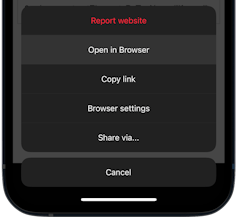
Click ‘open in browser’ to open a website in a trusted browser such as Safari.
screenshot

If you can’t find this screen option, you can manually copy and paste the web address into a trusted browser.

Another option is to access the social media platforms via a browser. So instead of using the Instagram or Facebook app, visit the sites by entering their URL into your trusted browser’s search bar. This should also solve the tracking problem.

I’m not suggesting you ditch Facebook or Instagram altogether. But we should all be aware of how our online movements and usage patterns may be carefully recorded and used in ways we’re not told about. Remember: on the internet, if the service is free, you’re probably the product. The Conversation

David Tuffley, Senior Lecturer in Applied Ethics & CyberSecurity, Griffith University

This article is republished from The Conversation under a Creative Commons license. Read the original article.

Data consent Data privacy Facebook Instagram Privacy Social media
Share. Facebook Twitter Pinterest LinkedIn Tumblr Email
The Conversation
  • Website

Related Posts

Private Credit Rating Agencies Shape Africa’s Access To Debt. Better Oversight Is Needed

2026-02-03

Why South Africa Cannot Afford To Wait For Healthcare Reform

2026-02-02

SA Auto Industry At Crossroads: Cheap Imports Threaten Future

2026-02-02

Stablecoins: The Quiet Revolution South Africa Can’t Ignore

2026-02-02

South Africa Could Unlock SME Growth By Exploiting AI’s Potential Through Corporate ESD Funds

2026-01-28

How Local Leaders Can Shift Their Trajectory In 2026

2026-01-23

Why Legal Businesses Must Lead Digital Transformation Rather Than Chase It

2026-01-23

Directing The Dual Workforce In The Age of AI Agents

2026-01-22

The Productivity Myth That’s Costing South Africa Talent

2026-01-21
Leave A Reply Cancel Reply

DON'T MISS
Breaking News

Dutch Entrepreneurial Development Bank FMO Invests R340M In Lula To Expand SME funding In SA

South African SME funding platform Lula has secured R340 million in local currency funding from…

Paarl Mall Gets R270M Mega Upgrade

2026-02-02

Huawei Says The Next Wave Of Infrastructure Investment Must Include People, Not Only Platforms

2026-01-21

South Africa: Best Starting Point In Years, With 3 Clear Priorities Ahead

2026-01-12
Stay In Touch
  • Facebook
  • Twitter
  • YouTube
  • LinkedIn
OUR PICKS

Vodacom Reports Robust Q3 Growth, Driven By Diversification And Strategic Moves

2026-02-04

South Africa’s First Institutional Rand Stablecoin, ZARU, Launches

2026-02-03

The EX60 Cross Country: Built For The “Go Anywhere” Attitude

2026-01-23

Mettus Launches Splendi App To Help Young South Africans Manage Their Credit Health

2026-01-22

Subscribe to Updates

Get the latest tech news from TechFinancials about telecoms, fintech and connected life.

About Us

TechFinancials delivers in-depth analysis of tech, digital revolution, fintech, e-commerce, digital banking and breaking tech news.

Facebook X (Twitter) Instagram YouTube LinkedIn WhatsApp Reddit RSS
Our Picks

Digitap ($TAP) Crushes NexChain with Real Banking Utility: Best Crypto to Buy in 2026

2026-02-06

Take Profit Trader Announces 40 Percent Discount on Evaluation with Fee-Free Activation

2026-02-06

ChatGPT Reveals 7 Top Altcoins for 2026: APEMARS Dominates as a High ROI Crypto Investment Project – $10K Could Grow to $1.18M

2026-02-06
Recent Posts
  • Digitap ($TAP) Crushes NexChain with Real Banking Utility: Best Crypto to Buy in 2026
  • Take Profit Trader Announces 40 Percent Discount on Evaluation with Fee-Free Activation
  • ChatGPT Reveals 7 Top Altcoins for 2026: APEMARS Dominates as a High ROI Crypto Investment Project – $10K Could Grow to $1.18M
  • More Profitable Than SHIB or SOL? Digitap’s Big-Time Deposit Upgrade Gains Worldwide Attention
  • Digitap ($TAP) Crushes NexChain with Real Banking Utility: Best Crypto to Buy in 2026
TechFinancials
RSS Facebook X (Twitter) LinkedIn YouTube WhatsApp
  • Homepage
  • Newsletter
  • Contact
  • Advertise
  • Privacy Policy
  • About
© 2026 TechFinancials. Designed by TFS Media. TechFinancials brings you trusted, around-the-clock news on African tech, crypto, and finance. Our goal is to keep you informed in this fast-moving digital world. Now, the serious part (please read this): Trading is Risky: Buying and selling things like cryptocurrencies and CFDs is very risky. Because of leverage, you can lose your money much faster than you might expect. We Are Not Advisors: We are a news website. We do not provide investment, legal, or financial advice. Our content is for information and education only. Do Your Own Research: Never rely on a single source. Always conduct your own research before making any financial decision. A link to another company is not our stamp of approval. You Are Responsible: Your investments are your own. You could lose some or all of your money. Past performance does not predict future results. In short: We report the news. You make the decisions, and you take the risks. Please be careful.

Type above and press Enter to search. Press Esc to cancel.

Ad Blocker Enabled!
Ad Blocker Enabled!
Our website is made possible by displaying online advertisements to our visitors. Please support us by disabling your Ad Blocker.