
Close Menu
  • Homepage
  • News
  • Cloud & AI
  • ECommerce
  • Entertainment
  • Finance
  • Opinion
  • Podcast
  • Contact

Subscribe to Updates

Get the latest technology news from TechFinancials News about FinTech, Tech, Business, Telecoms and Connected Life.

What's Hot

Digitap ($TAP) Crushes NexChain with Real Banking Utility: Best Crypto to Buy in 2026

2026-02-05

Bridging Financial Frontiers: ZOOMEX Launches “February XAUT Airdrop Event”

2026-02-05

More Profitable Than SHIB or SOL? Digitap’s Big-Time Deposit Upgrade Gains Worldwide Attention

2026-02-05
Facebook X (Twitter) Instagram
Trending
  • Digitap ($TAP) Crushes NexChain with Real Banking Utility: Best Crypto to Buy in 2026
Facebook X (Twitter) Instagram YouTube LinkedIn WhatsApp RSS
TechFinancials
  • Homepage
  • News
  • Cloud & AI
  • ECommerce
  • Entertainment
  • Finance
  • Opinion
  • Podcast
  • Contact
TechFinancials
Home»Opinion»NASA’s Space Telescope Has Reached Its Destination, 1.5 Million KM From Earth. Here’s What Happens Next
Opinion

NASA’s Space Telescope Has Reached Its Destination, 1.5 Million KM From Earth. Here’s What Happens Next

The ConversationBy The Conversation2022-01-26No Comments6 Mins Read
Share Facebook Twitter Pinterest LinkedIn Tumblr Email
NASA
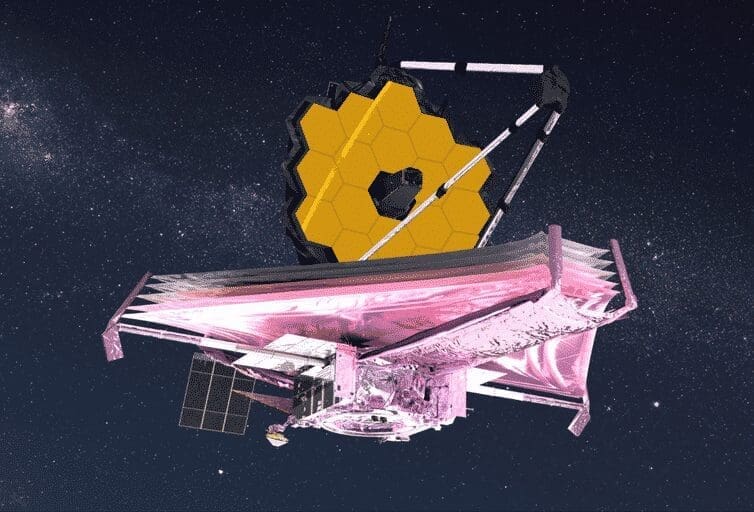
Artist’s conception NASA's James Webb Space Telescope
Share
Facebook Twitter LinkedIn Pinterest Email Copy Link

Since its launch on Christmas day, astronomers have eagerly followed the complex deployment and unfurling of NASA’s James Webb Space Telescope – the largest to ever take to the skies.

Right around the time this article is published, it’s expected Webb will have reached a place called the Earth-Sun “second Lagrange point”, or “L2”. This is a point in space about 1.5 million kilometres away from Earth (in the opposite direction from the Sun) where the gravity from both the Sun and Earth help to keep an orbiting satellite balanced in motion.

Now the astronomical community – including my team of Swinburne University astronomers – is preparing for a new epoch of major discoveries.

Play
This is an approximation of the path Webb will take at the L2 point, as it orbits around the Sun and Earth.

30 years and US$10 billion

In 2012, I wrote an article for The Conversation looking forward to the launch of Webb, and reminiscing about the amazing early days of its predecessor, the Hubble Space Telescope.

Back then, Webb’s planned launch date was in 2018. And when the project was originally conceived in the 1990s, the goal was to launch before 2010. Why did it take nearly 30 years, and more than US$10 billion (roughly A$14 billion), to get Webb off the ground?

First, it’s the largest telescope ever put into space, with a gold-coated mirror 6.5m in diameter (compared with Hubble’s 2.4m mirror). With size comes complexity, as the entire structure needed to be folded to fit inside the nose cone of an Ariane rocket.
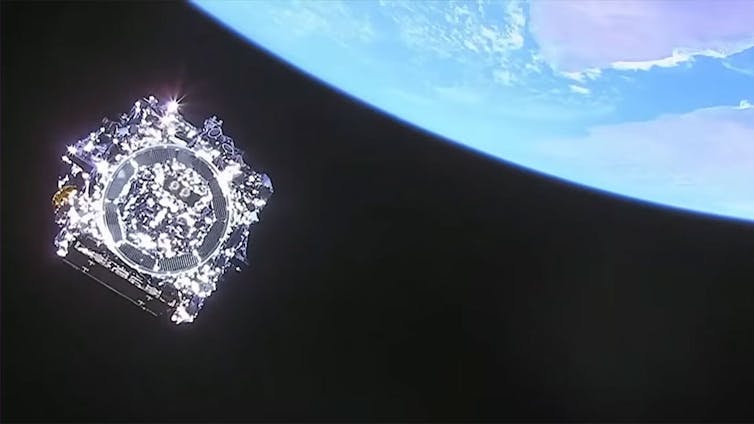
The James Webb Space Telescope hanging in space after separating from the Ariane launch vehicle over the Gulf of Aden, between Yemen and Somalia.
NASA/ESA

Second, there were two major engineering marvels to accomplish with Webb. For a large telescope to produce the sharpest images possible, the mirror’s surface needs to be aligned along a curve with extreme precision. For Webb this means unfolding and positioning the 18 hexagonal segments of the primary mirror, plus a secondary mirror, to a precision of 25 billionths of a metre.

Also, Webb will be observing infrared light, so it must be kept incredibly cold (roughly -233℃) to maximise its sensitivity. This means it must be kept far away from Earth, which is a source of heat and light. It must also be completely protected from the Sun – achieved by a 20m multilayered reflective sunshield.

All of Webb’s major spacecraft deployments, including the unfurling of the primary mirror and sunshield, were completed on January 8. The entire process involved more than 300 single points of failure (mechanisms that had only once chance to work). The remaining tiny motions will take place over the next few months.

Play
Deployment sequence of the James Webb Space Telescope. Credit: NASA.

The main mission

Webb’s primary mission will be to witness the birth of the first stars and galaxies in the early Universe. As the light from these very faint galaxies travels across the vast gulf of space, and 13.8 billion years of time, it gets stretched by the overall expansion of the Universe in a process we call “cosmological redshift”.

This stretching means what started out as extremely energetic ultraviolet radiation from young, hot and massive stars will be received by Webb as infrared light. This is why its mirrors are coated in gold: compared with silver or aluminium, gold is a better reflector of infrared light and red light.

Webb will see much farther into the infrared than Hubble could. It’s also up to a million times more sensitive than ground-based telescopes, where the light from distant galaxies is drowned out by the infrared emission of Earth’s own hot atmosphere.

Because of these previous technological limitations, the first billion years of cosmic history has barely been explored. We don’t know when or how the first stars formed. This is a complex question as stars produce heavy elements when they die. These elements pollute the interstellar gas in galaxies and change how this gas behaves and collapses to form later generations of stars.

All current star formation we can observe, such as in the Milky Way, is from enriched interstellar gas. We haven’t yet seen how stars form in pristine gas, which is without any heavy elements – as such a state hasn’t existed for more than 13 billion years.

But we think formation from pristine gas likely had a large effect on the properties of the first stellar populations.
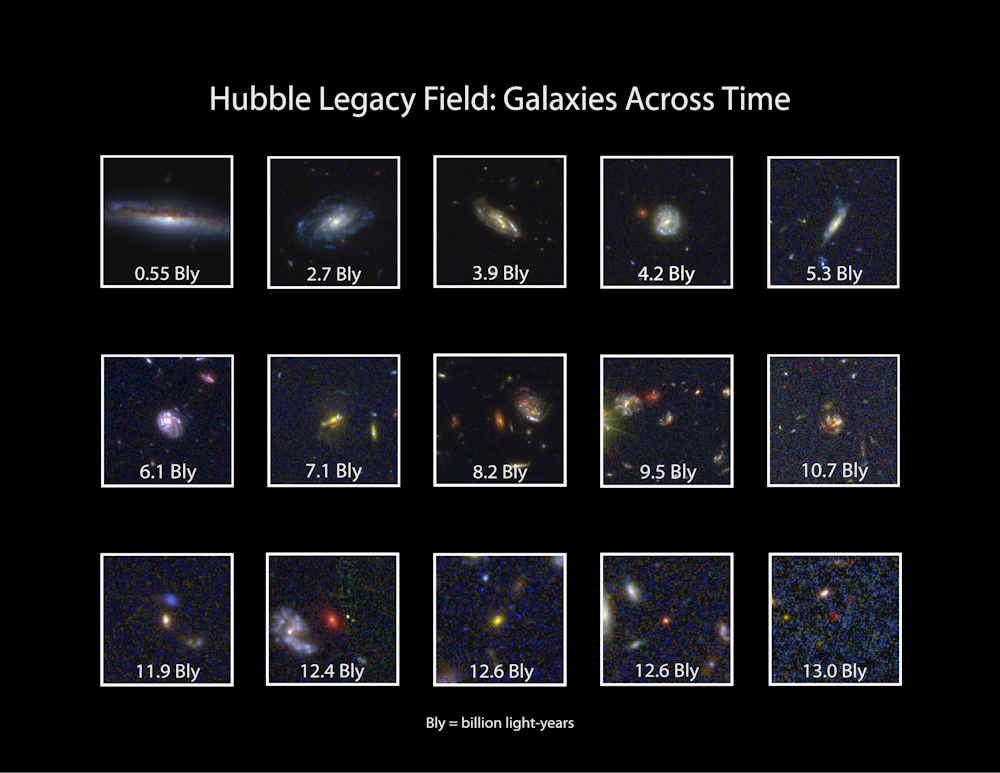
Compared to these Hubble images, Webb will provide a much clearer view of the first billion years after the Big Bang (bottom row), wherein Hubble could barely detect the most luminous objects from this time.
NASA/ESA

A deep space observatory

In addition to studying the early Universe, Webb will be a NASA “Great Observatory” and will support a diversity of other projects.

It will allow scientists to peer into regions obscured by dust, such as the centres of galaxies where supermassive black holes lurk, or regions of intense star formation in our galaxy and others. Webb will also be sensitive to the coldest objects, including very low mass stars, and planets orbiting other stars within the Milky Way.

One big improvement on Hubble is that Webb will be well-equipped for spectroscopy, dissecting light into its component wavelengths. This will let us measure the cosmic redshift of galaxies precisely, and figure out what elements they’re made of.

Closer to home, Webb will help us find molecules such as water, ammonia, carbon dioxide (and many others) within the solar system, the Milky Way and nearby galaxies. It will be able to see these in the atmospheres of planets around nearby stars, which is particularly exciting for the search for extraterrestrial life.

Astronomers await with anticipation for the first data to be collected in the next few months. While the most dramatic and risky mechanical motions have been completed, the telescope continues to move, and the mirror segments are making tiny nanometre-sized motions to bring it into a focus. This will take many weeks as the telescope cools to its operating temperature.

For myself, perhaps the most exciting aspect to look forward to is the completely unknown. With Webb, we’ll be observing a previously murky cosmic era, when physical conditions were very different to those in the modern Universe.

The history of astronomy suggests we can expect paradigm-shifting discoveries.The Conversation

Play
The launch of the James Webb Space Telescope. Credit: NASA.

Karl Glazebrook, Director & Distinguished Professor, Centre for Astrophysics & Supercomputing, Swinburne University of Technology

This article is republished from The Conversation under a Creative Commons license. Read the original article.

galaxy James Webb Space Telescope NASA
Share. Facebook Twitter Pinterest LinkedIn Tumblr Email
The Conversation
  • Website

Related Posts

Private Credit Rating Agencies Shape Africa’s Access To Debt. Better Oversight Is Needed

2026-02-03

Why South Africa Cannot Afford To Wait For Healthcare Reform

2026-02-02

SA Auto Industry At Crossroads: Cheap Imports Threaten Future

2026-02-02

Stablecoins: The Quiet Revolution South Africa Can’t Ignore

2026-02-02

South Africa Could Unlock SME Growth By Exploiting AI’s Potential Through Corporate ESD Funds

2026-01-28

How Local Leaders Can Shift Their Trajectory In 2026

2026-01-23

Why Legal Businesses Must Lead Digital Transformation Rather Than Chase It

2026-01-23

Directing The Dual Workforce In The Age of AI Agents

2026-01-22

The Productivity Myth That’s Costing South Africa Talent

2026-01-21
Leave A Reply Cancel Reply

DON'T MISS
Breaking News

Dutch Entrepreneurial Development Bank FMO Invests R340M In Lula To Expand SME funding In SA

South African SME funding platform Lula has secured R340 million in local currency funding from…

Paarl Mall Gets R270M Mega Upgrade

2026-02-02

Huawei Says The Next Wave Of Infrastructure Investment Must Include People, Not Only Platforms

2026-01-21

South Africa: Best Starting Point In Years, With 3 Clear Priorities Ahead

2026-01-12
Stay In Touch
  • Facebook
  • Twitter
  • YouTube
  • LinkedIn
OUR PICKS

Vodacom Reports Robust Q3 Growth, Driven By Diversification And Strategic Moves

2026-02-04

South Africa’s First Institutional Rand Stablecoin, ZARU, Launches

2026-02-03

The EX60 Cross Country: Built For The “Go Anywhere” Attitude

2026-01-23

Mettus Launches Splendi App To Help Young South Africans Manage Their Credit Health

2026-01-22

Subscribe to Updates

Get the latest tech news from TechFinancials about telecoms, fintech and connected life.

About Us

TechFinancials delivers in-depth analysis of tech, digital revolution, fintech, e-commerce, digital banking and breaking tech news.

Facebook X (Twitter) Instagram YouTube LinkedIn WhatsApp Reddit RSS
Our Picks

Digitap ($TAP) Crushes NexChain with Real Banking Utility: Best Crypto to Buy in 2026

2026-02-05

Bridging Financial Frontiers: ZOOMEX Launches “February XAUT Airdrop Event”

2026-02-05

More Profitable Than SHIB or SOL? Digitap’s Big-Time Deposit Upgrade Gains Worldwide Attention

2026-02-05
Recent Posts
  • Digitap ($TAP) Crushes NexChain with Real Banking Utility: Best Crypto to Buy in 2026
  • Bridging Financial Frontiers: ZOOMEX Launches “February XAUT Airdrop Event”
  • More Profitable Than SHIB or SOL? Digitap’s Big-Time Deposit Upgrade Gains Worldwide Attention
  • UK Financial Ltd Deploys On-Chain Whitelisting to Transform SMPRA into Institutional-Grade Security
  • Mr. Liu Xiaojun, on Behalf of Fufeng Group, has Fully Completed the Acquisition of Viva World Trade, Inc.
TechFinancials
RSS Facebook X (Twitter) LinkedIn YouTube WhatsApp
  • Homepage
  • Newsletter
  • Contact
  • Advertise
  • Privacy Policy
  • About
© 2026 TechFinancials. Designed by TFS Media. TechFinancials brings you trusted, around-the-clock news on African tech, crypto, and finance. Our goal is to keep you informed in this fast-moving digital world. Now, the serious part (please read this): Trading is Risky: Buying and selling things like cryptocurrencies and CFDs is very risky. Because of leverage, you can lose your money much faster than you might expect. We Are Not Advisors: We are a news website. We do not provide investment, legal, or financial advice. Our content is for information and education only. Do Your Own Research: Never rely on a single source. Always conduct your own research before making any financial decision. A link to another company is not our stamp of approval. You Are Responsible: Your investments are your own. You could lose some or all of your money. Past performance does not predict future results. In short: We report the news. You make the decisions, and you take the risks. Please be careful.

Type above and press Enter to search. Press Esc to cancel.

Ad Blocker Enabled!
Ad Blocker Enabled!
Our website is made possible by displaying online advertisements to our visitors. Please support us by disabling your Ad Blocker.