Close Menu
  • Homepage
  • News
  • Cloud & AI
  • ECommerce
  • Entertainment
  • Finance
  • Opinion
  • Podcast
  • Contact

Subscribe to Updates

Get the latest technology news from TechFinancials News about FinTech, Tech, Business, Telecoms and Connected Life.

What's Hot

Digitap ($TAP) Crushes NexChain with Real Banking Utility: Best Crypto to Buy in 2026

2026-02-05

Bridging Financial Frontiers: ZOOMEX Launches “February XAUT Airdrop Event”

2026-02-05

More Profitable Than SHIB or SOL? Digitap’s Big-Time Deposit Upgrade Gains Worldwide Attention

2026-02-05
Facebook X (Twitter) Instagram
Trending
  • Digitap ($TAP) Crushes NexChain with Real Banking Utility: Best Crypto to Buy in 2026
Facebook X (Twitter) Instagram YouTube LinkedIn WhatsApp RSS
TechFinancials
  • Homepage
  • News
  • Cloud & AI
  • ECommerce
  • Entertainment
  • Finance
  • Opinion
  • Podcast
  • Contact
TechFinancials
Home»Boardroom Games»Inside The Mind Of The Online Scammer
Boardroom Games

Inside The Mind Of The Online Scammer

ContributorBy Contributor2019-12-22No Comments5 Mins Read
Share Facebook Twitter Pinterest LinkedIn Tumblr Email
Online fraudster
Online scammers. Photo by Nahel Abdul Hadi on Unsplash
Share
Facebook Twitter LinkedIn Pinterest Email Copy Link

by Ken Rotenberg

When Dame Helen Mirren revealed she had been the victim of a “humiliating” scam on the press junket for her latest movie (in which, coincidentally, she also plays the victim of a hoax), it highlighted how everyone needs to be on their guard against fraudsters. Even members of the royal family are not immune, as was illustrated when Prince Charles was dragged into a major counterfeit art scandal. But what motivates scammers, other than greed? I believe the answer can be gleaned by investigating why humans lie in the first place.

Online fraudsters carry out a sophisticated and well-planned array of deceiving strategies to con people. These include romance scams in which the victim is enticed to contribute cash to foster a fake romantic relationship, fraudulent lotteries, prize draws, sweepstake games and auction sites. Substantial winnings are offered if the victim can send in some cash.

The fraudsters are constantly building better mousetraps in order to lure in increasingly sophisticated mice. For example, scams are being personalised to the victim by including references to familiar people or by targeting the victim’s occupation.

What’s behind the deception?

Scams are carried out using almost untraceable methods, so the criminals are often unknown, despite concerted efforts by law enforcement to identify and prosecute them. But the knowledge from several disciplines (ethology, social psychology and criminology) can help us to understand them.

Deception to ensure survival

Ethologists study animal behaviour. They have observed that species, including humans, have developed a complex means of deceiving their prey in order to ensure their survival. For example, ethologists have identified complex forms of deceptions in other species, such as the jumping spider, which uses behavioural and chemical mimicry. This allows them to coexist with ants and feed on them. This is regarded as comparable to humans engaging in embezzlement by which they use their privileged access to resources and reputation for illegally extracting finances from other people.

Play

Altruistic lies?

Social psychologists have found that when humans lie for altruistic purposes or advancement of the group, the lie is often praised rather than denigrated. For example, even young children (aged between five and seven) show a willingness to tell “white lies” in order to make others feel better. Meanwhile other research shows that adults perceive lying that benefits others (because sometimes the truth hurts) as more “ethical” than honest statements.

Play

Typical and serious lies

Social psychological research shows that lying is part of normal life. Frequently, people tell everyday lies that are rather benign. Most of these lies are self-serving, but many are designed to benefit others.

People most often tell “serious lies” to their closest relationship partners. They tell serious lies in order to avoid punishment, protect themselves from confrontation, appear a highly desirable person, to protect others and also to hurt their partner. Common serious lies tend to involve affairs and taking money from others without their knowledge.

Liars, fraudsters and corruption

Frauds represent a complex array of deceptive behaviour that originates in species and arises, in part, from some of the typical motivations for deception. It is, of course, a criminal activity that is well understood by criminologists. Most criminals are typically male and have parents with criminal records, delinquent peer friends, arrests at a young age and come from poor areas with higher crime rates.

Today’s most common online scams are often carried out by people from poor countries. These countries and their government officials are generally regarded as corrupt by international corruption indexes. Such corruption conveys the message that deception is a desirable strategy. Poverty combined with high corruption contributes to a heightened motivation to deceive others for survival.

The criminals in question tend to have traits of psychopathic and antisocial personality disorders. Research has investigated illegal downloading and hacking in adolescents from 30 countries. It was found that “cyber deviance” was mostly carried out by males and by people who experienced “school disorganisation” (stealing and vandalism) and “neighbourhood disorganisation” (having untrustworthy or criminal neighbours).

These “cyber deviants” tend to have elevated cognitive ability and, of course, have access to computers and technology. This type of fraud is often well planned and the fraudsters employ a range of deceptive tactics.
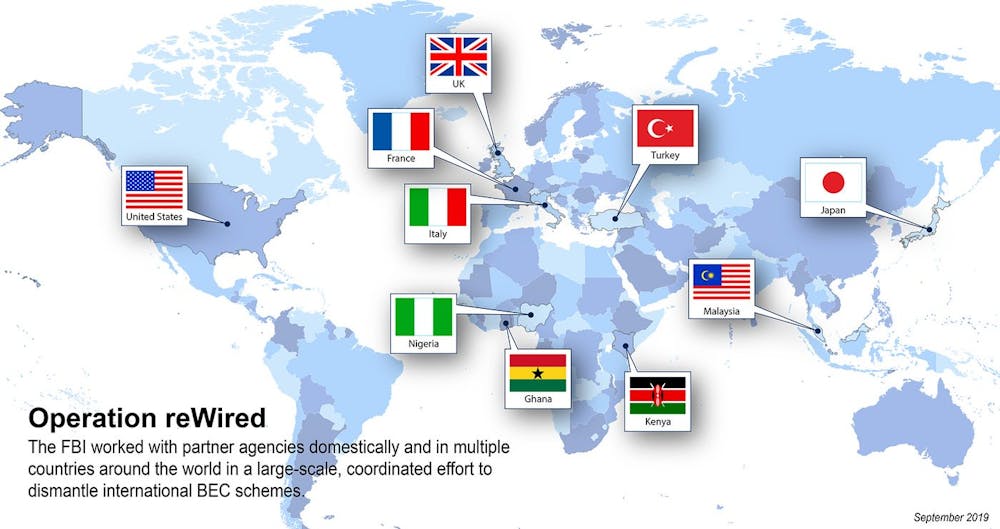
The FBI’s Operation reWired targeted business email compromise (BEC) scammers.
FBI/Twitter

The law tries to keep these criminals at bay. In September 2019, Operation reWired in the US succeeded in prosecuting 281 email scammers from several countries.

But the large numbers of fraudsters who combine deceptive and complex strategies make it extremely difficult to keep these crimes under control. So an understanding of how their minds work and their modus operandi is vital if one is to avoid becoming a victim.The Conversation

Ken Rotenberg, Professor in Psychology, Keele University

This article is republished from The Conversation under a Creative Commons license. Read the original article.

Criminology fraud lies Online fraudster online scammer
Share. Facebook Twitter Pinterest LinkedIn Tumblr Email
Contributor

Related Posts

Vodacom Reports Robust Q3 Growth, Driven By Diversification And Strategic Moves

2026-02-04

Private Credit Rating Agencies Shape Africa’s Access To Debt. Better Oversight Is Needed

2026-02-03

South Africa’s First Institutional Rand Stablecoin, ZARU, Launches

2026-02-03

Why South Africa Cannot Afford To Wait For Healthcare Reform

2026-02-02

SA Auto Industry At Crossroads: Cheap Imports Threaten Future

2026-02-02

Stablecoins: The Quiet Revolution South Africa Can’t Ignore

2026-02-02

South Africa Could Unlock SME Growth By Exploiting AI’s Potential Through Corporate ESD Funds

2026-01-28

How Local Leaders Can Shift Their Trajectory In 2026

2026-01-23

The EX60 Cross Country: Built For The “Go Anywhere” Attitude

2026-01-23
Leave A Reply Cancel Reply

DON'T MISS
Breaking News

Dutch Entrepreneurial Development Bank FMO Invests R340M In Lula To Expand SME funding In SA

South African SME funding platform Lula has secured R340 million in local currency funding from…

Paarl Mall Gets R270M Mega Upgrade

2026-02-02

Huawei Says The Next Wave Of Infrastructure Investment Must Include People, Not Only Platforms

2026-01-21

South Africa: Best Starting Point In Years, With 3 Clear Priorities Ahead

2026-01-12
Stay In Touch
  • Facebook
  • Twitter
  • YouTube
  • LinkedIn
OUR PICKS

Vodacom Reports Robust Q3 Growth, Driven By Diversification And Strategic Moves

2026-02-04

South Africa’s First Institutional Rand Stablecoin, ZARU, Launches

2026-02-03

The EX60 Cross Country: Built For The “Go Anywhere” Attitude

2026-01-23

Mettus Launches Splendi App To Help Young South Africans Manage Their Credit Health

2026-01-22

Subscribe to Updates

Get the latest tech news from TechFinancials about telecoms, fintech and connected life.

About Us

TechFinancials delivers in-depth analysis of tech, digital revolution, fintech, e-commerce, digital banking and breaking tech news.

Facebook X (Twitter) Instagram YouTube LinkedIn WhatsApp Reddit RSS
Our Picks

Digitap ($TAP) Crushes NexChain with Real Banking Utility: Best Crypto to Buy in 2026

2026-02-05

Bridging Financial Frontiers: ZOOMEX Launches “February XAUT Airdrop Event”

2026-02-05

More Profitable Than SHIB or SOL? Digitap’s Big-Time Deposit Upgrade Gains Worldwide Attention

2026-02-05
Recent Posts
  • Digitap ($TAP) Crushes NexChain with Real Banking Utility: Best Crypto to Buy in 2026
  • Bridging Financial Frontiers: ZOOMEX Launches “February XAUT Airdrop Event”
  • More Profitable Than SHIB or SOL? Digitap’s Big-Time Deposit Upgrade Gains Worldwide Attention
  • UK Financial Ltd Deploys On-Chain Whitelisting to Transform SMPRA into Institutional-Grade Security
  • Mr. Liu Xiaojun, on Behalf of Fufeng Group, has Fully Completed the Acquisition of Viva World Trade, Inc.
TechFinancials
RSS Facebook X (Twitter) LinkedIn YouTube WhatsApp
  • Homepage
  • Newsletter
  • Contact
  • Advertise
  • Privacy Policy
  • About
© 2026 TechFinancials. Designed by TFS Media. TechFinancials brings you trusted, around-the-clock news on African tech, crypto, and finance. Our goal is to keep you informed in this fast-moving digital world. Now, the serious part (please read this): Trading is Risky: Buying and selling things like cryptocurrencies and CFDs is very risky. Because of leverage, you can lose your money much faster than you might expect. We Are Not Advisors: We are a news website. We do not provide investment, legal, or financial advice. Our content is for information and education only. Do Your Own Research: Never rely on a single source. Always conduct your own research before making any financial decision. A link to another company is not our stamp of approval. You Are Responsible: Your investments are your own. You could lose some or all of your money. Past performance does not predict future results. In short: We report the news. You make the decisions, and you take the risks. Please be careful.

Type above and press Enter to search. Press Esc to cancel.

Ad Blocker Enabled!
Ad Blocker Enabled!
Our website is made possible by displaying online advertisements to our visitors. Please support us by disabling your Ad Blocker.