





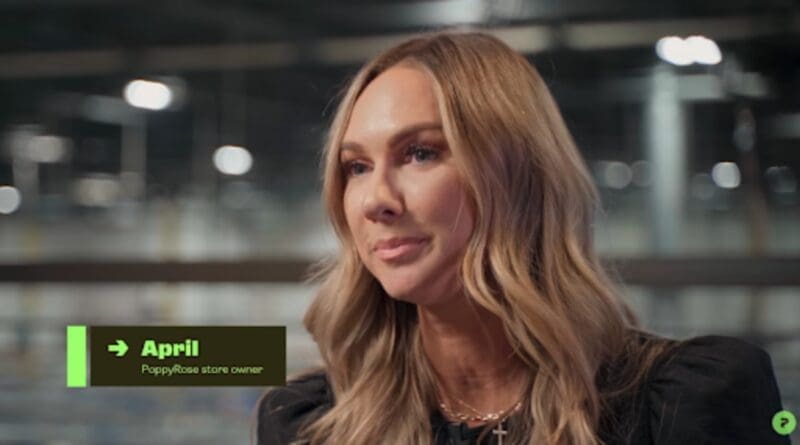
April Duplantis, who shut two boutiques and lost a dropshipping store overnight, shares how affiliates, LIVE selling and Printify fulfillment drove $3M in sales.
Printify, a leading print-on-demand platform, has released a customer success story following April Duplantis, a work-from-home mother of two who went from closing two failing boutiques to running a TikTok Shop business that brings in about $100,000 a month. Her account traces the path from a copyright claim that erased her dropshipping store in a day to a print-on-demand operation with $3M in total sales through Printify, and sets out the affiliate, LIVE-selling and product-research habits she says any seller can copy without a warehouse, staff or inventory.
From Two Closed Boutiques to a Top Etsy Seller
According to the story, Duplantis ran a women’s boutique and a children’s boutique before the pandemic. Both made a little money, she says, but the lesson that stayed with her was about cost: stock and operating expenses came due whether she sold ten items or a thousand. She closed both stores, moved online and tried dropshipping, only to lose the entire business in one day over a copyright violation. She then pressed t-shirts at home, where sales grew but the work did not suit her, and after weeks of late-night print-on-demand tutorials she committed to a model with no inventory cost and no overhead.
In 2023 she opened a POD Etsy store in the teacher niche, widely regarded as one of the marketplace’s most saturated categories, and became a top seller within six months. Her strategy was personalization taken to its limit: shirts for science teachers, art teachers and school nurses, each carrying the buyer’s name, with designs driven by sales data rather than her own taste.
A $28,000 First Month Without Going LIVE
The move to TikTok Shop came from Printify. Her account manager, who had watched her Etsy numbers climb, asked three times before she agreed to try a platform she had never used. She started small, adding products, switching on a few settings and leaning on affiliates for early traction: she messaged creators who already posted casual mom-life content, offered a free shirt and let them film a short video tagging the product. That first month she sold $28,000 on TikTok Shop without going LIVE or posting a single video of herself.
Two settings she believes most sellers overlook did much of the work. Open collaborations let creators promote her products without her approving each one, and refundable samples let affiliates buy an item and recoup the cost once they sell enough units. She sets her commission at 10% and keeps refundable samples on for every product. Her first viral product came from an affiliate she had never contacted: she woke up to 100 sales, the shirt reached 500 units by the end of the day, and orders continued for weeks.
Because her products already ran through Printify, adding the channel was largely a workflow task. Using the platform’s TikTok Shop integration, she selects Etsy products inside her Printify account, copies them to TikTok Shop and publishes, then finishes each listing with a category and size chart; listings go live in about 30 seconds.
Four Nights a Week on LIVE
Her TikTok account manager eventually persuaded her to go LIVE, with the advice that mistakes are how sellers learn. Her first session ran under a banner admitting it was her first LIVE; viewers pointed out she had not added anything to her cart, suggested flash sales and recommended a giveaway. It brought in just over $200. Within months her LIVEs were regularly generating $5,000 in two and a half hours, and she now goes LIVE four nights a week. A single session has brought in $30,000.
The story sets out five rules she applies to every session: a professional backdrop; pricing for volume, since she would rather sell 50 custom t-shirts at a $5 margin than ten at $10; repeating key points because the average viewer stays about three minutes; acknowledging every purchase by name, which she calls her biggest differentiator; and finding her energy before going on air.
“April’s story shows what print on demand makes possible when creator-led selling meets fulfillment that scales: six-figure months run from a family home, with no inventory and no warehouse,” said Davis Sarmins, Director of Growth Marketing at Printify.
Research, Rules and the Freedom to Work From Home
Her product decisions begin with existing demand. On TikTok Shop she browses categories the way a customer would and tracks what is sitting in carts; one leopard-print shirt built around a trademarked word appeared in more than 2,000 carts, so she kept the concept, swapped in an unprotected word, and the design became the bestseller of her next LIVE. The story is equally candid about platform rules: content violations arrive with little warning and hurt a shop score that is hard to rebuild, and she lists only best-selling products that meet TikTok’s two-day shipping requirement.
Duplantis describes Printify as the backbone of the operation rather than a tool. She says she effectively has seven figures’ worth of inventory and hundreds of people working on production without having spent anything on either, and that if she sold 10,000 shirts in a weekend the platform could ship them within two days. The business has cleared her debt, bought a new house and taken her children to Disney twice in the past year, though what she values most is control over her time. Her advice to new sellers is to start small and set a manageable daily target, because the hardest part is getting started.
About Printify
Printify is a leading print-on-demand platform that connects ecommerce merchants with a global network of Print Partners. With the industry’s largest Catalog, free AI design tools, and seamless integrations with major ecommerce platforms, Printify enables sellers to scale custom product businesses without upfront costs.


