


As countries around the world race to secure leadership in quantum technologies – an emerging field expected to transform computing, healthcare, manufacturing, agriculture and cybersecurity – the University of Pretoria (UP) has been selected to play a significant role in South Africa’s next step into the quantum era.
The University will host a new node of the South African Quantum Technology Initiative (SA QuTI), establishing UP Quantum Science and Technology (UPQuST – pronounced UPQuest) as one of six nationally funded quantum research hubs. Supported by the national Department of Science, Technology and Innovation over the next five years, the initiative will position UP at the centre of South Africa’s efforts to develop quantum technologies, build specialist skills, and translate advanced research into practical solutions for society and industry.
A quantum node is a collaborative research hub that brings together scientists, engineers and technology specialists from different disciplines to tackle complex challenges that no single field can solve alone. At UP, researchers will work across physics, chemistry, computer science, mathematics, engineering and agriculture to develop practical quantum technologies while training the next generation of scientists and innovators.
Professor Sunil Maharaj, UP’s Vice-Principal for Research, Innovation and Postgraduate Education, said the new node represents a significant investment in South Africa’s scientific future.
“Quantum technologies are recognised globally as strategic capabilities that will shape future economies,” he said. “By hosting this node, the University of Pretoria is strengthening South Africa’s knowledge economy through research, innovation and skills development. It creates opportunities to deepen partnerships across South Africa and internationally, connect research with industry priorities, and develop African solutions to global challenges while preparing our young scientists and engineers to contribute to globally significant breakthroughs.”
Although quantum science is highly specialised, its impact could be felt across everyday life. Researchers at UP will explore technologies that could detect crop diseases before they become visible, improve mineral exploration and processing, enable more accurate medical diagnostics, strengthen protection against cybercrime, and develop new computing approaches capable of solving problems beyond the reach of today’s computers.
Prof Tjaart Krüger, who leads the UPQuST node, said the initiative is about ensuring South Africa becomes a creator of future technologies rather than simply adopting innovations developed elsewhere.
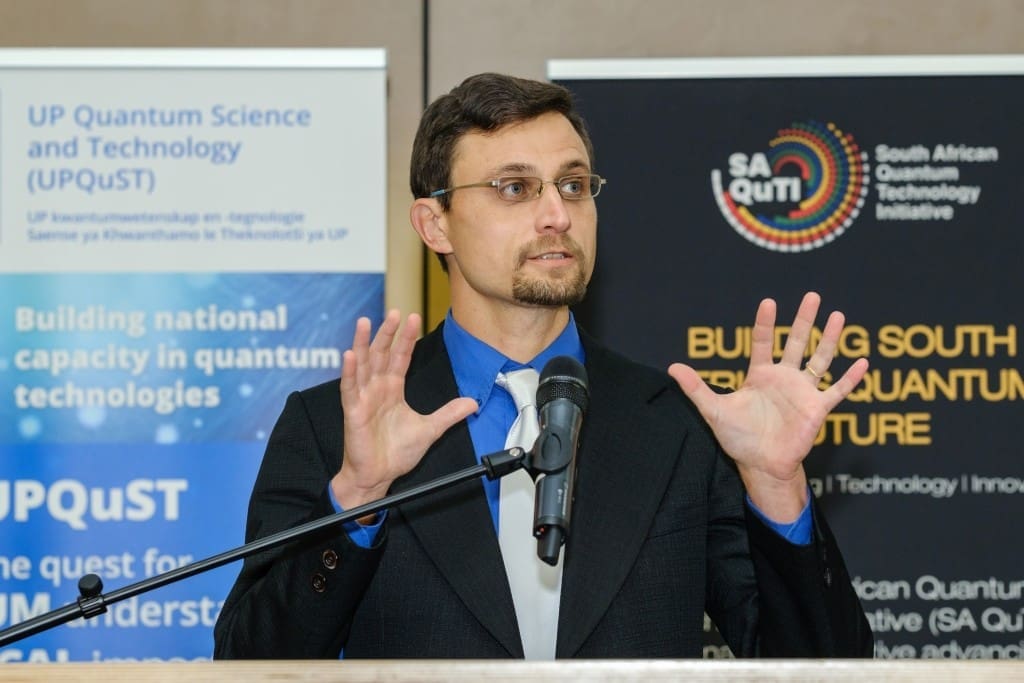
“Quantum technologies are expected to transform industries over the next decade in much the same way that artificial intelligence is transforming society today,” he said.
“Our ambition is to build South African capability in quantum computing, sensing and metrology while developing technologies that solve real-world challenges. We want to ensure that South Africa participates competitively in the global quantum economy by producing knowledge, innovation and skilled people.”
He added that UPQuST will focus on three strategic research areas: quantum computing, quantum sensing, and quantum metrology, the science of ultra-precise measurement. Together, these capabilities could unlock advances in engineering, agriculture, healthcare, advanced manufacturing, cybersecurity and financial systems.
The node will also investigate emerging technologies such as quantum-enhanced tools for detecting deepfakes and analysing ransomware threats, helping strengthen digital trust and improve resilience against increasingly sophisticated cybercrime.
According to Jodie Robbertse, project manager of SA QuTI, UP was selected because of its strong research capability, collaborative culture and ability to translate scientific excellence into meaningful impact.
“Each SA QuTI node contributes unique strengths to a national quantum ecosystem,” she said.
“The University of Pretoria brings together internationally recognised expertise across multiple disciplines and has demonstrated the capacity to transform research into innovation. UPQuST strengthens South Africa’s national capability by expanding research capacity, developing highly skilled graduates, and creating stronger partnerships between universities, government and industry.”
Beyond research, UPQuST will play a critical role in developing South Africa’s quantum workforce. The node will support postgraduate bursaries, postdoctoral fellowships and specialised training programmes while exposing, better known as CERN, and partnerships across the national SA QuTI network. students to international collaborations, including research connected to the European Organization for Nuclear Research, better known asCERN, and partnerships across the national SAQuTI network.
As global investment in quantum technologies accelerates, countries with strong research capacity and skilled workforces are expected to gain a significant competitive advantage. Through UPQuST, UP is positioning itself at the forefront of this technological revolution while helping ensure South Africa has the expertise, innovation and partnerships needed to compete on the global stage.
For UP, the establishment of UPQuST is more than the launch of a new research initiative. It is an investment in South Africa’s future, one that will build scientific excellence, drive innovation, create opportunities for young researchers and strengthen the country’s ability to shape one of the defining technologies of the 21st century.
