For decades, the business model of terrestrial internet service providers was built on a simple premise: if you wanted fast, reliable internet, you needed wires.
Fibre, copper, or coaxial cables were the arteries of the digital age, and the companies that laid them enjoyed something close to geographic monopolies, particularly in rural and small-town markets where the economics of infrastructure investment were marginal at best.
Then the sky arrived.
Low-Earth Orbit (LEO) satellite constellations, led by SpaceX’s Starlink and soon joined by Amazon’s Project Kuiper, now branded Amazon LEO, have fundamentally altered the competitive landscape.
Amazon LEO
The question was no longer whether LEO satellites threaten the business models of traditional ISPs.
They do.
The real question was: will South Africa’s ISPs be swept away, or will they find a way to ride the orbital wave?
The Wreckage: When Competition Becomes Extinction
The most intuitive evidence of disruption comes from New Zealand, where Starlink has become the largest rural broadband provider, capturing 27% of the rural market as of June 2025, up from just 18% a year earlier.
The casualties are already visible.
Evolution Networks, a Bay of Plenty wireless internet service provider that specialises in serving remote rural areas, was placed into voluntary liquidation in October 2025, owing close to $500,000 with barely $6,000 in cash on hand.
The liquidators’ report was blunt: “The business failed due to a lack of profitability and operating cash flows, as well as a lack of resources for capital expenditure.”
The rise of Starlink was cited as a primary factor.
Evolution is not an isolated case.
In the United States, HughesNet, a satellite internet provider that once dominated the rural market, is effectively liquidating its business model.
The company has been forced to refer its own customers to its rival Starlink, with analysts predicting potential bankruptcy.
The physics of LEO simply outperforms geostationary satellites.
Starlink’s median download speeds across Latin America reached 82.54 Mbps in late 2025, compared to HughesNet’s 15.93 Mbps.
When your competitor offers five times the speed, your business model doesn’t just weaken, it collapses.
The South African Exception: When Regulation Rewrites the Rules
But here’s where the story takes a sharp turn and why South Africa’s ISP industry might escape the fate that befell Evolution Networks.
While Starlink has steamrolled competitors across 27 African countries, it remains locked out of the market of Elon Musk’s birth – South Africa.
The Independent Communications Authority of South Africa (ICASA) has made it clear that satellite operators wanting to launch constellation-based services cannot obtain new network licences at present.
South Africa’s regulatory framework requires operators to comply with ownership and empowerment rules, including a minimum 30% shareholding by historically disadvantaged South Africans, a requirement Starlink, with its global policy prohibiting local equity dilution, has yet to meet.
As of June 2026, ICASA confirmed it had not received any licence applications from Starlink.
Meanwhile, SpaceX has committed R2.5 billion in local investment, including R500 million to connect 5,000 schools with free internet and equipment.
But as one observer put it: “The ball now sits firmly in ICASA’s court – and regulatory processes aren’t resolved by ministerial finger-snapping, regardless of political pressure”.
The Partnership Pivot: From Foe to Friend
This regulatory bottleneck created an opening, and Amazon LEO walked straight through it.
On 15 July 2026, Amazon announced that its LEO satellite network would enter South Africa through a distribution agreement with Herotel, the country’s largest fixed internet provider with 350,000 customers across more than 550 towns.
The new service, called evry, is expected to launch commercially in 2027.
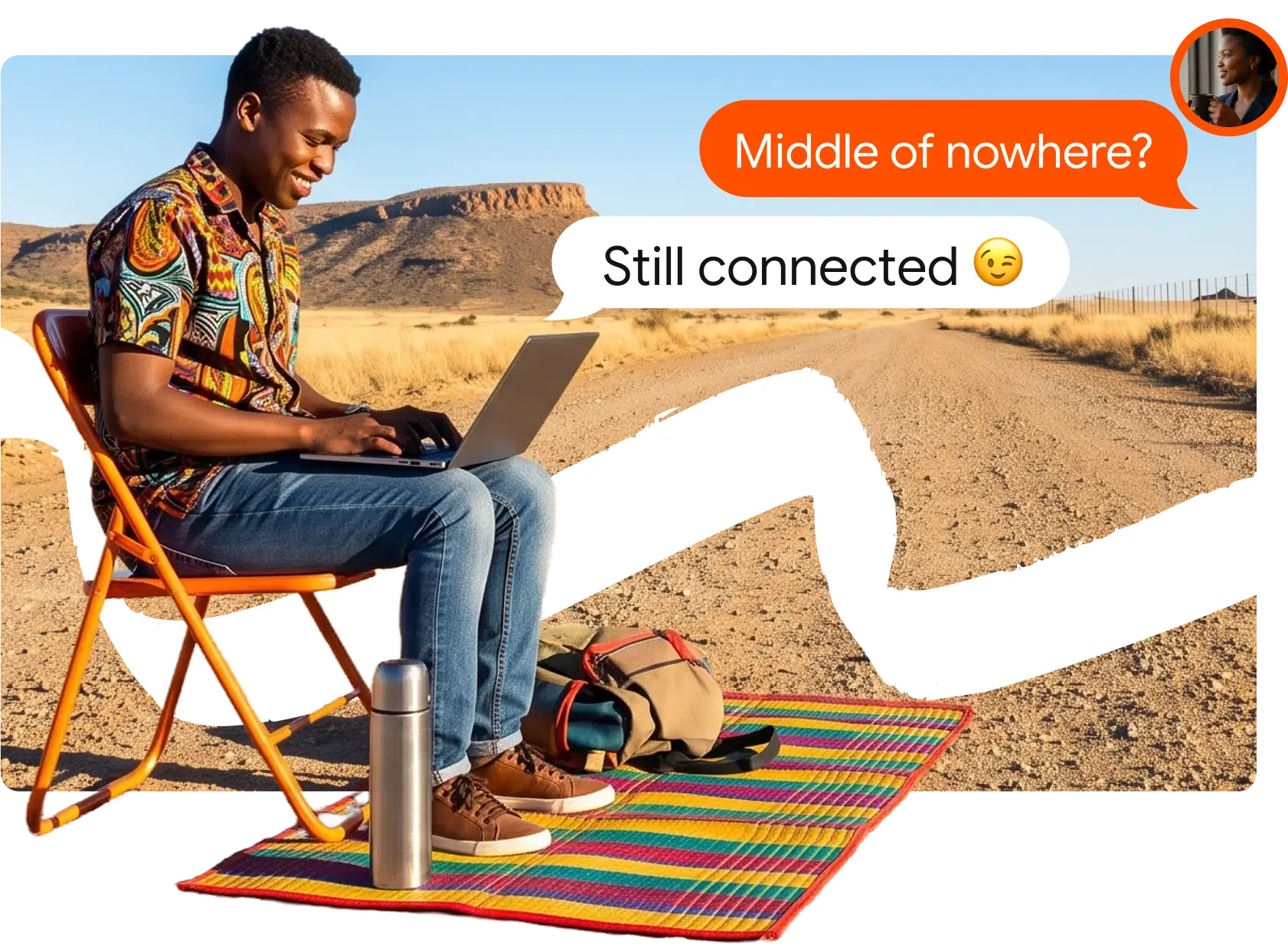
evry
Here’s the genius of Amazon’s approach: instead of demanding its own licence, it sells wholesale capacity to partners who already hold the necessary operating licences.
Herotel, a Maziv company (the fibre group in which Vodacom holds a 30% stake), already holds these licences.
As Amazon LEO’s head of global business, Trevor Vieweg, put it during a media briefing: “Amazon LEO is our low Earth orbit satellite constellation that is designed to connect tens of millions of customers around the globe.
“We have completed 14 launches, and we now have 390 satellites in orbit today; and that’s enough for us to start our initial service later this year in certain latitudes and to start connecting South Africa in 2027″.
Herotel CEO Van Zyl Botha was equally explicit: “With the Amazon Leo product, we can have a national reach beyond the existing telecoms infrastructure, and we can truly try and connect every South African and business”.
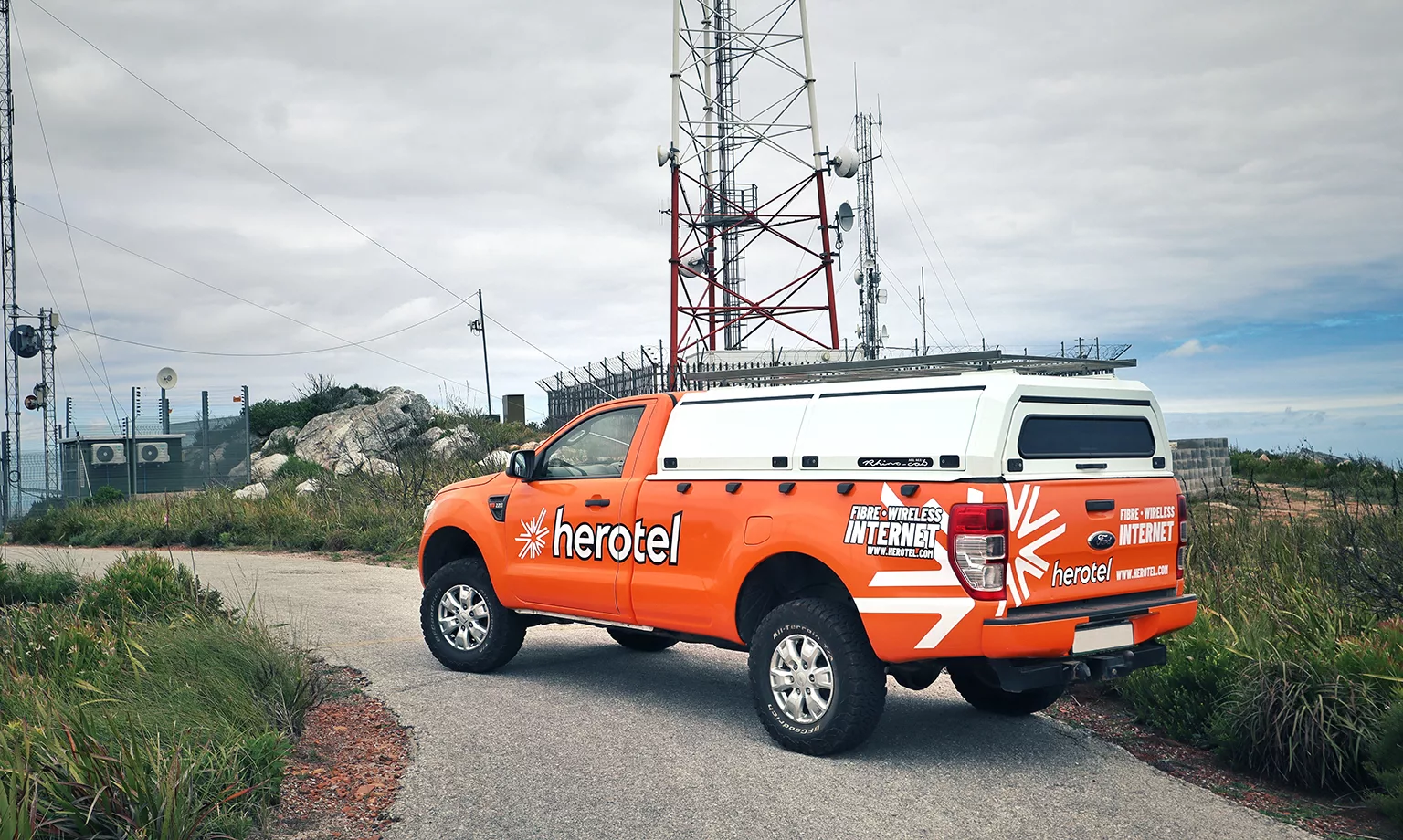
Herotel- Image source: Africa Outlook Magazine
Under the agreement, Herotel will handle satellite equipment installation, customer service, and field operations, leveraging its existing fibre and fixed wireless network infrastructure.
This is not disruption as annihilation. This is disruption as a catalyst.
In short, Amazon, not Starlink, will be the first LEO available to South Africans.
The Price of Survival: Competition Forces Change
The lesson from elsewhere in Africa is instructive.
In Zimbabwe, Starlink’s entry, with shared household packages for as little as US$10 a month, forced established operators like Liquid Home to slash prices, bundle fibre deals, and expand LTE coverage.
The traditional high-margin model that sustained Zimbabwe’s internet sector for years has been broken open.
In Kenya, the dynamic is even more striking.
Starlink actually lost 2,000 subscribers in the first quarter of 2025, a drop of nearly 11%, while the broader fixed internet market grew by 8%.
What happened?
Local providers like Safaricom fought back with aggressive pricing: fibre packages starting at 2,500 shillings (about $31) for 50 Mbps, compared to Starlink’s $210 hardware cost and $31–50 monthly fees.
Local ISPs rolled out promotions, free installations, and faster speeds.
The result? Starlink now ranks eighth among Kenyan internet providers, overtaken by local competitors.
In South Africa, Starlink’s pricing in neighbouring Eswatini and Lesotho suggests a monthly subscription between R900-R950, plus a R3,800 once-off equipment cost.
This positions Starlink at the higher end of the fibre-to-the-home market, where uncapped 100Mbit/s typically costs around R950/month.
As one analysis noted, “the addressable market for Starlink broadband services in South Africa will be a fraction of middle-to-high income households”.
The New Calculation: Compete, Partner, or Perish
The consensus emerging from industry discussions is clear: “the outcome depends entirely on the strategy and positioning of the individual ISP”.
Those who dig in their heels and demand protection will likely follow Evolution Networks into liquidation.
Those that adapt – whether by cutting prices, improving service, reselling LEO capacity, or using satellites as backhaul for their own networks – can not only survive but thrive.
The technical reality supports this.
While Starlink often outperforms local ISPs on download speeds, terrestrial networks remain competitive – often superior – in upload speeds and, crucially, multi-server latency, thanks to the inherent advantages of fibre routing.
Local ISPs that own fibre assets or can deploy fixed wireless access have genuine competitive advantages that LEO satellites cannot replicate.
Vodacom has already signed a partnership to integrate Starlink’s satellite backhaul into its mobile network.
Amazon LEO has partnered with Vodafone Group to use low-Earth orbit technology to connect remote African base stations.
The message is unmistakable: the smart money is on partnership, not resistance.
The Sky Is Not the Limit
The threat LEO satellites pose to traditional ISPs is real and immediate. In New Zealand, it has already claimed a casualty. In the United States, it is forcing a once-dominant satellite provider toward bankruptcy.
But South Africa is writing a different story.
Here, regulation has created a bottleneck that became a bridge.
Amazon LEO didn’t try to bulldoze through ICASA – it partnered with Herotel, a local ISP that already holds the licences, already knows the terrain, and already serves the customers.
Starlink, for all its global dominance, remains locked out, not because of protectionism, but because it couldn’t find a way to play by the rules.
The local ISP of the future will not be the one that fights the sky.
It will be the one that looks up, recognises the opportunity, and builds a hybrid model that leverages the best of both worlds: the reliability and low latency of terrestrial infrastructure where it exists, and the reach of LEO satellites where it does not.
The question is not whether LEO satellites will disrupt the ISP business model.
They already have in the rest of the continent and globally.
The question is whether South Africa’s ISPs will be disrupted out of existence—or disrupted into reinvention.
The evidence from South Africa suggests that for those willing to adapt, the sky is not the limit.
The article raises some great points.
If you look at what happened in the US during the early days of Starlink, and how WISPs and other service providers reacted, it gives us a glimpse of what we could see here in South Africa.
In the beginning, there will almost certainly be challenges. Uptime and service consistency will be among the biggest talking points. ISPs and FNOs pride themselves on delivering 99.99% or even 99.999% availability. As with any new technology entering a market, early LEO deployments may experience some growing pains while the networks mature. For some businesses that could be a concern, while for others the ability to access high-speed connectivity where none existed before will outweigh those early challenges.
As the technology matures, performance and reliability will continue to improve, making LEO an increasingly compelling connectivity option.
The smart operators won’t see LEO as a threat—they’ll see it as another tool. They’ll integrate it into their existing offerings as a resilient backup solution or use it as the primary way to reach locations where traditional infrastructure simply isn’t practical. Others may choose to compete against it rather than work with it, but history has shown that those who embrace innovation are often the ones who benefit the most.
LEO is new technology for South Africa. It’s different, it’s disruptive, and for some it may seem intimidating. But it’s coming, and it has the potential to strengthen connectivity across the country.
Fibre will remain the gold standard wherever it’s available. But imagine pairing your fibre connection with a LEO service like EVRY to provide resilient, diverse connectivity. Your production line keeps running. Your broadcast stays live. Your business remains online even when terrestrial infrastructure has an issue.
And perhaps the biggest win of all? Connecting the underserved. Connecting everyone.
That’s what makes this such a game changer.
It’s an exciting time to be part of the ISP and FNO industry.
🚀 We have lift-off.





1 Comment
The article raises some great points.
If you look at what happened in the US during the early days of Starlink, and how WISPs and other service providers reacted, it gives us a glimpse of what we could see here in South Africa.
In the beginning, there will almost certainly be challenges. Uptime and service consistency will be among the biggest talking points. ISPs and FNOs pride themselves on delivering 99.99% or even 99.999% availability. As with any new technology entering a market, early LEO deployments may experience some growing pains while the networks mature. For some businesses that could be a concern, while for others the ability to access high-speed connectivity where none existed before will outweigh those early challenges.
As the technology matures, performance and reliability will continue to improve, making LEO an increasingly compelling connectivity option.
The smart operators won’t see LEO as a threat—they’ll see it as another tool. They’ll integrate it into their existing offerings as a resilient backup solution or use it as the primary way to reach locations where traditional infrastructure simply isn’t practical. Others may choose to compete against it rather than work with it, but history has shown that those who embrace innovation are often the ones who benefit the most.
LEO is new technology for South Africa. It’s different, it’s disruptive, and for some it may seem intimidating. But it’s coming, and it has the potential to strengthen connectivity across the country.
Fibre will remain the gold standard wherever it’s available. But imagine pairing your fibre connection with a LEO service like EVRY to provide resilient, diverse connectivity. Your production line keeps running. Your broadcast stays live. Your business remains online even when terrestrial infrastructure has an issue.
And perhaps the biggest win of all? Connecting the underserved. Connecting everyone.
That’s what makes this such a game changer.
It’s an exciting time to be part of the ISP and FNO industry.
🚀 We have lift-off.