

The COVID-19 pandemic is a fundamentally social and societal event. The virus spreads between people, and impacts individuals, households and communities. Any country’s response to the pandemic must be guided by social data and expertise as much as by medical data and expertise. Failing to identify and address social impacts of the pandemic opens the way for devastating social damage and loss of life. Reliable and openly available social data are key to ensuring that a functional society emerges from this pandemic, rather than one more desperately vulnerable than before.
This is as true in South Africa as anywhere else in the world.
South Africa’s government took radical action when the virus was detected in the country. Its scientists, advisors and politicians were able to draw on the experiences of other countries, combined with local data, to evaluate the risks and make enormously difficult decisions. Strong initial containment efforts were followed with a nationwide lockdown as community transmission began to increase. Globally, South Africa’s rapid and evidence-based action has been lauded.
Unfortunately, this necessary strategy has come with massive and multi-dimensional costs, which have fallen hardest on the poor, who are least able to absorb them.
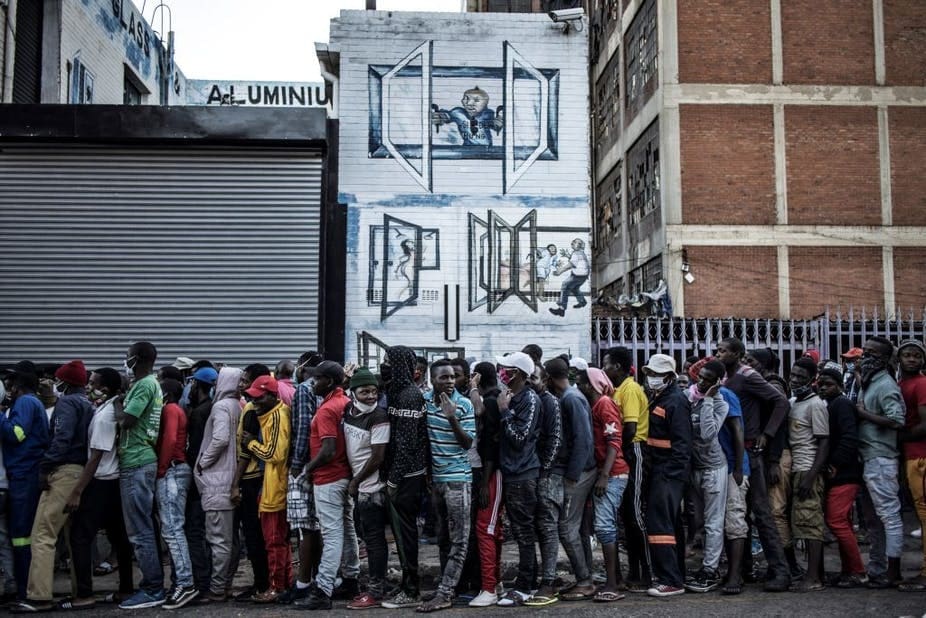
Most visibly, the lockdown has resulted in staggering levels of hunger, as household incomes have collapsed and nutritious food has become increasingly difficult to access. Other social impacts, such as job losses, interruptions to public health programmes, loss of access to educational and other child support services, growing challenges with mental health, and increased gender based violence are collectively deepening destitution in many communities.
These social impacts will leave a legacy long after the virus itself is eventually brought under control through a vaccine or effective treatment.
President Cyril Ramaphosa has recognised the urgency of providing social support. Ensuring that resources are directed to the areas of most urgent need requires a localised understanding of South Africa’s diverse human and physical geography.
The Gauteng City-Region Observatory (GCRO) has received many requests for data on localised vulnerability in the context of COVID-19. The research partnership, which focuses on the largely urban province of Gauteng, has been able to draw on its Quality of Life Survey V (2017/18) to explore the spatial distribution of vulnerability in the region. It can see where particular challenges such as hunger or interruptions to income are likely to be most strongly felt.
Combining this data with other geo-located data allows researchers to explore how population density and vulnerability intersect.
Generating and sharing local level social data
The collection of this data is funded by the Gauteng provincial government, with support from municipalities. The GCRO independently manages data collection and analysis, to academic standards. The data is freely available for non-commercial purposes and has been shared with many groups working to understand and respond to the pandemic.
In other provinces, access to relatively fine-grained spatial data is more limited. The most recent data available below the municipal level is often from Census 2011, which is now quite dated, particularly in rapidly changing urban areas. A range of models have been built on top of the census data. Models have an essential role to play, but cannot supplant real data collected on the ground.
In the longer term, a more frequent national census would enhance local data, but at enormous cost. Regular, high quality sample surveys, targeted at areas experiencing rapid social change, are a more cost-effective option.
In the short term, platforms that share existing research and governmental data, such as the University of Cape Town’s DataFirst, make a valuable contribution. Important work to enhance access to local data, for example through the South African Cities Open Data Almanac platform, must be continued. Approaches to open sharing of administrative data, while protecting confidentiality, are crucial. Vast amounts of local information are held by community organisations, local government and others. Systematic approaches to drawing on this will help validate and complement other data sources.
Survey by the Human Sciences Research Council and Statistics SA provides valuable social data on the pandemic’s impact. Telephone or online surveys with geographically targeted sampling would complement this work.
Read more:
Numbers can kill: politicians should handle South Africa’s coronavirus data with care
Social data can build trust
Social data, and platforms to share it, can have enormous value to government in guiding effective action and building trust. Drawing on localised social data provides government with an opportunity to demonstrate that it understands what is happening on the ground, through policy which is suited to the context, and includes essential social support. This is crucially important for a government asking its people to make extraordinary sacrifices.
Contrary to some early narratives, COVID-19 is not a great equalising force. Listening to local voices describing challenges and solutions is the best way to understand this. This is a crucial time to build trust and to draw on the skills and experience of stakeholders and partners.
Read more:
Pandemics don’t heal divisions — they reveal them. South Africa is a case in point
Boundary organisations, like the GCRO, along with academics and data scientists in civil society, have a particular role to play here. Small organisations with relative independence are able to respond with agility to shifting needs.
Clearly, a pandemic response guided by only medical or economic data alone is inadequate. Social data must also shape the response. Ongoing expansion of testing and tracing capacity is crucial, as is effective management of large and rapidly changing data flows on the spread of the pandemic. But understanding the social challenges being experienced, where relief is most needed, and what kind of relief is most effective are just as important. This kind of understanding can only be provided by reliable social data, and the governance infrastructure to absorb and respond to these insights.
Dr Rob Moore, Dr Alexandra Parker, Melinda Swift, and Gillian Maree all contributed to the article.
Julia de Kadt, Senior Researcher, Gauteng City-Region Observatory
This article is republished from The Conversation under a Creative Commons license. Read the original article.

1 Comment
Pingback: COVID-19 Highlights South Africa’s Need for Local Level Social Data - AfricaRebel.com