
Close Menu
  • Homepage
  • News
  • Cloud & AI
  • ECommerce
  • Entertainment
  • Finance
  • Opinion
  • Podcast
  • Contact

Subscribe to Updates

Get the latest technology news from TechFinancials News about FinTech, Tech, Business, Telecoms and Connected Life.

What's Hot

The Strait of Hormuz is in trouble: How can office workers earn passive income through the MoneySimpler platform?

2026-07-16

Financial Affordability Assessments in Gambling: What it Means

2026-07-16

Vodacom, Wits Partner To Develop Africa’s Future Leaders

2026-07-16
Facebook X (Twitter) Instagram
Trending
  • The Strait of Hormuz is in trouble: How can office workers earn passive income through the MoneySimpler platform?
Facebook X (Twitter) Instagram YouTube LinkedIn WhatsApp RSS
TechFinancials
  • Homepage
  • News
  • Cloud & AI
  • ECommerce
  • Entertainment
  • Finance
  • Opinion
  • Podcast
  • Contact
TechFinancials
Home»Opinion»The Most Important Cryptocurrency Event In Years Is About To Begin – And The Biggest Windfall Goes To The Planet
Opinion

The Most Important Cryptocurrency Event In Years Is About To Begin – And The Biggest Windfall Goes To The Planet

The ConversationBy The Conversation2022-09-05No Comments5 Mins Read
Share Facebook Twitter Pinterest LinkedIn Tumblr Email
Crypto
Crypto
Share
Facebook Twitter LinkedIn Pinterest Email Copy Link

Amid the continuous noise about cryptocurrencies, it’s often hard to pick out what really matters. However this month, if all goes to plan, the energy-hungry digital sector will undergo its biggest shake-up in years.

Ethereum, the world’s second largest cryptocurrency, is tomorrow expected to start a technology changeover which, once complete, should cause its carbon emissions to plummet by 99%.

The rapid growth in cryptocurrencies in recent years has been staggering. Unfortunately, so too has been their contribution to climate change, due to the enormous amount of electricity used by computers that manage the buying and selling of crypto coins.

Take, for example, the world’s biggest cryptocurrency, Bitcoin. At a time when the world is desperately trying to reduce energy consumption, Bitcoin uses more energy each year than medium-sized nations such as Argentina. If the Ethereum switch succeeds, Bitcoin and other cryptocurrencies will be under immense pressure to deal with this problem.

woman in mask walks past Bitcoin display
The Ethereum move puts pressure on Bitcoin and others to follow suit.
Kin Cheung/AAP

Why are cryptocurrencies so polluting?

Cryptocurrencies are digital currency systems in which people make direct online payments to each other.

Unlike traditional currencies, cryptocurrencies are not managed from a single location such as a central bank. Instead, they’re managed by a “blockchain”: a decentralised global network of high-powered computers. These computers are known as “miners”.

The Reserve Bank of Australia provides this simple explanation of how it all works (edited for brevity):

Suppose Alice wants to transfer one unit of cryptocurrency to Bob. Alice starts the transaction by sending an electronic message with her instructions to the network, where all users can see the message.

The transaction sits with a group of other recent transactions waiting to be compiled into a block (or group) of the most recent transactions. The information from the block is turned into a cryptographic code and miners compete to solve the code to add the new block of transactions to the blockchain.

Once a miner successfully solves the code, other users of the network check the solution and reach an agreement that it’s valid. The new block of transactions is added to the end of the blockchain, and Alice’s transaction is confirmed.

This process, used by most cryptocurrencies, is termed “proof-of-work mining”. The central design feature is the use of calculations which require a lot of computer time – and huge amounts of electricity – to perform.

Bitcoin alone consumes around 150 terawatt-hours of electricity each year. Producing that energy emits some 65 million tonnes of carbon dioxide into the atmosphere annually — about the same emissions as Greece.

Research suggests Bitcoin last year produced emissions responsible for around 19,000 future deaths.
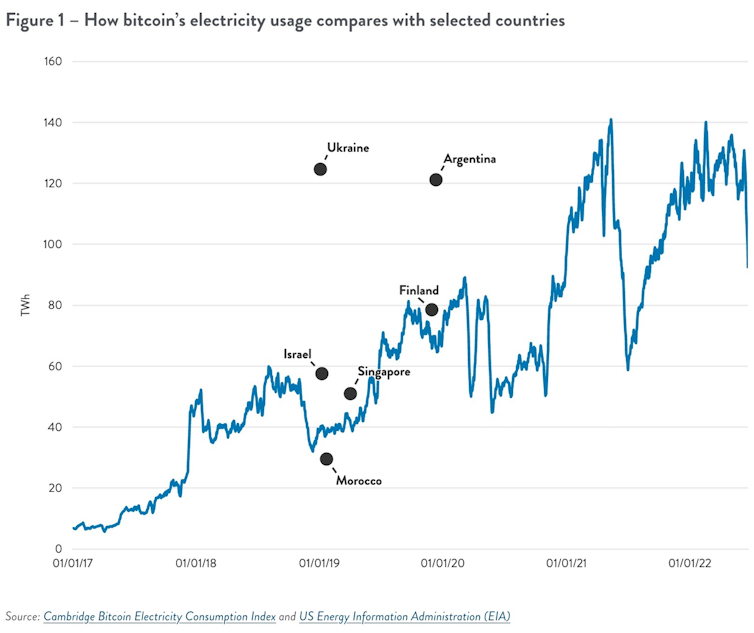
Author provided

The proof-of-work approach intentionally wastes energy. The data in a blockchain has no inherent meaning. Its sole purpose is to record difficult, but pointless, calculations which provide a basis for allocating new crypto coins.

Cryptocurrency advocates have given a variety of excuses for the monstrous energy consumption, but none stand up to scrutiny.

Some, for example, seek to justify cryptocurrency’s carbon footprint by saying some miners use renewable energy. That may be true, but in doing so they can displace other potential energy users – some of whom will have to use coal- or gas-fired power.

But now, the most successful of Bitcoin’s rivals, Ethereum, is changing tack. This month it promises to switch its computing technology to something far less polluting.
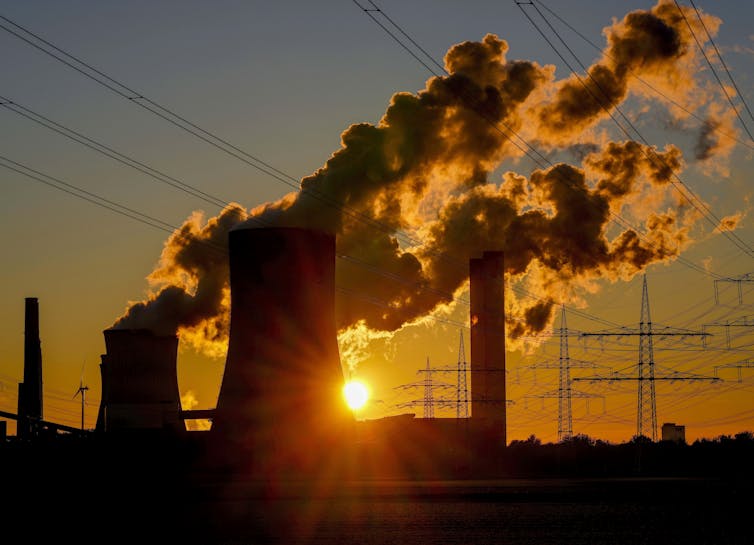
sun sets behind power plant emitting steam
The Ethereum switch will lead to a radical drop in electricity use.
Michael Probst/AP

What the switch is about

Ethereum’s project involves ditching the “proof of work” model for a new one called “proof of stake”.

Under this model, crypto transactions are validated by users, who stake substantial quantities of blockchain tokens (in this case, Ethereum coins) as collateral. If the users act dishonestly, they lose their stake.

Importantly, it will mean the vast network of supercomputers currently used to check transactions will no longer be required, because users themselves are doing the checking – a relatively easy task. Doing away with the computer “miners” will lead to an estimated 99% drop in Ethereum’s electricity use.

Some smaller cryptocurrencies – such as the Ada coin traded on the Cardano platform – use “proof of stake” but it’s been confined to the margins to date.

For the past year, Ethereum has been running the new model on experimental blockchains. But this month, the model will be merged into the main platform.

green-lit computers in darkened room with person tinkering
The new Ethereum model would dispense with the need for a global network of energy-sucking computers.
Lui Xingzhe/EPA

Nowhere for cryptocurrency to hide

So what does all this mean? The Ethereum experiment could fail – if, say, some stakeholders find ways to manipulate the system. But if the switch does succeed, Bitcoin and other cryptocurrencies will be under pressure to abandon the proof-of-work model, or else shut down.

This pressure has already begun. Tesla founder Elon Musk’s last year announced his company would no longer accept Bitcoin payment for its electric cars, due to the currency’s carbon footprint.

The New York state legislature in June passed a bill to ban some Bitcoin operations that use carbon-based power. (However, the decision requires sign off from New York’s governor and may be vetoed).

And in March this year, the European parliament voted on a proposal to ban the proof-of-work model. The proposal was defeated. But as Europe heads into the cooler months, and grapples with an energy crisis triggered by sanctions on Russian gas supplies, energy-guzzling cryptocurrencies will remain in the firing line.

One thing is clear: as the need to slash global emissions becomes ever more pressing, cryptocurrencies will run out of excuses for their egregious energy use.The Conversation

John Quiggin, Professor, School of Economics, The University of Queensland

This article is republished from The Conversation under a Creative Commons license. Read the original article.

Bitcoin climate change Cryptocurrency energy ethereum
Share. Facebook Twitter Pinterest LinkedIn Tumblr Email
The Conversation
  • Website

Related Posts

From Innovation To Application: AI In The Business Of Property

2026-07-14

What We Can Learn From AI Skeptics

2026-07-14

If Your Wallet Only Works In One Shop, It Isn’t Really Money

2026-07-09

The Case For Grid Defection – Why South African Residential Estates Are Choosing Energy Independence

2026-07-08

Every Year We Lose 12,000 South Africans On Our Roads. We Already Have The Tech To Change That

2026-07-08

CASINOenquirer Launches Best Bitcoin & Crypto Casino Listings for Canadians in 2026

2026-07-08

The Risk Of AI Tunnel Vision In IT Efficiency

2026-07-03

South Africa: AI And Cyber Insurance: A Market In Transition

2026-07-01

African Expansion Still Appeals To Banks. The Real Risk Is Thinking The Old Playbook Still Works

2026-06-29
Leave A Reply Cancel Reply

DON'T MISS
Breaking News

Eskom Green Secures Final PFMA Approvals, Targets 32GW Utility-Scale Renewable Push By 2040

South Africa’s energy landscape enters a transformative new chapter this week as Eskom Holdings secures…

From Innovation To Application: AI In The Business Of Property

2026-07-14

SA FinTech Float Exports Card-Linked Instalment Innovation To The UK

2026-07-08

South African AI Coding Startup HyperDev Secures R16 Million Pre-Seed Funding Amid Explosive User Growth

2026-07-06
Stay In Touch
  • Facebook
  • Twitter
  • YouTube
  • LinkedIn
OUR PICKS

Amazon Leo Names Herotel, Maziv As Distributors In Starlink Battle

2026-07-15

Giant Data Centres Get The First Green Light From Cape Town Tribunal

2026-07-15

Eskom Launches Eskom Green, A Dedicated Renewable Energy Business

2026-06-09

Why South Africans Are No Longer Switching Mobile Phone Operators?

2026-06-01

Subscribe to Updates

Get the latest tech news from TechFinancials about telecoms, fintech and connected life.

About Us

TechFinancials delivers in-depth analysis of tech, digital revolution, fintech, e-commerce, digital banking and breaking tech news.

Facebook X (Twitter) Instagram YouTube LinkedIn WhatsApp Reddit RSS
Our Picks

The Strait of Hormuz is in trouble: How can office workers earn passive income through the MoneySimpler platform?

2026-07-16

Financial Affordability Assessments in Gambling: What it Means

2026-07-16

Vodacom, Wits Partner To Develop Africa’s Future Leaders

2026-07-16
Recent Posts
  • The Strait of Hormuz is in trouble: How can office workers earn passive income through the MoneySimpler platform?
  • Financial Affordability Assessments in Gambling: What it Means
  • Vodacom, Wits Partner To Develop Africa’s Future Leaders
  • Eskom Green Secures Final PFMA Approvals, Targets 32GW Utility-Scale Renewable Push By 2040
  • The Range Rover Sport Is Going Electric – Looks Almost Identical To Its Combustion-Engine Sibling
TechFinancials
RSS Facebook X (Twitter) LinkedIn YouTube WhatsApp
  • Homepage
  • Newsletter
  • Contact
  • Advertise
  • Privacy Policy
  • About
© 2026 TechFinancials. Designed by TFS Media. TechFinancials brings you trusted, around-the-clock news on African tech, crypto, and finance. Our goal is to keep you informed in this fast-moving digital world. Now, the serious part (please read this): Trading is Risky: Buying and selling things like cryptocurrencies and CFDs is very risky. Because of leverage, you can lose your money much faster than you might expect. We Are Not Advisors: We are a news website. We do not provide investment, legal, or financial advice. Our content is for information and education only. Do Your Own Research: Never rely on a single source. Always conduct your own research before making any financial decision. A link to another company is not our stamp of approval. You Are Responsible: Your investments are your own. You could lose some or all of your money. Past performance does not predict future results. In short: We report the news. You make the decisions, and you take the risks. Please be careful.

Type above and press Enter to search. Press Esc to cancel.

Ad Blocker Enabled!
Ad Blocker Enabled!
Our website is made possible by displaying online advertisements to our visitors. Please support us by disabling your Ad Blocker.