


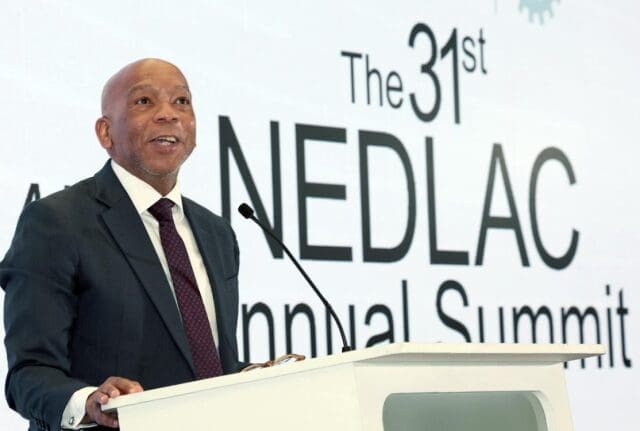
Minister of Electricity and Energy, Dr Kgosientsho Ramokgopa, has called for a human-centered approach to artificial intelligence (AI), emphasising that rapid technological innovation must not leave South Africa’s workforce behind.
The Minister delivered the keynote address on behalf of Deputy President Paul Mashatile at the National Economic Development Labour Council’s (NEDLAC) 31st Annual Summit currently underway in Pretoria.
“Artificial intelligence and digital technologies are rapidly changing the way economies operate, businesses produce goods and services, governments deliver services and people work. These developments present enormous opportunities.
“AI can improve productivity, support innovation, strengthen service delivery, create new industries and open new opportunities for entrepreneurship and employment.
“However, we must also recognise that technological progress is not automatically inclusive. If not properly managed, technological change can deepen existing inequalities, displace workers, widen the digital divide, and exclude those who do not have access to the skills and infrastructure required to participate in the new economy,” Ramokgopa noted.
The Minister emphasised that any transition towards a tech-enabled economy must be cushioned by targeted investments in human capital.
Furthermore, upskilling and re-skilling initiatives are essential to ensure young South Africans and current workers are fully equipped to navigate shifting labour market dynamics.
“Artificial Intelligence is already changing the world of work. Some occupations will change, some tasks will become automated, new occupations will emerge, whilst existing occupations will require new skills. We must therefore ensure that our approach to AI is centered on people.
“The transition to an AI-enabled economy must not leave workers behind. This requires investments in education, skills development, re-skilling, and lifelong learning. Our young people in particular must be equipped to participate meaningfully in the digital economy.
“We must also ensure that workers are protected as workplaces undergo technological transformation. This is an area in which social dialogue will be particularly important. Business will need to consider how technology can improve productivity while supporting workers through periods of transition,” he noted.
The Minister noted that while more needs to be done, the age of AI presents South Africa with an “opportunity to improve South Africa’s productivity and competitiveness.”
“Our challenge is to ensure that increased productivity translates into broader economic benefits.
“Technological advancements must support investment, strengthen enterprises – particularly small and emerging businesses – and contribute to sustainable employment creation,” he said.
Working together for a better future
In the face of the “difficult economic and social challenges” that the country faces, the Minister noted that platforms and institutions like NEDLAC remain critical.
“The concept of social dialogue is central to our democratic project. It provides a platform through which government, business, labour and the community constituency can engage, identify areas of interest and work towards solutions to the challenges facing our economy and society.
“Under today’s theme, we must ask: how can we utilise social dialogue to ensure that [AI] contributes to inclusive economic growth, improved productivity and competitiveness and job creation.
“Our response [to difficulties] requires more than the efforts of government alone. It requires meaningful partnership between government, business, labour and communities. Social dialogue can assist us in building greater consensus around the difficult choices that must be made to place our economy on a more sustainable and inclusive growth path,” Ramokgopa said.
He noted that the country is simultaneously facing technological and environmental transitions which must be “managed in a manner that is just and inclusive.”
“Workers and communities whose livelihoods may be affected by economic restructuring must not be left behind. We must invest in skills, infrastructure and new economic opportunities whilst ensuring that the benefits of the transition are broadly shared and inclusive.
“This requires strong partnerships between government, business, labour and communities,” Ramokgopa said. – SAnews.gov.za
