
Close Menu
  • Homepage
  • News
  • Cloud & AI
  • ECommerce
  • Entertainment
  • Finance
  • Opinion
  • Podcast
  • Contact

Subscribe to Updates

Get the latest technology news from TechFinancials News about FinTech, Tech, Business, Telecoms and Connected Life.

What's Hot

SGL Golf Launches in U.S. Market to Meet Demand for Autonomous Course Management Solutions

2026-02-03

Private Credit Rating Agencies Shape Africa’s Access To Debt. Better Oversight Is Needed

2026-02-03

Xgram Launches Private USDT ERC20 to XMR Swaps

2026-02-03
Facebook X (Twitter) Instagram
Trending
  • SGL Golf Launches in U.S. Market to Meet Demand for Autonomous Course Management Solutions
Facebook X (Twitter) Instagram YouTube LinkedIn WhatsApp RSS
TechFinancials
  • Homepage
  • News
  • Cloud & AI
  • ECommerce
  • Entertainment
  • Finance
  • Opinion
  • Podcast
  • Contact
TechFinancials
Home»Breaking News»South Africa Sees Big Increase Of Spam Calls Following Ease Of Lockdown 2020
Breaking News

South Africa Sees Big Increase Of Spam Calls Following Ease Of Lockdown 2020

Staff WriterBy Staff Writer2020-12-08Updated:2020-12-08No Comments4 Mins Read
Share Facebook Twitter Pinterest LinkedIn Tumblr Email
mtn
woman wearing beanie with smartphone on ear. Photo by Fezbot2000 on Unsplash
Share
Facebook Twitter LinkedIn Pinterest Email Copy Link

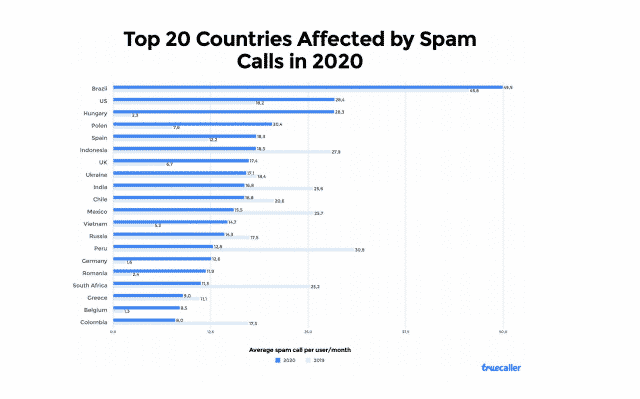
Truecaller today released findings from its Truecaller Insights report, a look into the top 20 countries affected by spam calls in 2020.

With the pandemic breaking out earlier this year and countries going into various lockdowns there has been a significant change in communication behaviour and patterns of spam around the world. The fourth edition of the report reveals the significant shift in which countries are now receiving the most spam calls.
A closer look at spam calls in South Africa


Last year, South Africa ranked in as the sixth-highest spammed country in the world and this year is now the 17th most spammed country globally. Users are on average receiving 11.3 spam calls a month compared to 25.2 spam calls from last year’s findings.

Over the past three years, South Africa has consistently been one of the most spammed countries in the world. For the first time in three years, spam calls in South Africa have decreased. Insurance and scam calls continue to be a big threat for consumers in South Africa.

Looking closer at the trends in South Africa, spam calls saw a 59% dive from March to April, in correlation to the lockdown in the country. However, from April to October there has been a 191% increase in spam calls. This reflects a surprising global trend that emerged this year.

Comparing the month of October with March, spam calls are at all-time high (17% higher than pre-lockdown).

Global spam trends

The COVID-19 pandemic has directly and indirectly affected not only global economies and societies but spammer behaviour. As the virus spread exponentially worldwide, spam calls started to decrease around March. Spam reached its lowest point in April when strict curfews and lock downs were implemented worldwide.

The overall volume of calls also dipped during this period. However, from this point, reports of scammers taking advantage of the uncertainty around the pandemic emerged. In May, spam calls started to pick up again and have been increasing on average by 9.7% per month.

October, with a record high in terms of spam calls, was 22% higher than the pre-lockdown period.

This year’s trend, and the distribution of spam worldwide, shows that rather than mitigating spam, the pandemic only offered a brief respite to victims of scammers. And despite various countries re-entering lockdowns in the latter part of 2020, this has not affected global spam rates negatively. If anything, spammers have now adjusted to a COVID world.

What are the trends we are seeing?

  • Brazil is still the most affected country when it comes to spam calls, with an increase of 9% compared to last year.
  • The US is now the second most spammed country in the world and has seen a 56% increase of spam calls compared to last year. This is a significant rise from last year’s position of 8th.
  • India, a country that used to receive the most spam calls in the world, has now dropped to 9th position.
  • Last year, the top 10 countries were dominated by the South American region. This year Chile, Peru and Colombia have seen a decrease in spam calls.
  • A lot of European countries have surfaced on the list – Hungary, Poland, Spain, UK, Ukraine, Germany, Romania, Greece and Belgium. None of these countries were on the list last year.
  • The biggest increase of spam calls comes from Europe and the US – where Hungary has seen the biggest jump (1132%), followed by Germany (685%), Belgium (557%) and Romania (395%).
  • Indonesia (18.3), India (16.8), Vietnam (14.7) and Russia (14.3) are the most affected countries in Asia.
  • An escalation of scam calls and robocalls around the world is expanding their share within the most common spam categories. Scammers taking advantage of the pandemic is a reason for the increase of scam calls.
  • Just like us, spammers take time off from work on weekends, as can be seen in a global weekly reduction of spam calls on those days.

COVID-19 Spam calls Truecaller
Share. Facebook Twitter Pinterest LinkedIn Tumblr Email
Staff Writer

Related Posts

Dutch Entrepreneurial Development Bank FMO Invests R340M In Lula To Expand SME funding In SA

2026-02-03

Paarl Mall Gets R270M Mega Upgrade

2026-02-02

Meet The €2.95M Capricorn 01 Zagato Hypercar Rebel

2026-01-30

How a Major Hotel Group Is Electrifying South Africa’s Travel

2026-01-29

Volvo ES90 South Africa Launch: Pricing, Specs & Core, Plus, Ultra Trims

2026-01-29

Ramaphosa Orders Special Police Unit To Probe Madlanga Commission Allegations

2026-01-29

Volvo C70: 30 Years Of The Car That Changed The Way Volvo Looked

2026-01-29

Eskom and the Netherlands launch Grootvlei Climate Smart Horticulture Centre in Mpumalanga

2026-01-26

The EX60 Cross Country: Built For The “Go Anywhere” Attitude

2026-01-23
Leave A Reply Cancel Reply

DON'T MISS
Breaking News

Dutch Entrepreneurial Development Bank FMO Invests R340M In Lula To Expand SME funding In SA

South African SME funding platform Lula has secured R340 million in local currency funding from…

Paarl Mall Gets R270M Mega Upgrade

2026-02-02

Huawei Says The Next Wave Of Infrastructure Investment Must Include People, Not Only Platforms

2026-01-21

South Africa: Best Starting Point In Years, With 3 Clear Priorities Ahead

2026-01-12
Stay In Touch
  • Facebook
  • Twitter
  • YouTube
  • LinkedIn
OUR PICKS

South Africa’s First Institutional Rand Stablecoin, ZARU, Launches

2026-02-03

What’s Stopping Sunny South Africa’s Solar Industry?

2026-02-02

The EX60 Cross Country: Built For The “Go Anywhere” Attitude

2026-01-23

Mettus Launches Splendi App To Help Young South Africans Manage Their Credit Health

2026-01-22

Subscribe to Updates

Get the latest tech news from TechFinancials about telecoms, fintech and connected life.

About Us

TechFinancials delivers in-depth analysis of tech, digital revolution, fintech, e-commerce, digital banking and breaking tech news.

Facebook X (Twitter) Instagram YouTube LinkedIn WhatsApp Reddit RSS
Our Picks

SGL Golf Launches in U.S. Market to Meet Demand for Autonomous Course Management Solutions

2026-02-03

Private Credit Rating Agencies Shape Africa’s Access To Debt. Better Oversight Is Needed

2026-02-03

Xgram Launches Private USDT ERC20 to XMR Swaps

2026-02-03
Recent Posts
  • SGL Golf Launches in U.S. Market to Meet Demand for Autonomous Course Management Solutions
  • Private Credit Rating Agencies Shape Africa’s Access To Debt. Better Oversight Is Needed
  • Xgram Launches Private USDT ERC20 to XMR Swaps
  • Bridging Financial Frontiers: ZOOMEX Launches “February XAUT Airdrop Event”
  • Why Haier, World’s #1 Appliance Maker, Is Targeting South Africa
TechFinancials
RSS Facebook X (Twitter) LinkedIn YouTube WhatsApp
  • Homepage
  • Newsletter
  • Contact
  • Advertise
  • Privacy Policy
  • About
© 2026 TechFinancials. Designed by TFS Media. TechFinancials brings you trusted, around-the-clock news on African tech, crypto, and finance. Our goal is to keep you informed in this fast-moving digital world. Now, the serious part (please read this): Trading is Risky: Buying and selling things like cryptocurrencies and CFDs is very risky. Because of leverage, you can lose your money much faster than you might expect. We Are Not Advisors: We are a news website. We do not provide investment, legal, or financial advice. Our content is for information and education only. Do Your Own Research: Never rely on a single source. Always conduct your own research before making any financial decision. A link to another company is not our stamp of approval. You Are Responsible: Your investments are your own. You could lose some or all of your money. Past performance does not predict future results. In short: We report the news. You make the decisions, and you take the risks. Please be careful.

Type above and press Enter to search. Press Esc to cancel.

Ad Blocker Enabled!
Ad Blocker Enabled!
Our website is made possible by displaying online advertisements to our visitors. Please support us by disabling your Ad Blocker.