
Close Menu
  • Homepage
  • News
  • Cloud & AI
  • ECommerce
  • Entertainment
  • Finance
  • Opinion
  • Podcast
  • Contact

Subscribe to Updates

Get the latest technology news from TechFinancials News about FinTech, Tech, Business, Telecoms and Connected Life.

What's Hot

Ethereum Traders Increase Leverage On-Chain As HFDX Liquidity Hits New Highs

2026-01-31

New To On-Chain Perps? HFDX Is Rapidly Emerging As The Beginner-Friendly Option

2026-01-31

Standard Chartered GBA Business Confidence Indices reveal steady business sentiment

2026-01-31
Facebook X (Twitter) Instagram
Trending
  • Ethereum Traders Increase Leverage On-Chain As HFDX Liquidity Hits New Highs
Facebook X (Twitter) Instagram YouTube LinkedIn WhatsApp RSS
TechFinancials
  • Homepage
  • News
  • Cloud & AI
  • ECommerce
  • Entertainment
  • Finance
  • Opinion
  • Podcast
  • Contact
TechFinancials
Home»Breaking News»Impact of School Closures on Education Outcomes in South Africa
Breaking News

Impact of School Closures on Education Outcomes in South Africa

Gugu LourieBy Gugu Lourie2020-05-08No Comments5 Mins Read
Share Facebook Twitter Pinterest LinkedIn Tumblr Email
online learning
Parents and family must consciously support children in completing a few hours of school work during this period. GettyImages
Share
Facebook Twitter LinkedIn Pinterest Email Copy Link

by Vijay Reddy

By mid-April, about 1.725 billion students globally had been affected by the closure of schools and higher education institutions in response to the coronavirus pandemic. According to the UNESCO Monitoring Report, 192 countries have implemented nationwide closures, affecting about 99% of the world’s student population.

This is unprecedented. The scale and complexity of what’s happening is entirely new territory.

In recent decades crises such as natural disasters, armed conflicts and epidemics have disrupted education around the world. For example, in 2005, Hurricane Katrina in the US destroyed 110 of New Orleans’ 126 public schools. In the past decade, at least 2.8 million Syrian children have been out of school for some period, and in 2013, 5 million children were out of school as a result of the Ebola epidemic in West Africa.

School closures affect students, teachers and families and have far-reaching economic and social effects. This is especially the case for fragile education systems and the negative effects will be more severe for disadvantaged learners and their families.

Finding alternative learning forms during this time is difficult. But not impossible.

In response to COVID-19 school closures and adherence to social distancing, UNESCO and many governments and agencies have recommended the use of distance learning, open educational applications and online learning to reduce disruption to education.

Richer households are better placed to sustain learning through online learning strategies, although with a lot of effort and challenges for teachers and parents. In poorer households many children don’t have a desk, books, internet connectivity, a computer, or parents who can take the role of homeschooling. The disparity in access to digital devices and connectivity between rich and poor is immense.


Read more:
How South Africa can address digital inequalities in e-learning


While it’s necessary to institute educational programmes during this period, these will not replace regular school. Despite the best efforts of government, schools and parents there will be learning losses for almost everybody and worsened educational outcomes for the poor.

We applied the learning curve scenario methodology developed by the World Bank to the South African Trends in International Mathematics and Science Study data to illustrate the patterns of expected learning losses over the next few months due to school closures and disruptions.

Possible education outcomes

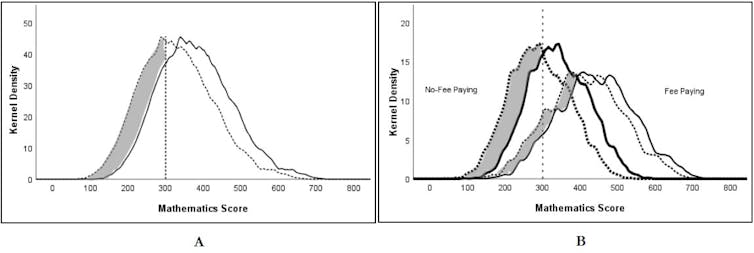
We plotted the kernel density learning curves for the 2015 study scores and a (hypothetical) reduced learning average across the distribution. We then plotted the kernel density curves for the fee-paying and no-fee schools and the reduced learning averages for each.

We expect higher learning losses in no-fee schools. While we don’t know the exact value of the learning losses, these graphs illustrate that learning loss patterns will be different for learners in different school types.
Provided by authors.

In graph A the solid line shows the South African learner mathematics achievement. The dotted line shows learner achievement profile because of learning losses. Graph B shows the expected learning graphs for current achievement and expected reduced achievement in no-fee and fee-paying schools.

We use the cut-off score of 300 to show the numbers of poorly achieving learners. The shaded portions in these graphs show the increased proportion of learners achieving very low achievement scores. The existing data show a larger proportion of learners in no-fee schools obtaining scores below the 300 point cut-off compared to learners in fee-paying schools.

Our findings underscore the fact that disasters amplify the existing structural inequalities in society and worsen inequalities through an unequal recovery process.

Going forward

Parental and family support is important during this period. Parents and family must consciously and deliberately support children in completing a few hours of school work. A Human Sciences Research Council study on early educational environments found that close to one third of parents reported that they read books to their children and played with alphabets, number toys and word games.

Half of them reported that they wrote numbers, watched educational TV and sang songs with their children. The patterns are different for learners in fee and no-fee schools. But home activities are happening and parents must be supported and encouraged to continue with educational activities.

It’s also important to start preparing for the recovery period when schools reopen. The curriculum must be simplified, targeting areas where learning loss will be most consequential for the following years. The sad and uncomfortable truth is that for South Africa, with low and unequal achievement scores, the longer social distancing is in place the bigger the learning losses for learners, especially the most disadvantaged, thereby deepening inequalities.The Conversation

Vijay Reddy, Distinguished Research Specialist, Human Sciences Research Council; Crain Soudien, Chief Executive Officer of the Human Sciences Research Council, Human Sciences Research Council, and Lolita Desiree Winnaar, Senior Research Specialist, Education and Skills Development, Human Sciences Research Council

This article is republished from The Conversation under a Creative Commons license. Read the original article.

Coronavirus in South Africa COVID-19 Education Online learning School South Africa
Share. Facebook Twitter Pinterest LinkedIn Tumblr Email
Gugu Lourie
  • Website

Related Posts

Meet The €2.95M Capricorn 01 Zagato Hypercar Rebel

2026-01-30

SARB Holds Repo Rate Steady in Cautious Monetary Policy Decision

2026-01-29

Huawei Says The Next Wave Of Infrastructure Investment Must Include People, Not Only Platforms

2026-01-21

Stablecoins Are Gaining Ground As Digital Currency In Africa: How To Avoid Risks

2026-01-13

South Africa: Best Starting Point In Years, With 3 Clear Priorities Ahead

2026-01-12

Tipping Crisis? Tappy’s Wearable Tech Goes Cashless

2025-12-11

Sanlam Launches “Pay-As-You-Go” Funeral Cover

2025-12-09

Capitec Acquires Fintech Walletdoc In R400m Payments Push

2025-12-08

How SA’s Largest Wholesale Network is Paving the Way for a Connected, Agile Future

2025-12-02
Leave A Reply Cancel Reply

DON'T MISS
Breaking News

Meet The €2.95M Capricorn 01 Zagato Hypercar Rebel

capricorn GROUP (capricorn), the German-based industry leader in automotive and motorsport lightweight technology, presented two…

SARB Holds Repo Rate Steady in Cautious Monetary Policy Decision

2026-01-29

Huawei Says The Next Wave Of Infrastructure Investment Must Include People, Not Only Platforms

2026-01-21

South Africa: Best Starting Point In Years, With 3 Clear Priorities Ahead

2026-01-12
Stay In Touch
  • Facebook
  • Twitter
  • YouTube
  • LinkedIn
OUR PICKS

How a Major Hotel Group Is Electrifying South Africa’s Travel

2026-01-29

Volvo C70: 30 Years Of The Car That Changed The Way Volvo Looked

2026-01-29

The EX60 Cross Country: Built For The “Go Anywhere” Attitude

2026-01-23

Mettus Launches Splendi App To Help Young South Africans Manage Their Credit Health

2026-01-22

Subscribe to Updates

Get the latest tech news from TechFinancials about telecoms, fintech and connected life.

About Us

TechFinancials delivers in-depth analysis of tech, digital revolution, fintech, e-commerce, digital banking and breaking tech news.

Facebook X (Twitter) Instagram YouTube LinkedIn WhatsApp Reddit RSS
Our Picks

Ethereum Traders Increase Leverage On-Chain As HFDX Liquidity Hits New Highs

2026-01-31

New To On-Chain Perps? HFDX Is Rapidly Emerging As The Beginner-Friendly Option

2026-01-31

Standard Chartered GBA Business Confidence Indices reveal steady business sentiment

2026-01-31
Recent Posts
  • Ethereum Traders Increase Leverage On-Chain As HFDX Liquidity Hits New Highs
  • New To On-Chain Perps? HFDX Is Rapidly Emerging As The Beginner-Friendly Option
  • Standard Chartered GBA Business Confidence Indices reveal steady business sentiment
  • AFF draws 4,000+ global political and business leaders, inaugural Global Business Summit
  • NSFW AI Chat with Advanced Memory Systems for Contextual Interaction Launches on Dream Companion
TechFinancials
RSS Facebook X (Twitter) LinkedIn YouTube WhatsApp
  • Homepage
  • Newsletter
  • Contact
  • Advertise
  • Privacy Policy
  • About
© 2026 TechFinancials. Designed by TFS Media. TechFinancials brings you trusted, around-the-clock news on African tech, crypto, and finance. Our goal is to keep you informed in this fast-moving digital world. Now, the serious part (please read this): Trading is Risky: Buying and selling things like cryptocurrencies and CFDs is very risky. Because of leverage, you can lose your money much faster than you might expect. We Are Not Advisors: We are a news website. We do not provide investment, legal, or financial advice. Our content is for information and education only. Do Your Own Research: Never rely on a single source. Always conduct your own research before making any financial decision. A link to another company is not our stamp of approval. You Are Responsible: Your investments are your own. You could lose some or all of your money. Past performance does not predict future results. In short: We report the news. You make the decisions, and you take the risks. Please be careful.

Type above and press Enter to search. Press Esc to cancel.

Ad Blocker Enabled!
Ad Blocker Enabled!
Our website is made possible by displaying online advertisements to our visitors. Please support us by disabling your Ad Blocker.