
Close Menu
  • Homepage
  • News
  • Cloud & AI
  • ECommerce
  • Entertainment
  • Finance
  • Opinion
  • Podcast
  • Contact

Subscribe to Updates

Get the latest technology news from TechFinancials News about FinTech, Tech, Business, Telecoms and Connected Life.

What's Hot

The .za Domain Name Authority Confirms Annual Registry Fee Adjustment

2026-07-17

The Strait of Hormuz is in trouble: How can office workers earn passive income through the MoneySimpler platform?

2026-07-16

Financial Affordability Assessments in Gambling: What it Means

2026-07-16
Facebook X (Twitter) Instagram
Trending
  • The .za Domain Name Authority Confirms Annual Registry Fee Adjustment
Facebook X (Twitter) Instagram YouTube LinkedIn WhatsApp RSS
TechFinancials
  • Homepage
  • News
  • Cloud & AI
  • ECommerce
  • Entertainment
  • Finance
  • Opinion
  • Podcast
  • Contact
TechFinancials
Home»Opinion»Spyware Can Infect Your Phone Or Computer Via The Ads You See Online – Report
Opinion

Spyware Can Infect Your Phone Or Computer Via The Ads You See Online – Report

The ConversationBy The Conversation2023-09-26Updated:2026-03-13No Comments5 Mins Read
Share Facebook Twitter Pinterest LinkedIn Tumblr Email
Consumer
Young Afro girl wearing glasses looking happy texting with friends on a smartphone. Female using mobile phone outdoors
Share
Facebook Twitter LinkedIn Pinterest Email Copy Link

by Claire Seungeun Lee, UMass Lowell

Each day, you leave digital traces of what you did, where you went, who you communicated with, what you bought, what you’re thinking of buying, and much more. This mass of data serves as a library of clues for personalized ads, which are sent to you by a sophisticated network – an automated marketplace of advertisers, publishers and ad brokers that operates at lightning speed.

The ad networks are designed to shield your identity, but companies and governments are able to combine that information with other data, particularly phone location, to identify you and track your movements and online activity. More invasive yet is spyware – malicious software that a government agent, private investigator or criminal installs on someone’s phone or computer without their knowledge or consent. Spyware lets the user see the contents of the target’s device, including calls, texts, email and voicemail. Some forms of spyware can take control of a phone, including turning on its microphone and camera.

Now, according to an investigative report by the Israeli newspaper Haaretz, an Israeli technology company called Insanet has developed the means of delivering spyware via online ad networks, turning some targeted ads into Trojan horses. According to the report, there’s no defense against the spyware, and the Israeli government has given Insanet approval to sell the technology.

Sneaking in unseen

Insanet’s spyware, Sherlock, is not the first spyware that can be installed on a phone without the need to trick the phone’s owner into clicking on a malicious link or downloading a malicious file. NSO’s iPhone-hacking Pegasus, for instance, is one of the most controversial spyware tools to emerge in the past five years.

Pegasus relies on vulnerabilities in Apple’s iOS, the iPhone operating system, to infiltrate a phone undetected. Apple issued a security update for the latest vulnerability on Sept. 7, 2023.
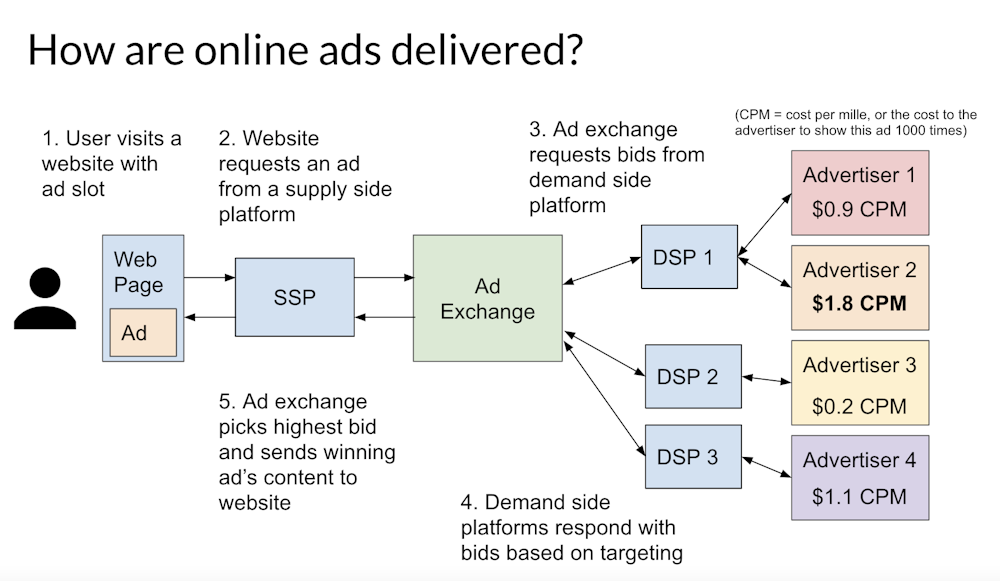
Diagram showing the different entities involved in real time bidding, and the requests and responses
When you see an ad on a web page, behind the scenes an ad network has just automatically conducted an auction to decide which advertiser won the right to present their ad to you.
Eric Zeng, CC BY-ND

What sets Insanet’s Sherlock apart from Pegasus is its exploitation of ad networks rather than vulnerabilities in phones. A Sherlock user creates an ad campaign that narrowly focuses on the target’s demographic and location, and places a spyware-laden ad with an ad exchange. Once the ad is served to a web page that the target views, the spyware is secretly installed on the target’s phone or computer.

Although it’s too early to determine the full extent of Sherlock’s capabilities and limitations, the Haaretz report found that it can infect Windows-based computers and Android phones as well as iPhones.

Spyware vs. malware

Ad networks have been used to deliver malicious software for years, a practice dubbed malvertising. In most cases, the malware is aimed at computers rather than phones, is indiscriminate, and is designed to lock a user’s data as part of a ransomware attack or steal passwords to access online accounts or organizational networks. The ad networks constantly scan for malvertising and rapidly block it when detected.

Spyware, on the other hand, tends to be aimed at phones, is targeted at specific people or narrow categories of people, and is designed to clandestinely obtain sensitive information and monitor someone’s activities. Once spyware infiltrates your system, it can record keystrokes, take screenshots and use various tracking mechanisms before transmitting your stolen data to the spyware’s creator.

While its actual capabilities are still under investigation, the new Sherlock spyware is at least capable of infiltration, monitoring, data capture and data transmission, according to the Haaretz report.

Play
The new Sherlock spyware is likely to have the same frightening capabilities as the previously discovered Pegasus.

Who’s using spyware

From 2011 to 2023, at least 74 governments engaged in contracts with commercial companies to acquire spyware or digital forensics technology. National governments might deploy spyware for surveillance and gathering intelligence as well as combating crime and terrorism. Law enforcement agencies might similarly use spyware as part of investigative efforts, especially in cases involving cybercrime, organized crime or national security threats.

Companies might use spyware to monitor employees’ computer activities, ostensibly to protect intellectual property, prevent data breaches or ensure compliance with company policies. Private investigators might use spyware to gather information and evidence for clients on legal or personal matters. Hackers and organized crime figures might use spyware to steal information to use in fraud or extortion schemes.

On top of the revelation that Israeli cybersecurity firms have developed a defense-proof technology that appropriates online advertising for civilian surveillance, a key concern is that Insanet’s advanced spyware was legally authorized by the Israeli government for sale to a broader audience. This potentially puts virtually everyone at risk.

The silver lining is that Sherlock appears to be expensive to use. According to an internal company document cited in the Haaretz report, a single Sherlock infection costs a client of a company using the technology a hefty US$6.4 million.The Conversation

Claire Seungeun Lee, Associate Professor of Criminology and Justice Studies, UMass Lowell

This article is republished from The Conversation under a Creative Commons license. Read the original article.

ad networks cybersecurity Israel spyware surveillance
Share. Facebook Twitter Pinterest LinkedIn Tumblr Email
The Conversation
  • Website

Related Posts

From Innovation To Application: AI In The Business Of Property

2026-07-14

What We Can Learn From AI Skeptics

2026-07-14

If Your Wallet Only Works In One Shop, It Isn’t Really Money

2026-07-09

The Case For Grid Defection – Why South African Residential Estates Are Choosing Energy Independence

2026-07-08

Every Year We Lose 12,000 South Africans On Our Roads. We Already Have The Tech To Change That

2026-07-08

The Risk Of AI Tunnel Vision In IT Efficiency

2026-07-03

South Africa: AI And Cyber Insurance: A Market In Transition

2026-07-01

African Expansion Still Appeals To Banks. The Real Risk Is Thinking The Old Playbook Still Works

2026-06-29

Cash Is Still King: The SARB’s Cash Smart Strategy

2026-06-29
Leave A Reply Cancel Reply

DON'T MISS
Breaking News

Eskom Green Secures Final PFMA Approvals, Targets 32GW Utility-Scale Renewable Push By 2040

South Africa’s energy landscape enters a transformative new chapter this week as Eskom Holdings secures…

From Innovation To Application: AI In The Business Of Property

2026-07-14

SA FinTech Float Exports Card-Linked Instalment Innovation To The UK

2026-07-08

South African AI Coding Startup HyperDev Secures R16 Million Pre-Seed Funding Amid Explosive User Growth

2026-07-06
Stay In Touch
  • Facebook
  • Twitter
  • YouTube
  • LinkedIn
OUR PICKS

Amazon Leo Names Herotel, Maziv As Distributors In Starlink Battle

2026-07-15

Giant Data Centres Get The First Green Light From Cape Town Tribunal

2026-07-15

Eskom Launches Eskom Green, A Dedicated Renewable Energy Business

2026-06-09

Why South Africans Are No Longer Switching Mobile Phone Operators?

2026-06-01

Subscribe to Updates

Get the latest tech news from TechFinancials about telecoms, fintech and connected life.

About Us

TechFinancials delivers in-depth analysis of tech, digital revolution, fintech, e-commerce, digital banking and breaking tech news.

Facebook X (Twitter) Instagram YouTube LinkedIn WhatsApp Reddit RSS
Our Picks

The .za Domain Name Authority Confirms Annual Registry Fee Adjustment

2026-07-17

The Strait of Hormuz is in trouble: How can office workers earn passive income through the MoneySimpler platform?

2026-07-16

Financial Affordability Assessments in Gambling: What it Means

2026-07-16
Recent Posts
  • The .za Domain Name Authority Confirms Annual Registry Fee Adjustment
  • The Strait of Hormuz is in trouble: How can office workers earn passive income through the MoneySimpler platform?
  • Financial Affordability Assessments in Gambling: What it Means
  • Vodacom, Wits Partner To Develop Africa’s Future Leaders
  • Eskom Green Secures Final PFMA Approvals, Targets 32GW Utility-Scale Renewable Push By 2040
TechFinancials
RSS Facebook X (Twitter) LinkedIn YouTube WhatsApp
  • Homepage
  • Newsletter
  • Contact
  • Advertise
  • Privacy Policy
  • About
© 2026 TechFinancials. Designed by TFS Media. TechFinancials brings you trusted, around-the-clock news on African tech, crypto, and finance. Our goal is to keep you informed in this fast-moving digital world. Now, the serious part (please read this): Trading is Risky: Buying and selling things like cryptocurrencies and CFDs is very risky. Because of leverage, you can lose your money much faster than you might expect. We Are Not Advisors: We are a news website. We do not provide investment, legal, or financial advice. Our content is for information and education only. Do Your Own Research: Never rely on a single source. Always conduct your own research before making any financial decision. A link to another company is not our stamp of approval. You Are Responsible: Your investments are your own. You could lose some or all of your money. Past performance does not predict future results. In short: We report the news. You make the decisions, and you take the risks. Please be careful.

Type above and press Enter to search. Press Esc to cancel.

Ad Blocker Enabled!
Ad Blocker Enabled!
Our website is made possible by displaying online advertisements to our visitors. Please support us by disabling your Ad Blocker.