


by Bhaso Ndzendze, University of Johannesburg and Siphamandla Zondi, University of Johannesburg
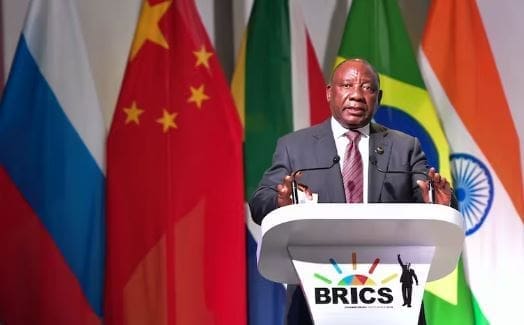
Eager to escape perceived western domination, several countries – mostly in the global south – are looking to join the Brics bloc. The five-country bloc (Brazil, Russia, India, China and South Africa) is also looking to grow its global partnerships.
What began in 2001 as an acronym for four of the fastest growing states, BRIC (Brazil, Russia, India and China), is projected to account for 45% of global GDP in purchasing power parity terms by 2030. It has evolved into a political formation as well.
Crucial to this was these countries’ decision to form their own club in 2009, instead of joining an expanded G7 as envisioned by former Goldman Sachs CEO Jim O’Neill, who coined the term “Bric”. Internal cohesion on key issues has emerged and continues to be refined, despite challenges.
South Africa joined the group after a Chinese-initiated invitation in 2010; a boost for then president Jacob Zuma’s administration, which was eager to pivot further to the east. The bloc also gained by having a key African player and regional leader.
Ever since, the grouping has taken on a more pointedly political tone, particularly on the need to reform global institutions, in addition to its original economic raison d’etre.
The possibility of its enlargement has dominated headlines in the run up to its 15th summit in Johannesburg on 22-24 August.
We are political scientists whose research interests include changes to the global order and emerging alternative centres of power. In our view, it won’t be easy to expand the bloc. That’s because the group is still focused on harmonising its vision, and the potential new members do not readily make the cut.
Some may even bring destabilising dynamics for the current composition of the formation. This matters because it tells us that the envisioned change in the global order is likely to be much slower. Simply put, while some states are opposed to western hegemony, they do not yet agree among themselves on what the new alternative should be.
Evolution of BRICS
BRICS’ overtly political character partially draws on a long history of non-alignment as far back as the Bandung Conference of 1955. It was attended mostly by recently decolonised states and independence movements intent on asserting themselves against Cold War superpowers – the Soviet Union and the United States.
BRICS has come to be viewed as challenging the counter hegemony of the US and its allies, seen as meddling in the internal affairs of other states.
Reuters estimates that more than 40 states are aspiring to join BRICS. South African diplomat Anil Sooklal says 13 had formally applied by May 2023.
Many, though not all, of the aspiring joiners have this overtly political motivation of countering US hegemony. The other important incentive is access to funds from the BRICS’ New Development Bank. This is especially pronounced in the post-COVID climate in which many economies are yet to fully recover. Of course the two can overlap, as in the case of Iran.
The notable applicants have included Saudi Arabia, Belarus, Ethiopia, Argentina, Algeria, Iran, Mexico, and Turkey.
Expanded BRICS
A strategically expanded BRICS would be seismic for the world order, principally in economic terms.
Key among the club’s reported priorities is reduction of reliance on the US dollar (“de-dollarisation” of the global economy). One of the hurdles to this is the lack of buy-in by much of the world. Though some states may disagree with the dollar’s dominance, they still see it as the most reliable.
Given the extent of globalisation, it’s unlikely that there will be attempts to chip away at the west’s access to strategic minerals and trade routes as happened during the Suez Crisis of 1956, at the height of the Cold War.
Instead, the new joiners would likely use their new BRICS membership to better bargain with their western partners, having more options on hand.
Herein lies the challenge (and the paradox) with BRICS expansion. On one hand, the grouping is not yet offering anything concrete to justify such drastic measures as de-dollarisation. On the other, the current five members also need to be selective about who they admit.
Among the considerations must surely be the track record of the applicants as well as their closeness to the west. The experience of having had a right-wing leader such as former Brazilian president Jair Bolsonaro in its midst must have been a lesson about the need to be circumspect when admitting new members.
Weighing the likely contenders
In this regard, aspirants such as Saudi Arabia and Mexico seem the least likely to make the cut in the short term. That’s despite the Saudis’ oil wealth and Mexico’s leftist-progressive leader Andres Manuel Lopez Obrador. Although they might be currently experiencing rocky relations with Washington, they have proven to be capable of rapprochement following previous disagreements with the US, with which they seem inextricably intertwined.
Saudi Arabia has a long-term military relationship with the US, while Mexico is the US’s number-one trading partner.
Of equal importance in the evaluation of potential new members is the relationship the aspirants have with the existing BRICS members. This is because another crucial lesson has been the tiff between two of its largest members, China and India, over their disputed border. As a result of the uneasy relationship between two of its members, the bloc has become alert to the importance of direct bilateral relations and dispute resolution among its constituent leaders.
Among the applicants, Saudi Arabia, which has had a fractious relationship with Moscow in the past, seems to face an uphill climb. It also has difficult relations with Iran, another applicant, despite their recent rapprochement.
The country which seems the most suitable to join BRICS for ideological reasons, and will expand the bloc’s footing in the Caribbean, is Cuba. It enjoys strong ties with the existing members. It also has solid “counter-hegemonic” credentials, having been the bête noire of the US for more than 60 years.
Cuba is also a leader in the Latin American left and enjoys strong ties with many states in Central and South America (particularly with Guatemala, Honduras, Nicaragua and Venezuela). Membership would boost its influence.
Character matters
If an expanded BRICS is to be an agent for change on the world scene, it will need to be capable of action. Having rivals, or states that are at least ambivalent towards each other, seems anathema to that.
Eager to proceed cautiously and expand strategically, the current BRICS states seems likely, at least in the short term, to pursue a BRICS-plus strategy. In other words, there may emerge different strata of membership, with full membership granted to states that meet the group’s criteria over time.
It is thus not mere expansion, but the character of the expansion which will guide the five principals on whether they grow from that number.
Bhaso Ndzendze, Associate Professor (International Relations), University of Johannesburg and Siphamandla Zondi, Acting Director: Institute for Pan-African Thought & Conversation, University of Johannesburg
This article is republished from The Conversation under a Creative Commons license. Read the original article.
