

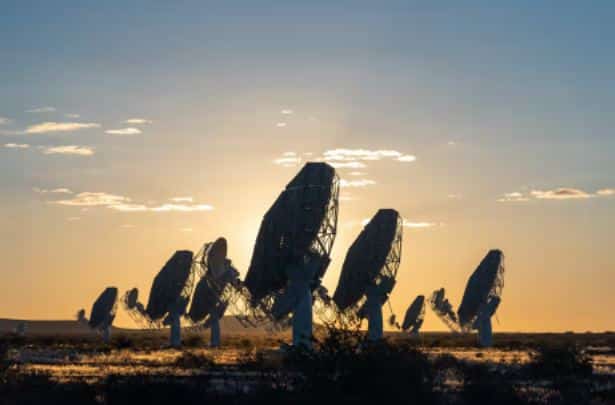
When astronomers dream of their ideal telescopes, it’s not that different to what people want from their TVs and computer monitors. Images they produce should be large and high definition, such as those from the Australian Square Kilometre Array Pathfinder (ASKAP), which have ~10k resolution (beyond the typical quality you get from digital TVs and digital cinematography). And they should have a high dynamic range, indicating high quality imaging with deep sensitivity to faint objects.
But not every telescope can do it all. That’s why complementary science – using some telescopes for some tasks, others for different but related tasks, and then combining the data – is so important in astronomy.
The value of complementary science is emphasised in our recent paper. We worked with ASKAP and South Africa’s MeerKAT telescope to harness their different capabilities. In 2019, ASKAP discovered a rare and mysterious type of object, referred to as an “odd radio circle” (ORC). We didn’t know what these eerie glowing rings in the sky were.
It took data from MeerKAT to help us conclude that the circles are most likely enormous shells of gas, about a million light years across, emanating from the central galaxy.
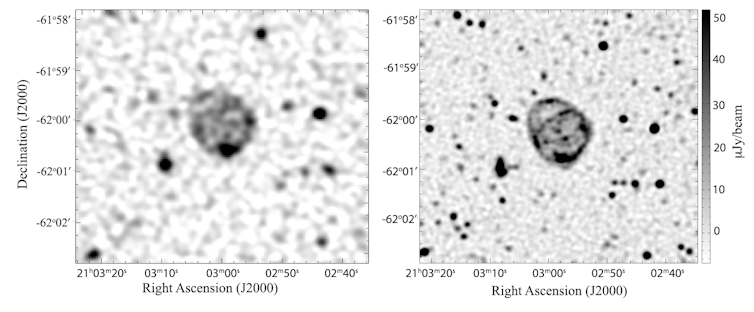
Author supplied
Neither the discovery nor the detail would have been possible without both telescopes. ASKAP’s uniquely large field of view enables the discovery of rare objects like ORCs. It also enabled the discovery of many new Fast Radio Bursts; these are seemingly rare, extremely bright and short-lived flashes of radio waves.
Meanwhile, MeerKAT’s unique sensitivity and sampling ability, achieved by its large number of dishes (64, located in a remote part of South Africa’s Northern Cape province), highly sensitive low noise amplifiers and large bandwidth, enables these objects to be studied in greater detail. MeerKAT is the best imaging radio telescope of its kind.
Both ASKAP and MeerKAT are precursors to the Square Kilometre Array (SKA). This is a global project to build the world’s largest and most sensitive radio telescope within the coming decade, co-located in South Africa and Australia. As our new research makes clear, complementary science will be at the heart of the SKA. This is an exciting prospect for African science, with South Africans putting themselves forward as world leaders within radio astronomy.
The nature of ORC1
Our new paper focuses on the first ORC that ASKAP discovered in 2019. We call it ORC1. MeerKAT provided something critical to deepening our understanding of what it might be and how it formed: beautiful, detailed images.
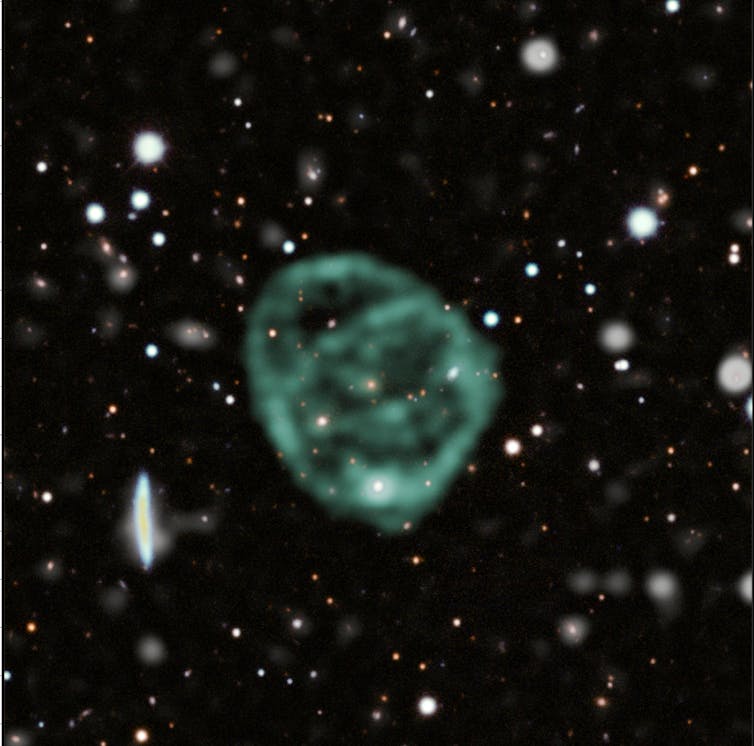
Jayanne English using data from MeerKAT and the Dark Energy Survey
The data we collected from MeerKAT was run through a complex workflow. This was developed and provided by the Inter-University Institute for Data Intensive Astronomy (IDIA), a partnership of three South African universities. This specialised software enabled specific data products to be generated, such as images of ORC1’s polarisation and “radio colour”.
MeerKAT’s technology revealed three especially important and previously uncertain details about ORC1. First was the object’s internal structure, revealed for the first time due to MeerKAT’s deep sensitivity and high resolution. We can now see ORC1 contains multiple arcs, a radio source where the central galaxy is located, and knots of radio emission associated with other galaxies within the vicinity.
Our theory is that the central galaxy, a few billion light years away, caused the ORC during a particular event. This may have been the merging of supermassive black holes or a starburst event (the rapid forming of many stars within the galaxy) that occurred billions of years ago. It was during this event, we hypothesise, that the ORC expanded to its enormous size of about 1.6 million light years.
The second detail revealed by MeerKAT’s data relates to the ORC’s polarisation, made possible by its deep sensitivity.
All light from the electromagnetic spectrum is polarised: its magnetic and electric fields are oriented in a certain direction. However, waves or photons from an unpolarised source of light are randomly polarised – they do not tend toward any particular orientation.
Certain physical processes, such as the presence of magnetic fields, can polarise light. This causes some or all of the waves to be oriented in the same direction. We found that ORC1 is strongly polarised along its outer ring.
The third detail was the structure of ORC1’s spectral index or “radio colour”: how its brightness changes across frequency.
Typically, spectral index is measured with several radio telescopes combined, each observing at a different frequency that one can compare to see how the brightness changes. For large resolved sources like ORC1, there’s huge scope for uncertainty. MeerKAT’s large bandwidth enabled us to measure an “in-band” spectral index map across the entire source. Within this map, every pixel itself measures the spectral index across the many frequencies we’ve combined. Our resulting map showed a steep spectral index across both the ring and its internal structure, suggesting they may have been produced by the same mechanism.
These new details fit with an explanation where synchrotron radiation (electrons whizzing around magnetic fields) is causing the radio emission, from a shell of gas in the form of a spherical shock wave. However, the internal arcs and rings require further explanation. We hypothesised that these are caused by the nearby galaxies moving through the shell and leaving trails in their wake.
New questions to pursue
So, what does it all mean? As with so much radio astronomy, we’re not certain: more data and information added to the mystery, with some clues provided.
However, we have three hypotheses to explain the nature of ORCs. One: it’s a spherical shell from an expanding shock wave caused by a huge explosion, such as the coalescing of two supermassive black holes. Two: it’s a spherical shell from the “termination shock” of a previous “starburst” event – when many stars rapidly formed within the galaxy over a short period of time. Three: it may be a view from one end of powerful radio jets of highly energetic particles that spew out from near a central supermassive black hole.
Not having definite answers may strike some as frustrating. But this is the nature of some science. What’s exciting is that there’s more to come: the SKA, which is due to become operational within the coming decade, will probe even more deeply into faint, rare and mysterious objects. This almost guarantees the discovery of the unexpected, as we’ve seen throughout the history of science, and as we now see with ORCs. Future discoveries far above us may look faint – but the possibilities paint a bright future.
Jordan Collier, ilifu Support Astronomer, Inter-University Institute for Data Intensive Astronomy
This article is republished from The Conversation under a Creative Commons license. Read the original article.
