

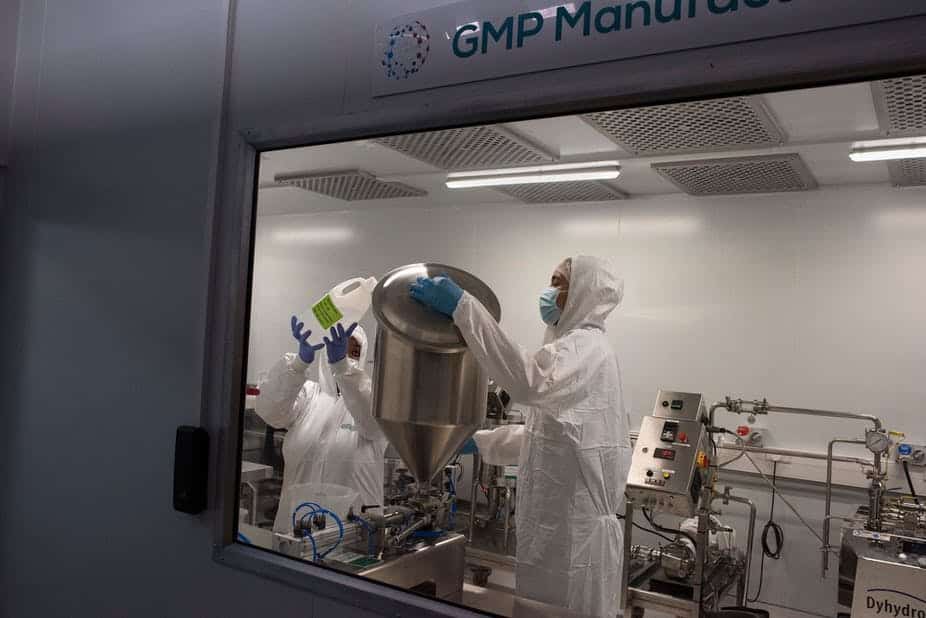
The World Health Organisation and the COVID Vaccines Global Access (COVAX) initiative announced in mid-2021 that they were working with a consortium to establish the first COVID messenger RNA (mRNA) vaccine technology transfer hub on the African continent, in South Africa. The Conversation Africa’s Natasha Joseph spoke with Petro Terblanche, Afrigen’s managing director and a professor at South Africa’s North-West University, about what this work entails – and what it will mean for the continent.
What is a technology transfer hub?
The technology transfer model is designed to create a platform that facilitates localised manufacturing of vaccines and stimulates vaccine innovation through partnerships with universities and science councils.
The pandemic stimulated and gave enormous momentum to establishing this first ever mRNA vaccine hub based in Africa. The use of a hub and spoke model based on technology transfer practices is quite common and well established, but it requires significant partnerships between the owners of technology and the recipients. One successful example is the WHO influenza vaccine technology transfer to about ten developing countries during the 2007 pandemic. The insights from this case study are being applied to the mRNA Hub.
Africa currently has no vaccine technology hub, although there are six vaccine production facilities on the continent. One of these is the Pasteur Institute in Senegal; it’s based on a technology transfer model and produces the yellow fever vaccine.
The decision to set up a South African hub was driven by COVAX. It realised some way into the pandemic that the necessary vaccine supply to Africa just isn’t going to happen. That’s partly because of the capacity and prioritisation of established manufacturers; the continent is completely reliant on the expansion of existing manufacturing capacity in China, India, the US and Europe.
So, there’s now a significant drive towards making vaccines in the region where they will be used. The WHO will select a few recipients of the technology from the mRNA Hub in South Africa which has now been nominated as the global mRNA Hub for lower and middle income countries. The hub will transfer end-to-end vaccine production technology to the recipients and train the personnel in these entities to implement the technology. The recipients will produce commercial scale vaccines and supply to countries where it is most needed.
What is Afrigen’s role in this process?
Afrigen will be a technology transfer and training hub: it shares technology and develops skills specifically around how to produce a safe, effective and affordable mRNA vaccine.
We have to establish a unit that is fully compliant with global Good Manufacturing Processes, complying with quality standards, safety for patients and workers, environmental responsibility. When we achieve these milestones, we’ll get a licence from the South African Health Products Regulatory Authority, which will have international endorsement from stringent regulatory authorities.
At our facility in Cape Town, we’ll make the drug substance and the drug product which is the final formulated mRNA vaccine. The facility will be licensed to make clinical material batches.
Afrigen will conduct Phase 1 and Phase 2 clinical trials while transferring the end-to-end production processes to Biovac; they will perform the Phase 3 clinical trial and obtain full market authorisation for commercial production and distribution into Africa. Between Biovac and Afrigen there will be the capacity to make more than 250 million doses a year – that’s small when you consider that Moderna and Pfizer-BioNTech can produce 1.7 billion doses a year.
Other commercial production facilities in Africa will receive Afrigen’s vaccine technology, too.
We’ll also be working closely with a consortium of South Africa universities, coordinated by the country’s Medical Research Council, to design and develop new and improved vaccines and manufacturing processes to enable the successful commercialisation of a pipeline of vaccines relevant for the burden of disease in Africa.
Why does it require specialised skills to produce vaccines with this technology?
The development and the production of any vaccine that meets safety and efficacy targets, and can be made at scale in an affordable model, is complex. It requires the combination of engineering and science with regulatory and quality systems at every step of the process. So it’s highly specialised work.
For mRNA vaccines we require geneticists, bioprocess engineers, biochemists, analytical chemists, molecular biologists, pharmacists and mechanical operators. It’s not easy to separate DNA into the RNA strands; it uses all sorts of enzymes and processes, and scientists must ensure throughout that the RNA is stable and safe for use.
What are your timelines?
The first step is to get all the necessary equipment and qualified people in place; then to produce the vaccine at lab scale to ensure we have the properties required for a safe, effective vaccine. After that we have to scale up and produce vaccines under non-Good Manufacturing Processes, as part of training and process validation. Then, on to Good Manufacturing Processes standards, with all the regulatory boxes ticked.
By the end of September 2022, we should have the first Good Manufacturing Processes batches ready. It’s very ambitious, but we believe this is healthy pressure.
It helps that we’re being well supported. The WHO and Medicines Patent pool, along with the South African government, the African Union and Africa CDC, have put in enormous effort and support, and the funders have recognised that South Africa’s scientists are very capable – some of the global leaders in the vaccine space.
Where does the “transfer” part of your work come in?
People will come to us to learn. We’re in touch with research hubs in Brazil, Argentina, the Ukraine, Colombia, the Philippines and several other African countries. Groups of people from the designated “spokes of the hub” will come and train with us. In a lab like this, everyone is highly trained and specialised, up to and including the cleaners; you’re operating in an environment that’s totally sterile and temperature controlled and must have no contamination.
We’re exploring a “train the trainers” model. We’ll likely do some off-site training at the University of Cape Town, then move people to our facility to obtain their final qualification: make the vaccine up to Good Manufacturing Processes standards. They’ll take that knowledge and technology back to their colleagues at home.
The consortium comprises Afrigen Biologics and Vaccines (South Africa), Biovac (South Africa), a network of universities as well as the Africa Centres for Disease Control and Prevention which is headquartered in Ethiopia.
Petro Terblanche, Professor, Business Development; Managing Director, Afrigen Biologics, North-West University
This article is republished from The Conversation under a Creative Commons license. Read the original article.
