Close Menu
  • Homepage
  • News
  • Cloud & AI
  • ECommerce
  • Entertainment
  • Finance
  • Opinion
  • Podcast
  • Contact

Subscribe to Updates

Get the latest technology news from TechFinancials News about FinTech, Tech, Business, Telecoms and Connected Life.

What's Hot

The Rise of Virtual Items: How Digital Assets Became Valuable

2026-02-08

Digitap ($TAP) Crushes NexChain with Real Banking Utility: Best Crypto to Buy in 2026

2026-02-07

Football Fans Can Share Their ‘Super Bowl Spread’  With The Chance To Win an NFL Jersey

2026-02-07
Facebook X (Twitter) Instagram
Trending
  • The Rise of Virtual Items: How Digital Assets Became Valuable
Facebook X (Twitter) Instagram YouTube LinkedIn WhatsApp RSS
TechFinancials
  • Homepage
  • News
  • Cloud & AI
  • ECommerce
  • Entertainment
  • Finance
  • Opinion
  • Podcast
  • Contact
TechFinancials
Home»Trending News»Darknet Markets Generate Millions In Revenue Selling Stolen Personal Data, Supply Chain Study Finds
Trending News

Darknet Markets Generate Millions In Revenue Selling Stolen Personal Data, Supply Chain Study Finds

The ConversationBy The Conversation2022-12-05No Comments5 Mins Read
Share Facebook Twitter Pinterest LinkedIn Tumblr Email
Hackers
Masked Hacker. Gorodenkoff / Shutterstock.com
Share
Facebook Twitter LinkedIn Pinterest Email Copy Link

It is common to hear news reports about large data breaches, but what happens once your personal data is stolen? Our research shows that, like most legal commodities, stolen data products flow through a supply chain consisting of producers, wholesalers and consumers. But this supply chain involves the interconnection of multiple criminal organizations operating in illicit underground marketplaces.

The stolen data supply chain begins with producers – hackers who exploit vulnerable systems and steal sensitive information such as credit card numbers, bank account information and Social Security numbers. Next, the stolen data is advertised by wholesalers and distributors who sell the data. Finally, the data is purchased by consumers who use it to commit various forms of fraud, including fraudulent credit card transactions, identity theft and phishing attacks.

This trafficking of stolen data between producers, wholesalers and consumers is enabled by darknet markets, which are websites that resemble ordinary e-commerce websites but are accessible only using special browsers or authorization codes.

We found several thousand vendors selling tens of thousands of stolen data products on 30 darknet markets. These vendors had more than US$140 million in revenue over an eight-month period.

Horizontal left-to-right flowchart with four segments
The stolen data supply chain, from data theft to fraud.
Christian Jordan Howell, CC BY-ND

Darknet markets

Just like traditional e-commerce sites, darknet markets provide a platform for vendors to connect with potential buyers to facilitate transactions. Darknet markets, though, are notorious for the sale of illicit products. Another key distinction is that access to darknet markets requires the use of special software such as the Onion Router, or TOR, which provides security and anonymity.

Silk Road, which emerged in 2011, combined TOR and bitcoin to become the first known darknet market. The market was eventually seized in 2013, and the founder, Ross Ulbricht, was sentenced to two life sentences plus 40 years without the possibility of parole. Ulbricht’s hefty prison sentence did not appear to have the intended deterrent effect. Multiple markets emerged to fill the void and, in doing so, created a thriving ecosystem profiting from stolen personal data.
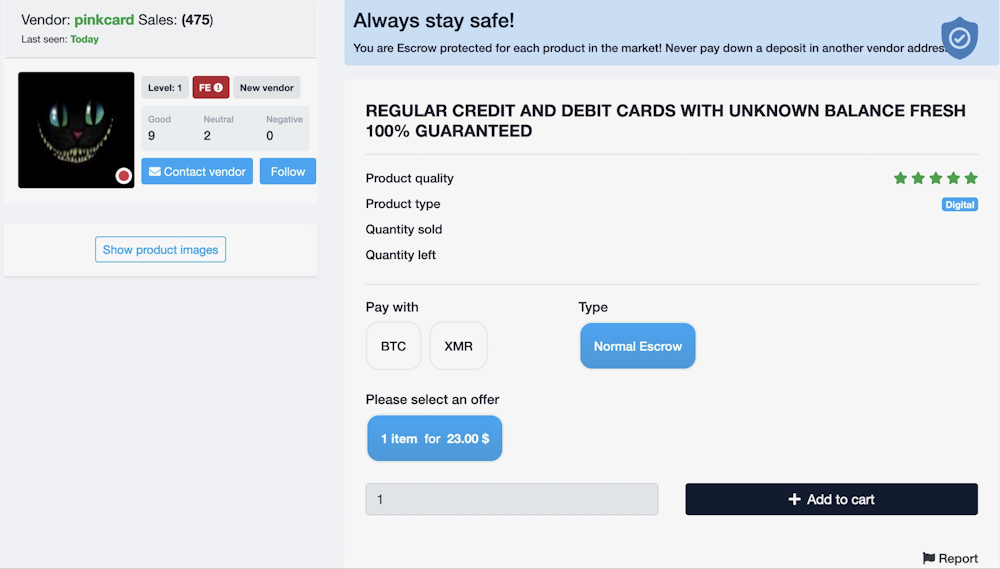
Screenshot of a webpage showing a product for sale
Example of a stolen data ‘product’ sold on a darknet market.
Screenshot by Christian Jordan Howell, CC BY-ND

Stolen data ecosystem

Recognizing the role of darknet markets in trafficking stolen data, we conducted the largest systematic examination of stolen data markets that we are aware of to better understand the size and scope of this illicit online ecosystem. To do this, we first identified 30 darknet markets advertising stolen data products.

Next, we extracted information about stolen data products from the markets on a weekly basis for eight months, from Sept. 1, 2020, through April 30, 2021. We then used this information to determine the number of vendors selling stolen data products, the number of stolen data products advertised, the number of products sold and the amount of revenue generated.

In total, there were 2,158 vendors who advertised at least one of the 96,672 product listings across the 30 marketplaces. Vendors and product listings were not distributed equally across markets. On average, marketplaces had 109 unique vendor aliases and 3,222 product listings related to stolen data products. Marketplaces recorded 632,207 sales across these markets, which generated $140,337,999 in total revenue. Again, there is high variation across the markets. On average, marketplaces had 26,342 sales and generated $5,847,417 in revenue.
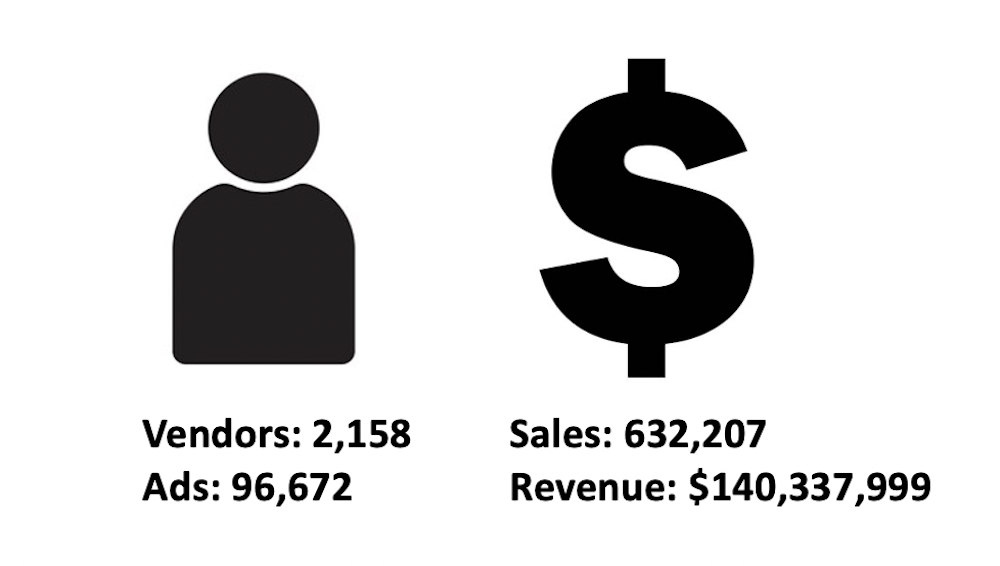
Graphic with a silhouette representing a person and a dollar sign
The size and scope of the stolen data ecosystem over an eight-month period.
Christian Jordan Howell, CC BY-ND

After assessing the aggregate characteristics of the ecosystem, we analyzed each of the markets individually. In doing so, we found that a handful of markets were responsible for trafficking most of the stolen data products. The three largest markets – Apollon, WhiteHouse and Agartha – contained 58% of all vendors. The number of listings ranged from 38 to 16,296, and the total number of sales ranged from 0 to 237,512. The total revenue of markets also varied substantially during the 35-week period: It ranged from $0 to $91,582,216 for the most successful market, Agartha.

For comparison, most midsize companies operating in the U.S. earn between $10 million and $1 billion annually. Both Agartha and Cartel earned enough revenue within the 35-week period we tracked them to be characterized as midsize companies, earning $91.6 million and $32.3 million, respectively. Other markets like Aurora, DeepMart and WhiteHouse were also on track to reach the revenue of a midsize company if given a full year to earn.

Our research details a thriving underground economy and illicit supply chain enabled by darknet markets. As long as data is routinely stolen, there are likely to be marketplaces for the stolen information.

These darknet markets are difficult to disrupt directly, but efforts to thwart customers of stolen data from using it offers some hope. We believe that advances in artificial intelligence can provide law enforcement agencies, financial institutions and others with information needed to prevent stolen data from being used to commit fraud. This could stop the flow of stolen data through the supply chain and disrupt the underground economy that profits from your personal data.The Conversation

Christian Jordan Howell, Assistant Professor in Cybercrime, University of South Florida and David Maimon, Professor of Criminal Justice and Criminology, Georgia State University

This article is republished from The Conversation under a Creative Commons license. Read the original article.

Darknet Data breaches Data theft Hackers Stolen Personal Data Supply Chain
Share. Facebook Twitter Pinterest LinkedIn Tumblr Email
The Conversation
  • Website

Related Posts

Ransomware: What It Is And Why It’s Your Problem

2026-01-19

Volvo EX60 – It’s A Middle Finger To The Petrol Price

2026-01-09

WeThinkCode_ Announces New CEO As It Enters Its Second Decade

2026-01-07

AI Unlocks A R3 Trillion Treasure in SA’s Townships

2025-12-23

Vodacom Bets R36 Billion For Control of Kenya’s Telecom Crown Jewel, Safaricom

2025-12-04

Can AI Be Inclusive Without Africa?

2025-12-01

Humanising Tech Means Designing For African Reality, Says Telkom CMO

2025-12-01

Africa Has A Moral Voice In AI, Says Telkom CEO, Championing Continent As Co-Creator, Not Consumer

2025-12-01

Huge TNS To Enable Organisations To Launch MVNO Services in South Africa With Zero Capex

2025-11-25
Leave A Reply Cancel Reply

DON'T MISS
Breaking News

Digitap ($TAP) Crushes NexChain with Real Banking Utility: Best Crypto to Buy in 2026

The crypto presale market in 2026 has seen dozens of projects compete for investor attention.…

Dutch Entrepreneurial Development Bank FMO Invests R340M In Lula To Expand SME funding In SA

2026-02-03

Paarl Mall Gets R270M Mega Upgrade

2026-02-02

Huawei Says The Next Wave Of Infrastructure Investment Must Include People, Not Only Platforms

2026-01-21
Stay In Touch
  • Facebook
  • Twitter
  • YouTube
  • LinkedIn
OUR PICKS

Vodacom Reports Robust Q3 Growth, Driven By Diversification And Strategic Moves

2026-02-04

South Africa’s First Institutional Rand Stablecoin, ZARU, Launches

2026-02-03

The EX60 Cross Country: Built For The “Go Anywhere” Attitude

2026-01-23

Mettus Launches Splendi App To Help Young South Africans Manage Their Credit Health

2026-01-22

Subscribe to Updates

Get the latest tech news from TechFinancials about telecoms, fintech and connected life.

About Us

TechFinancials delivers in-depth analysis of tech, digital revolution, fintech, e-commerce, digital banking and breaking tech news.

Facebook X (Twitter) Instagram YouTube LinkedIn WhatsApp Reddit RSS
Our Picks

The Rise of Virtual Items: How Digital Assets Became Valuable

2026-02-08

Digitap ($TAP) Crushes NexChain with Real Banking Utility: Best Crypto to Buy in 2026

2026-02-07

Football Fans Can Share Their ‘Super Bowl Spread’  With The Chance To Win an NFL Jersey

2026-02-07
Recent Posts
  • The Rise of Virtual Items: How Digital Assets Became Valuable
  • Digitap ($TAP) Crushes NexChain with Real Banking Utility: Best Crypto to Buy in 2026
  • Football Fans Can Share Their ‘Super Bowl Spread’  With The Chance To Win an NFL Jersey
  • Why Traditional Banks Need Mobile Money Solutions to Survive the Next 5 Years
  • Spotify Brings Audiobooks to South Africa
TechFinancials
RSS Facebook X (Twitter) LinkedIn YouTube WhatsApp
  • Homepage
  • Newsletter
  • Contact
  • Advertise
  • Privacy Policy
  • About
© 2026 TechFinancials. Designed by TFS Media. TechFinancials brings you trusted, around-the-clock news on African tech, crypto, and finance. Our goal is to keep you informed in this fast-moving digital world. Now, the serious part (please read this): Trading is Risky: Buying and selling things like cryptocurrencies and CFDs is very risky. Because of leverage, you can lose your money much faster than you might expect. We Are Not Advisors: We are a news website. We do not provide investment, legal, or financial advice. Our content is for information and education only. Do Your Own Research: Never rely on a single source. Always conduct your own research before making any financial decision. A link to another company is not our stamp of approval. You Are Responsible: Your investments are your own. You could lose some or all of your money. Past performance does not predict future results. In short: We report the news. You make the decisions, and you take the risks. Please be careful.

Type above and press Enter to search. Press Esc to cancel.

Ad Blocker Enabled!
Ad Blocker Enabled!
Our website is made possible by displaying online advertisements to our visitors. Please support us by disabling your Ad Blocker.