Close Menu
  • Homepage
  • News
  • Cloud & AI
  • ECommerce
  • Entertainment
  • Finance
  • Opinion
  • Podcast
  • Contact

Subscribe to Updates

Get the latest technology news from TechFinancials News about FinTech, Tech, Business, Telecoms and Connected Life.

What's Hot

Salesforce Appoints Nick Christodoulou As Area VP Of Sales For Africa

2026-02-02

Why South Africa Cannot Afford To Wait For Healthcare Reform

2026-02-02

How is Technology Used in Cricket?

2026-02-02
Facebook X (Twitter) Instagram
Trending
  • Salesforce Appoints Nick Christodoulou As Area VP Of Sales For Africa
Facebook X (Twitter) Instagram YouTube LinkedIn WhatsApp RSS
TechFinancials
  • Homepage
  • News
  • Cloud & AI
  • ECommerce
  • Entertainment
  • Finance
  • Opinion
  • Podcast
  • Contact
TechFinancials
Home»Opinion»What The Voyager Space Probes Can Teach Humanity About Immortality
Opinion

What The Voyager Space Probes Can Teach Humanity About Immortality

The ConversationBy The Conversation2022-05-26No Comments6 Mins Read
Share Facebook Twitter Pinterest LinkedIn Tumblr Email
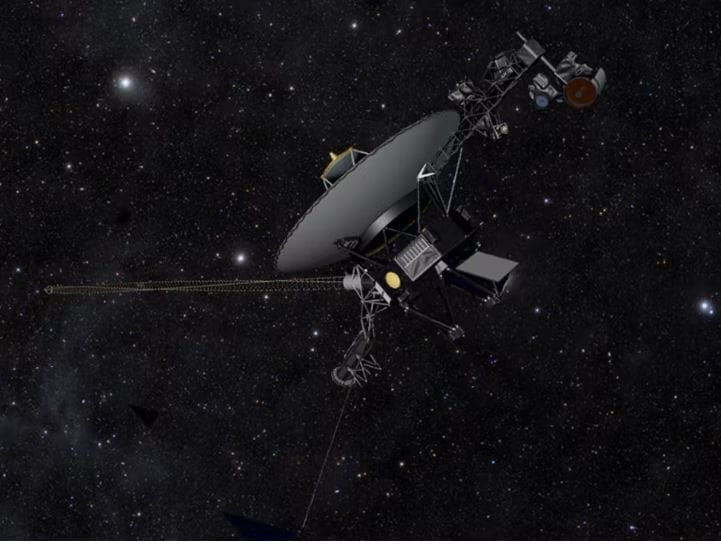
Voyager
Scientists expect the Voyager spacecraft to outlive Earth by at least a trillion years. NASA/JPL-CalTech
Share
Facebook Twitter LinkedIn Pinterest Email Copy Link

Voyager 1 is the farthest human-made object from Earth. After sweeping by Jupiter, Saturn, Uranus and Neptune, it is now almost 15 billion miles (24 billion kilometers) from Earth in interstellar space. Both Voyager 1 and its twin, Voyager 2, carry little pieces of humanity in the form of their Golden Records. These messages in a bottle include spoken greetings in 55 languages, sounds and images from nature, an album of recordings and images from numerous cultures, and a written message of welcome from Jimmy Carter, who was U.S. president when the spacecraft left Earth in 1977.

A golden colored record with 'The Sounds of Earth' written in the center.
Each Voyager spacecraft carries a Golden Record containing two hours of sounds, music and greetings from around the world. Carl Sagan and other scientists assumed that any civilization advanced enough to detect and capture the record in space could figure out how to play it.
NASA/Wikimedia Commons

The Golden Records were built to last a billion years in the environment of space, but in a recent analysis of the paths and perils these explorers may face, astronomers calculated that they could exist for trillions of years without coming remotely close to any stars.

Having spent my career in the field of religion and science, I’ve thought a lot about how spiritual ideas intersect with technological achievements. The incredible longevity of the Voyager spacecraft presents a uniquely tangible entry point into exploring ideas of immortality.

For many people, immortality is the everlasting existence of a soul or spirit that follows death. It can also mean the continuation of one’s legacy in memory and records. With its Golden Record, each Voyager provides such a legacy, but only if it is discovered and appreciated by an alien civilization in the distant future.

People in black standing around a coffin at a gravesite.
Many religions espouse some form of life after death.
RubberBall Productions/Brand X Pictures via Getty Images

Life after death

Religious beliefs about immortality are numerous and diverse. Most religions foresee a postmortem career for a personal soul or spirit, and these range from everlasting residence among the stars to reincarnation.

The ideal eternal life for many Christians and Muslims is to abide forever in God’s presence in heaven or paradise. Judaism’s teachings about what happens after death are less clear. In the Hebrew Bible, the dead are mere “shades” in a darkened place called Sheol. Some rabbinical authorities give credence to the resurrection of the righteous and even to the eternal status of souls.

Immortality is not limited to the individual. It can be collective as well. For many Jews, the final destiny of the nation of Israel or its people is of paramount importance. Many Christians anticipate a future general resurrection of all who have died and the coming of the kingdom of God for the faithful.

Jimmy Carter, whose message and autograph are immortalized in the Golden Records, is a progressive Southern Baptist and a living example of religious hope for immortality. Now battling brain cancer and approaching centenarian status, he has thought about dying. Following his diagnosis, Carter concluded in a sermon: “It didn’t matter to me whether I died or lived. … My Christian faith includes complete confidence in life after death. So I’m going to live again after I die.”

It is plausible to conclude that the potential of an alien witnessing the Golden Record and becoming aware of Carter’s identity billions of years in the future would offer only marginal additional consolation for him. Carter’s knowledge in his ultimate destiny is a measure of his deep faith in the immortality of his soul. In this sense, he likely represents people of numerous faiths.

Secular immortality

For people who are secular or nonreligious there is little solace to be found in an appeal to the continuing existence of a soul or spirit following one’s death. Carl Sagan, who came up with the idea for the Golden Records and led their development, wrote of the afterlife: “I know of nothing to suggest that it is more than just wishful thinking.” He was more saddened by thoughts of missing important life experiences – like seeing his children grow up – than fearful about the expected annihilation of his conscious self with the death of his brain.

For those like Sagan there are other possible options for immortality. They include freezing and preserving the body for future physical resurrection or uploading one’s consciousness and turning it into a digital form that would long outlast the brain. Neither of these potential paths to physical immortality has proved to be feasible yet.

Play
The Golden Records contain a snapshot of Earth and humanity.

The Voyagers and legacy

Most people, whether secular or religious, want the actions they do while alive to bear continuing meaning into the future as their fruitful legacy. People want to be remembered and appreciated, even cherished. Sagan summed it up nicely: “To live in the hearts we leave behind is to live forever.”

With Voyagers 1 and 2 estimated to exist for more than a trillion years, they are about as immortal as it gets for human artifacts. Even before the Sun’s expected demise when it runs out of fuel in about 5 billion years, all living species, mountains, seas and forests will have long been obliterated. It will be as if we and all the marvelous and extravagant beauty of planet Earth never existed – a devastating thought to me.
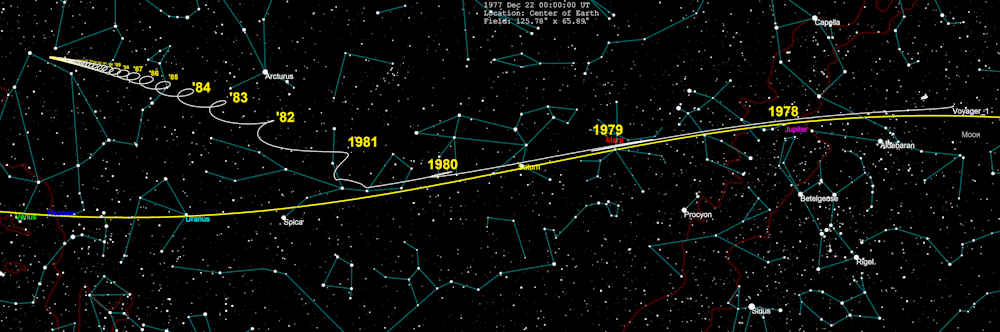
A chart showing the path of Voyager 1 spiraling off into the distance.
Voyager 1’s path, in white, has taken the craft well past the orbits of the outer planets into interstellar space, where aliens may someday come across the relic of humanity.
NASA/JPL via Wikimedia Commons, CC BY-SA

But in the distant future, the two Voyager spacecraft will still be floating in space, awaiting discovery by an advanced alien civilization for whom the messages on the Golden Records were intended. Only those records will likely remain as testimony and legacy of Earth, a kind of objective immortality.

Religious and spiritual people can find solace in the belief that God or an afterlife waits for them after death. For the secular, hoping that someone or something will remember humanity, any wakeful and appreciative aliens will have to do.The Conversation

James Edward Huchingson, Professor Emeritus and Lecturer in Religion and Science, Florida International University

This article is republished from The Conversation under a Creative Commons license. Read the original article.

Aliens God Heaven Immortality Religion space
Share. Facebook Twitter Pinterest LinkedIn Tumblr Email
The Conversation
  • Website

Related Posts

Why South Africa Cannot Afford To Wait For Healthcare Reform

2026-02-02

Stablecoins: The Quiet Revolution South Africa Can’t Ignore

2026-02-02

South Africa Could Unlock SME Growth By Exploiting AI’s Potential Through Corporate ESD Funds

2026-01-28

How Local Leaders Can Shift Their Trajectory In 2026

2026-01-23

Why Legal Businesses Must Lead Digital Transformation Rather Than Chase It

2026-01-23

Directing The Dual Workforce In The Age of AI Agents

2026-01-22

The Productivity Myth That’s Costing South Africa Talent

2026-01-21

The Boardroom Challenge: Governing AI, Data And Digital

2026-01-20

Ransomware: What It Is And Why It’s Your Problem

2026-01-19
Leave A Reply Cancel Reply

DON'T MISS
Breaking News

SA Auto Industry At Crossroads: Cheap Imports Threaten Future

Government must urgently finalise new energy vehicles policy, refine tariffs and deploy anti-dumping measures to…

Paarl Mall Gets R270M Mega Upgrad

2026-02-02

Huawei Says The Next Wave Of Infrastructure Investment Must Include People, Not Only Platforms

2026-01-21

South Africa: Best Starting Point In Years, With 3 Clear Priorities Ahead

2026-01-12
Stay In Touch
  • Facebook
  • Twitter
  • YouTube
  • LinkedIn
OUR PICKS

What’s Stopping Sunny South Africa’s Solar Industry?

2026-02-02

How a Major Hotel Group Is Electrifying South Africa’s Travel

2026-01-29

The EX60 Cross Country: Built For The “Go Anywhere” Attitude

2026-01-23

Mettus Launches Splendi App To Help Young South Africans Manage Their Credit Health

2026-01-22

Subscribe to Updates

Get the latest tech news from TechFinancials about telecoms, fintech and connected life.

About Us

TechFinancials delivers in-depth analysis of tech, digital revolution, fintech, e-commerce, digital banking and breaking tech news.

Facebook X (Twitter) Instagram YouTube LinkedIn WhatsApp Reddit RSS
Our Picks

Salesforce Appoints Nick Christodoulou As Area VP Of Sales For Africa

2026-02-02

Why South Africa Cannot Afford To Wait For Healthcare Reform

2026-02-02

How is Technology Used in Cricket?

2026-02-02
Recent Posts
  • Salesforce Appoints Nick Christodoulou As Area VP Of Sales For Africa
  • Why South Africa Cannot Afford To Wait For Healthcare Reform
  • How is Technology Used in Cricket?
  • SA Auto Industry At Crossroads: Cheap Imports Threaten Future
  • Stablecoins: The Quiet Revolution South Africa Can’t Ignore
TechFinancials
RSS Facebook X (Twitter) LinkedIn YouTube WhatsApp
  • Homepage
  • Newsletter
  • Contact
  • Advertise
  • Privacy Policy
  • About
© 2026 TechFinancials. Designed by TFS Media. TechFinancials brings you trusted, around-the-clock news on African tech, crypto, and finance. Our goal is to keep you informed in this fast-moving digital world. Now, the serious part (please read this): Trading is Risky: Buying and selling things like cryptocurrencies and CFDs is very risky. Because of leverage, you can lose your money much faster than you might expect. We Are Not Advisors: We are a news website. We do not provide investment, legal, or financial advice. Our content is for information and education only. Do Your Own Research: Never rely on a single source. Always conduct your own research before making any financial decision. A link to another company is not our stamp of approval. You Are Responsible: Your investments are your own. You could lose some or all of your money. Past performance does not predict future results. In short: We report the news. You make the decisions, and you take the risks. Please be careful.

Type above and press Enter to search. Press Esc to cancel.

Ad Blocker Enabled!
Ad Blocker Enabled!
Our website is made possible by displaying online advertisements to our visitors. Please support us by disabling your Ad Blocker.