


After months of anticipation and debate, Australia’s social media ban is now in force.
Young Australians under 16 must now come to grips with the new reality of being unable to have an account on some social media platforms, including Instagram, TikTok and Facebook.
Only time will tell whether this bold, world-first experiment will succeed. Despite this, many countries are already considering following Australia’s lead.
But there are other jurisdictions that are taking a different approach to try and keep young people safe online.
Here’s what’s happening overseas.
A global movement
In November, the European parliament called for a similar social media ban for under 16s.
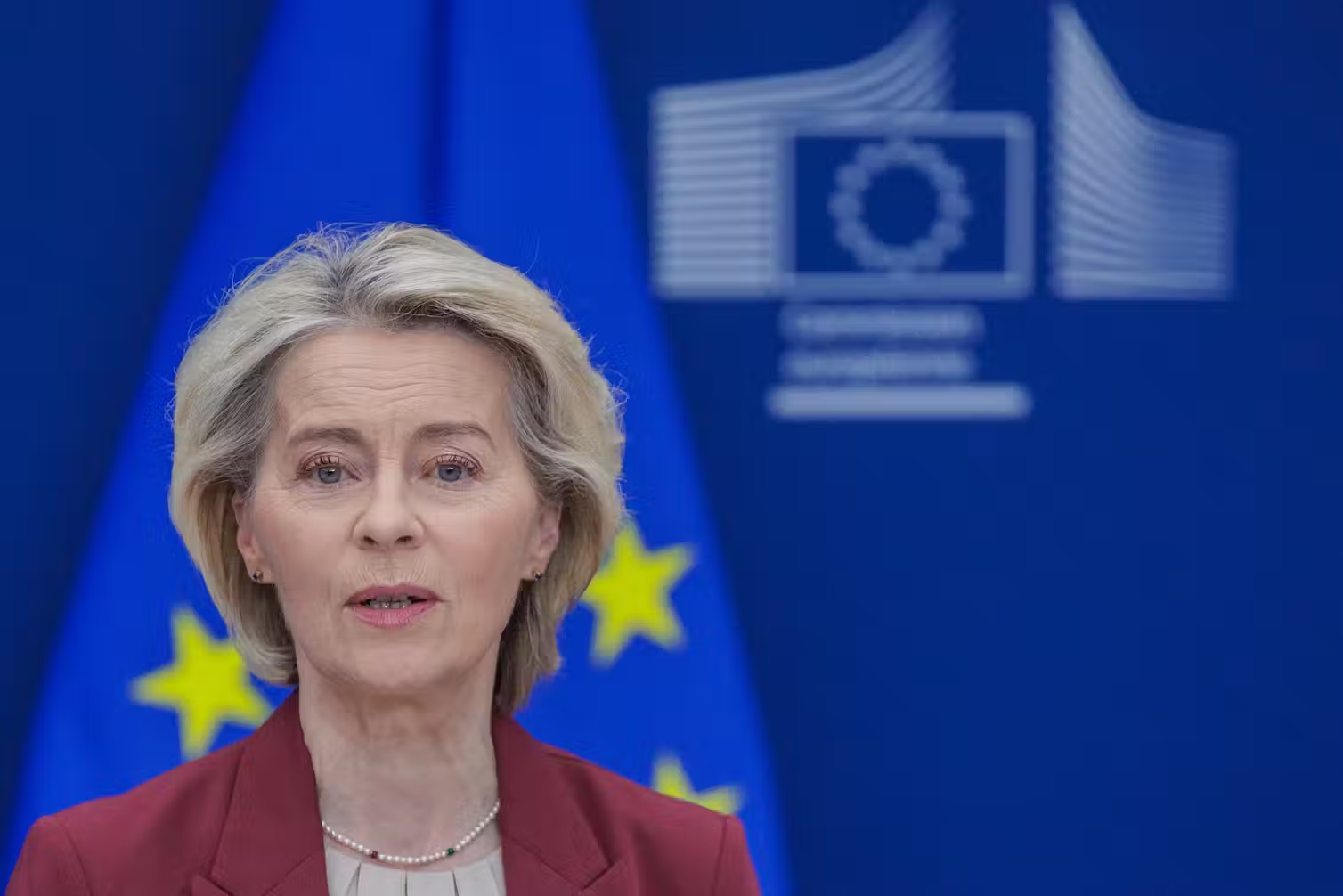
The President of the European Commission, Ursula von der Leyen, said she has been studying Australia’s restrictions and how they address what she described as “algorithms that prey on children’s vulnerabilities”, leaving parents feeling powerless against “the tsunami of big tech flooding their homes”.
In October, New Zealand announced it would introduce similar legislation to Australia’s, following the work of a parliamentary committee to examine how best to address harm on social media platforms. The committee’s report will be released in early 2026.
Pakistan and India are aiming to reduce children’s exposure to harmful content by introducing rules requiring parental consent and age verification for platform access, alongside content moderation expectations for tech companies.
Malaysia has announced it will ban children under 16 from social media starting in 2026. This follows the country requiring social media and messaging platforms with eight million or more users to obtain licenses to operate, and use age verification and content-safety measures from January 2025.
France is also considering a social media ban for children under 15 and a 10pm to 8am curfew for platform use for 15- to 18-year-olds. These are among 43 recommendations made by a French inquiry in September 2025, which also recommended banning smartphones in schools, and implementing a crime of “digital negligence for parents who fail to protect their children”.
While France introduced a requirement in 2023 that platforms obtain parental consent for children under 15 to create social media accounts, it has yet to be enforced. This is also the case in Germany. There, children aged between 13 and 16 can only access platforms with parental consent, but without formal checks in place.
And, in Spain, the minimum age for social media accounts will rise from 14 to 16, unless parents provide consent.
Norway announced plans in July to restrict access to social media for under 15s. The government explained the law would be “designed in accordance with children’s fundamental rights, including freedom of expression, access to information, and the right to association”.
In November, Denmark announced it would “ban access to social media for anyone under 15”. However, unlike Australia’s legislation, parents can override the rules to enable 13- and 14-year-olds to retain platform access. Yet there is no date for implementation, with lawmakers expected to take months to pass the legislation.
It’s also unclear how Denmark’s ban will be enforced. But the country does have a national digital ID program that may be used.
In July, Denmark was named as part of a pilot program (with Greece, France, Spain, and Italy) to trial an age verification app that could be launched across the European Union for use by adult content sites and other digital providers.
Some pushback
The implementation of similar restrictions is not being taken up everywhere.
For example, South Korea has decided against a social media ban for children. But it will ban the use of mobile phones and other devices in classrooms starting in March 2026.
In the city of Toyoake (south-west of Tokyo, Japan), a very different solution has been proposed. The city’s mayor, Masafumi Koki, issued an ordinance in October, limiting the use of smartphones, tablets, and computers to two hours per day for people of all ages.
Koki is aware of Australia’s social media restrictions. But as he explained:
If adults are not held to the same standards, children will not accept the rules.
While the ordinance has faced backlash, and is non-binding, it prompted 40% of residents to reflect on their behaviour, with 10% reducing their time on smartphones.
In the United States, the opposition to Australia’s social media restrictions has been extremely vocal and significant.
American media and technology companies have urged President Donald Trump to “reprimand” Australia over its legislation. They argue American companies are being unfairly targeted and have lodged formal complaints with the Office of US Trade.
President Trump has stated he would stand up to any countries that “attacked” American technology companies. The US recently called eSafety Commissioner Julie Inman-Grant to testify in front of Congress. US Republican Jim Jordan claimed her enforcement of Australia’s Online Safety Act “imposes obligations on American companies and threatens speech of American citizens”, which Inman-Grant strongly denied.
The world will keep watching
While much of the world seems united in concern about the harmful content and algorithmic features children experience on social media, only one thing is clear – there is no silver bullet for addressing these harms.
There is no agreed set of restrictions, or specific age at which legislators agree children should have unrestricted access to these platforms.
Many countries outside Australia are empowering parents to provide access, if they believe it is right for their children. And many countries are considering how best to enforce restrictions, if they implement similar rules.
As experts point to the technical challenges in enforcing Australia’s restrictions, and as young Australians consider workarounds to maintain their accounts or find new platforms to use, other countries will continue to watch and plan their next moves.
Lisa M. Given, Professor of Information Sciences & Director, Social Change Enabling Impact Platform, RMIT University
This article is republished from The Conversation under a Creative Commons license. Read the original article.
