


HERMANUS, CAPE TOWN – The conversation around Artificial Intelligence (AI) in Africa is rapidly shifting from “if” to “how.”
While the potential is universally acknowledged, the path to tangible, scalable, and locally relevant implementation remains the critical challenge.
At the SATNAC 2025 conference, the focus was squarely on this practical execution, with industry leaders outlining a future where AI doesn’t just exist in research papers but actively solves everyday problems and drives economic growth.
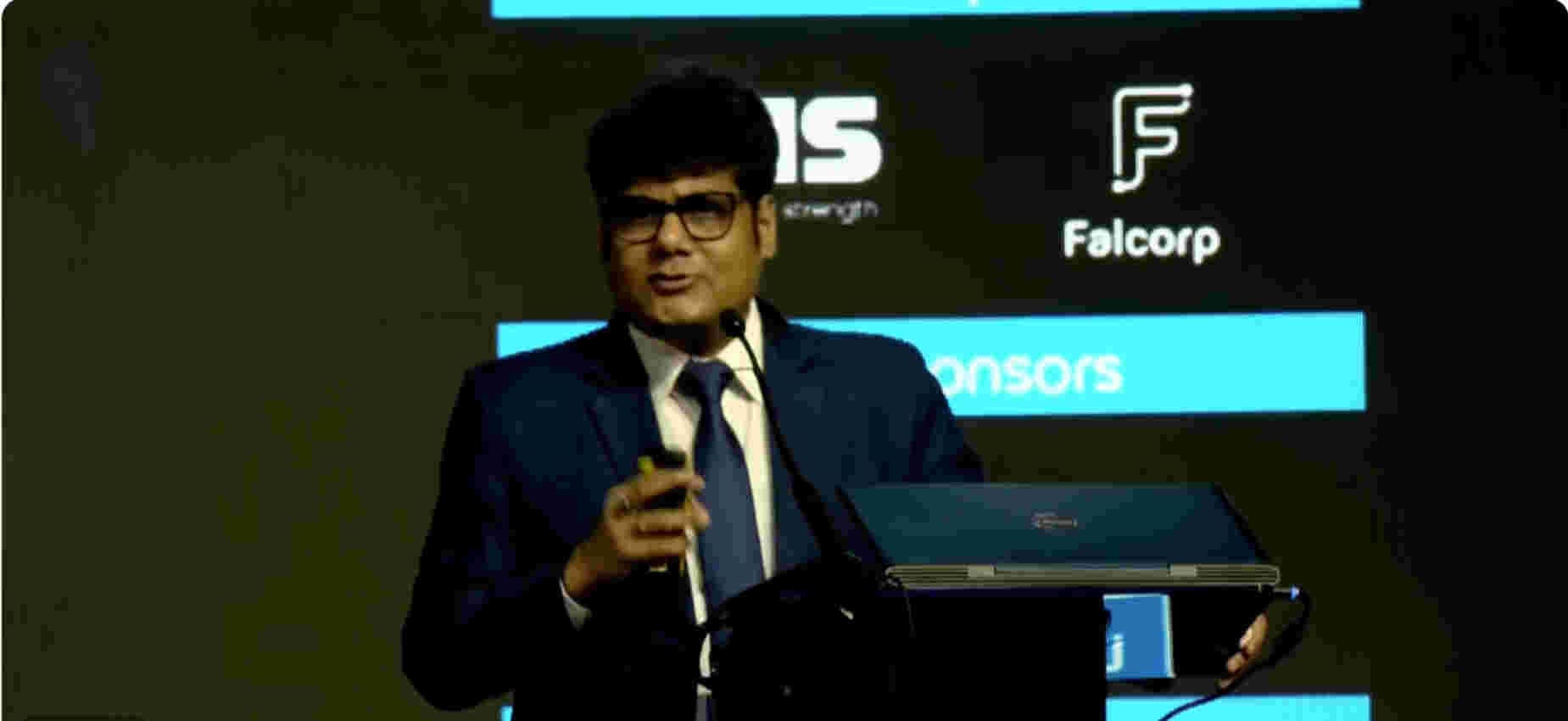
Amit Sharma, Executive: Product Manager Carrier Cloud & IT Southern Africa Region at Huawei, delivered a keynote titled “Accelerate Intelligence, Amplify Success,” weaving a compelling narrative around the urgent need for digital transformation anchored in real-world AI innovation.

He didn’t just speak in theoretical terms; he presented a portfolio of deployed solutions, from South African railways to Zambian universities, proving that the intelligent era is already here.
The Case for Digital Transformation
Sharma opened with a humorous yet pointed anecdote from his very trip to the conference, emphasising a fundamental truth: gaps in traditional systems are everywhere, and digital integration is the answer.
He recounted arriving late at night at the Arabella Hotel, Golf & Spa, Kleinmond, Hermanus, Western Cape, South Africa, only to be given keys to a villa that was already occupied by a startled homeowner and his dog.
The failure wasn’t due to a lack of physical security but a disconnect in the digital chain of information.
“Sometimes we think that physical security can provide us with some level of protection. Yes, it definitely provides us. But it is not the end-to-end security,” Sharma stated.
“We should look for digital transformation in every area where we work… this is also one of the areas.”

This simple story defined his entire message: digital transformation and AI are not about chasing the most complex project first, but about systematically solving real, sometimes simple, points of failure that impact efficiency, cost, and experience.
The Engine of Change: Cloud for AI, AI for Cloud
Sharma explained Huawei’s dual-strategy engine: “Cloud for AI and AI for Cloud.”
This means building powerful, innovative infrastructure (like advanced AI computing hardware and cloud-native services) specifically designed to fuel AI development (“Cloud for AI”).
Simultaneously, they use AI to make the cloud itself smarter, more efficient, and more resilient (“AI for Cloud”).
This technical foundation allows Huawei Cloud to differentiate on what enterprises truly need: “security, stability, and quality,” coupled with high availability, low latency, and advanced data-AI convergence.
But Sharma was quick to add that technology alone is not enough.
“The ecosystem is also equally important,” Sharma said.
“We generally partner with our partners as well as our customers to innovate jointly.
“And then this brings a complete end-to-end digital transformation and AI adoption across the organisation.”
A Global Gallery of Real-World AI
The core of Sharma’s presentation was a walkthrough of concrete, deployed AI solutions across industries, providing a blueprint for what’s possible in Africa and beyond.
1. Transportation & Infrastructure:
- High-Speed Rail Inspection: In China, AI-powered inspection robots, using Huawei’s Pangu model, scan 32,000 detection points on trains, identifying over 350 fault types with over 90% accuracy out-of-the-box. A multimodal approach (combining 2D, 3D, and laser data) pushes this to over 98% accuracy, spotting issues even expert technicians might miss.
- Port & Airport Efficiency: Collaboration with a major Chinese port led to AI solutions for ship and container scheduling and preventive maintenance, decreasing vessel port time by 10%. At Shenzhen Airport, an intelligent stand allocation system reduced the need for passenger shuttle buses, saving an estimated 1.6 million passenger bus journeys per year.
2. Public Services & Sovereignty:
Emphasising a crucial point for African nations, Sharma highlighted Huawei’s work on sovereign AI clouds.
“To provide a sovereign cloud, an AI-based sovereign cloud is really very, very important for every African country,” he said.
The company has collaborated with over 800 cities globally on government cloud projects, integrating full cloud stacks and AI technology.
He pointed to Shenzhen, recently awarded a global smart city prize, where projects like AI-powered digital twins for city management are operational.
3. Finance, Retail & Beyond:
- In finance, Huawei assists in core system modernisation, with innovations like in-place cloud OS upgrades and fully encrypted databases. They’ve also developed tools to automatically convert business APIs for AI agent ecosystems, enabling banks to create super-apps and internal AI co-pilots.
- In retail, a partnership with the Chinese chain Mianjia (38,000 stores) digitalised its supply chain and inventory management. The most striking outcome? The creation of fully autonomous, human-free stores where customers interact with digital assistants for shopping and checkout.
4. Telecommunications – The AI Co-Pilot Revolution:
Sharma drilled down on telecoms, a key sector for Africa.
He described AI co-pilots for customer service that can resolve 70% of queries automatically, and for network operations where a “data chat for CXO” allows executives to ask natural language questions about network health and get instant reports.
For marketing, an AI co-pilot can automatically identify target user groups (e.g., potential 5G adopters), design campaigns, match offers, and even generate the SMS content—deployed for over 20 scenarios globally.
The Foundation: Pangu AI Models & Strategic Collaborations
Underpinning these use cases is Huawei’s growing AI portfolio.
Sharma highlighted the Pangu large language model, specialized for industries like manufacturing, finance, and healthcare, and noted its open-source availability. He also pointed to strategic collaborations, including with DeepSeek, allowing customers to build on Huawei’s infrastructure.
He shared a significant technical achievement: Huawei’s new AI computing hardware (the Cloud Matrix AI Solution), which, when compared to a leading competitor’s chip, offers 67% higher performance, 107% higher bandwidth, and 113% more memory.
“You must have seen… NVIDIA’s CEO… praised Huawei for its performance and the innovations,” Sharma noted.
African Innovations: From Mines to Classrooms
Crucially, Sharma dedicated a segment to projects already active in Africa, moving the narrative from potential to present action:
- Madagascar: Partnering with NGO Matal, Huawei implemented a precise, fast weather forecasting model to protect fishing communities from sudden cyclones.
- South Africa: Collaboration with the Passenger Rail Agency of South Africa (PRASA) on an AI-based management system to enhance performance.
- Canyon Coal Mine: AI solutions helped increase ore production by 25%.
- Zambia: Working with 11 universities to deploy an online AI education platform featuring hybrid teaching, AI proctoring, and teacher training, designed to “reach the last student… sitting in a remote place.”
A Commitment to Real-World Impact
Sharma concluded by reinforcing Huawei’s commitment to practical, deployed innovation.
He expressed unwavering optimism for the road ahead: “We are not only committed to innovation, to develop and to develop technology… I’m sure you will see new innovation next year, and that will not just be on paper, that will be actually deployed into the industry.”
