



Rapid advances in artificial intelligence and crisis management raise an urgent question for modern society. How much control should we hand over to machines when human survival is on the line? Algorithms can process massive amounts of data and calculate odds, yet they cannot measure compassion, regret, or the human soul.
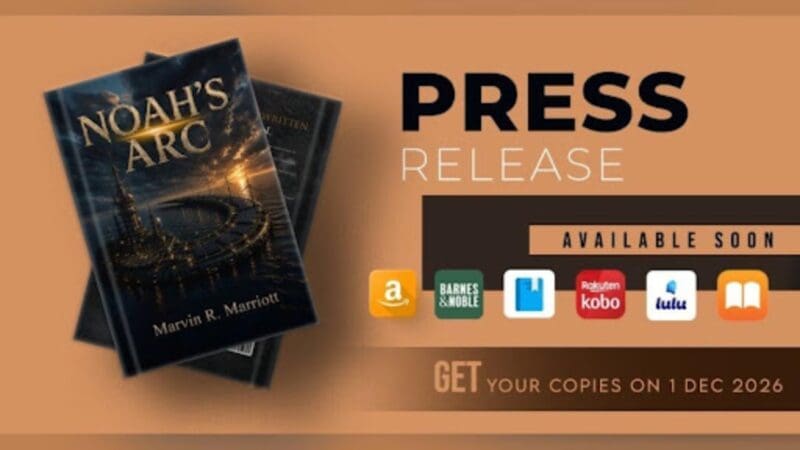
Marvin R. Marriott brings more than three decades of real-world crisis and safety leadership to this exact dilemma in his debut novel, Noah’s Arc. After retiring as a Director in the Office of System Safety at MTA New York City Transit, Marriott turned a lifelong curiosity about science, human behavior, and faith into a gripping speculative thriller launching December 1. In this interview, he discusses how his background in high-stakes emergency response shaped the book and why human judgment remains irreplaceable.
Q: You spent over 30 years managing transportation safety, accident investigations, and emergency response at MTA New York City Transit. How did your career handling complex, high-stakes systems influence the way you built the underwater sanctuary in Noah’s Arc?
Marvin R. Marriott: When I began my career with MTA New York City Transit, I started as a trackworker and worked my way up through the ranks. That experience gave me the foundation in construction, engineering, structural design, and the technical specifications required to help operate and maintain one of the world’s most complex transportation systems.
I think most people would be surprised by the complexity of engineering, planning, and precision required to keep the New York City subway system running. It’s truly an engineering masterpiece, and having the opportunity to understand a lot of its design gave me a unique perspective.
Combining that practical experience with my college education, my love of science and mathematics, and all my years in the transportation industry helped me design the fictional Arc with a sense of realism. I wanted to create something extraordinary and unique yet grounded in enough real-life principles to make it believable.
My goal was never simply to create an impressive underwater sanctuary. I wanted readers to consider the technology behind it and think, “Hmm, you know what? That might actually be possible.”
Q: In the novel, the supercomputer AGNES can calculate almost anything, yet it still requires Dr. Olivia Noah and the temporal centrifuge to evaluate prospective survivors. What does this partnership say about the limits of artificial intelligence in making moral decisions?
Marvin R. Marriott: I believe artificial intelligence has an important role in our everyday lives. Its ability to process enormous amounts of information and provide knowledge almost instantaneously is truly remarkable. However, despite these extraordinary capabilities, I believe AI has limitations, particularly in understanding human morality.
To me, morality is birthed and developed in the human soul. No matter how intelligent or technologically advanced a machine becomes, it can not truly understand the human heart or the spiritual foundation of right and wrong.
That is why, despite the close relationship (almost a love) between AGNES and Dr. Olivia Noah, I deliberately wanted the final stages of selecting humanity’s survivors to involve human judgment. The temporal centrifuge lets Olivia bring something AGNES cannot calculate: empathy, compassion, moral understanding, and the ability to recognize the complexities of human nature.
I wanted the readers to understand that intelligence and wisdom are not necessarily the same thing. AGNES may be able to calculate the probability of someone’s actions, but does that mean it can truly understand their intentions, their capacity for forgiveness, or their ability to change?
Ultimately, the question must be asked:
Just because of artificial intelligence’s abilities, should we give it the authority to decide human worth and morality?
That question is at the very heart of Noah’s Arc.
Q: Olivia witnesses people’s past mistakes and future sacrifices before deciding their fate. What drew you to explore the moral tension of judging a person’s worth based on their potential usefulness?
Marvin R. Marriott: What drew me to explore the moral tension of judging a person’s worth as a determining factor was that, throughout history, we have witnessed countless examples of intelligent, talented, or influential individuals whose decisions have had devastating consequences for humanity. Some of humanity’s greatest tragedies have resulted from brilliant minds using their abilities for destructive purposes.
When faced with the responsibility of selecting individuals who would contribute to humanity’s survival, what should be the ultimate determining factor?
Through the temporal centrifuge, Olivia gains the extraordinary ability to glimpse a person’s future. This allows her to look beyond appearances, accomplishments, and even mistakes to better understand an individual’s character, intentions, and the choices they might make when faced with extraordinary circumstances.
I wanted Olivia to recognize that a person’s true value cannot always be measured by what they know or what they have accomplished. But should knowing someone’s future determine whether or not they deserve one?
I believe that if Noah’s Arc and Dr. Olivia Noah truly existed, choosing individuals to inhabit the facility would not be as simple as making a moral judgment.
Q: Your Christian faith plays a central role in the story, particularly through Olivia’s struggle to reconcile a loving Creator with human cruelty and free will. Why was it important to anchor a futuristic sci-fi novel in these spiritual questions?
Marvin R. Marriott: Olivia’s spiritual struggle is not very different from what many of us experience in our own lives, myself included. We live in a time when television, social media, and the internet bring the entire world to us daily. Every day, we witness wars, violence, cruelty, suffering, and unimaginable acts of inhumanity. It is difficult to observe these tragedies without sometimes questioning our faith and asking, “Where was God when this happened?” or “Why would a loving God allow such suffering?”
From the biblical story of Cain killing his brother Abel, mankind has demonstrated great cruelty toward one another. Despite centuries of progress, education, and technological advancement, we continue to struggle with the same moral failures.
As a Christian, I believe God created humanity with the gift of free will. We have the freedom to choose between right and wrong, between compassion and cruelty, and between building a better world or destroying the one we have been given.
One of the greatest challenges of faith is understanding that the existence of suffering does not necessarily mean the absence of God. Sometimes, in our darkest moments, His love, grace, and forgiveness give us the strength to endure, heal, and face another day with hope.
That is why I felt it was important to include these spiritual questions in Noah’s Arc. I wanted to create more than a futuristic story about extraordinary technology and humanity’s struggle for survival. I wanted to explore the conflict between our technological achievements and our spiritual responsibilities. I tried to achieve that through Olivia. She is a brilliant scientist who believes in evidence, logic, and reason, yet she finds herself confronting questions that science alone cannot answer. Her journey reflects something I believe many of us experience: trying to reconcile God’s goodness with humanity’s imperfections.
Ultimately, I wanted readers to consider that perhaps the greatest threat to humanity is not our inability to advance technologically, but our failure to grow morally and spiritually.
Q: Amid the threat of global collapse, you made sure to include everyday moments inside the Arc, from jazz sessions to walks through hydroponic gardens. Why do those ordinary pleasures matter when imagining a civilization worth saving?
Marvin R. Marriott: Because, ultimately, those ordinary moments are what make life worth living. We often become so consumed by our responsibilities, ambitions, and the challenges of everyday life that we overlook the simple pleasures that give our lives meaning and remind us what it truly means to be human.
In Noah’s Arc, I wanted to emphasize that preserving humanity involves much more than simply surviving. What good would it be to save civilization if we lost the very things that make life meaningful?
The jazz sessions, hydroponic gardens, and other everyday experiences aboard the Arc remind us that if humanity is worth saving, then so are the love, laughter, music, beauty, and ordinary moments that make our existence worthwhile.
Q: You brought Noah’s Arc to life after retirement, drawing encouragement from your granddaughter, Amelia. What inspired you to finally turn this long-held idea into your debut novel now?
Marvin R. Marriott: For most of my adult life, my career and personal responsibilities demanded a tremendous amount of my time and attention. Working in a field where safety, emergencies, and critical decisions were part of everyday life meant that my cellphone and laptop had practically become permanent extensions of me. Even when I wasn’t physically at work, my responsibilities were never very far away.
The precious moments I spent with my granddaughter, Amelia, were the exception to what had become my daily routine.
There is something extraordinary about a child’s innocence and unconditional love. Amelia has an incredible ability to make the weight of the world disappear with something as simple as a smile. Those moments gave me an opportunity to reflect on my life, my dreams, and the things I had always wanted to accomplish but kept postponing.
I traveled with the idea of Noah’s Arc for more than 25 years. Over time, I had developed characters, imagined extraordinary technologies, and envisioned an entire world, but I never seemed to have the time or mental freedom to bring it all together. Retirement finally gave me that opportunity. In fact, less than a week after retiring, I began writing Noah’s Arc. What had existed only in my imagination for decades was finally becoming a reality, one page at a time.
I think Amelia’s greatest influence was reminding me that life is about more than responsibilities and accomplishments. It’s also about seeing the joy on her face on a warm, sunny day while we’re both running through the sprinklers in the park. That is one of the best ways to make the most of the time God has blessed us with.
Through Noah’s Arc, Marvin R. Marriott examines what happens when humanity tries to engineer its own salvation. Drawing on decades of experience in system safety and a deep appreciation for human complexity, his perspective highlights a vital truth: technology can build a shelter, but only empathy, accountability, and free will can make it a home.
As artificial intelligence takes on a larger role in shaping our real-world decisions, the questions at the heart of Marriott’s novel become even more relevant. Protecting the future requires more than advanced systems and strict logic. Noah’s Arc challenges readers to look closely at what truly defines human value before we let algorithms decide for us.
Get a copy at https://www.kobo.com/in/en/ebook/noah-s-arc-2


