


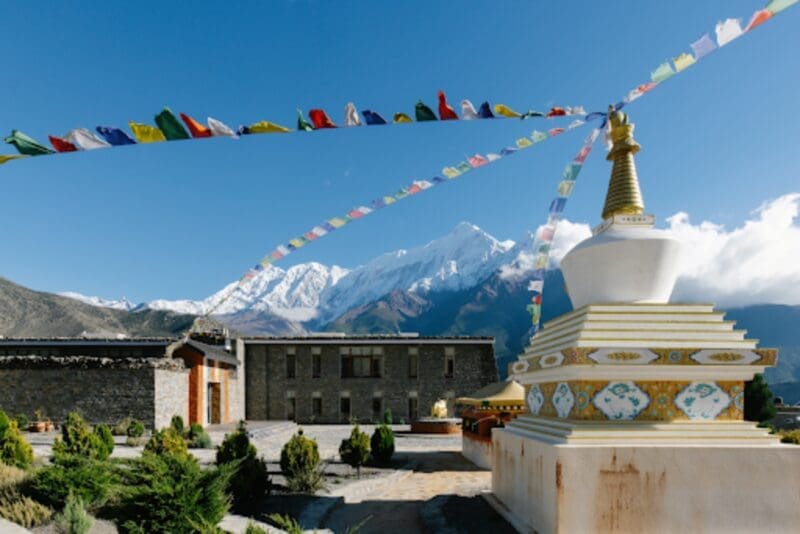

Shinta Mani Mustang receiving the ‘Best Hotel in the World’ award from Robb Report feels like a seminal moment for Nepal’s travel industry. Unlike neighbouring Bhutan, whose luxury travel industry is well established, the country evolved in the ’60s and ’70s as a budget travel destination favoured by backpacking ‘hippies’, ‘dirtbag’ mountaineers and committed hikers. As recently as 2015, Nepal’s mountain accommodation was synonymous with the Nepali teahouse – super-budget accommodation that, albeit delivered with care and dedication, featured shared facilities, paper-thin walls, long-drop toilets and bedding that might be changed on a weekly basis.
With the Bill Bensley-designed Shinta Mani Mustang, Nepal finally has a mountain property to rival Bhutan’s embarrassment of riches in the luxury lodge space, with the likes of Six Senses and Aman offering experiential stays in the kingdom. Shinta Mani Mustang, perched on a ridge above the town of Jomsom (best known as the finishing point for the Annapurna trek), is the latest offering from Nepali travel industry pioneer Namgyal Sherpa (whose mother was the first Nepali woman to climb Mount Everest). His portfolio also includes Le Sherpa in Kathmandu and the Mountain Lodges of Nepal. As you would expect, the hotel has been beautifully designed by Bill Bensley, but it is the experiences the hotel has designed for guests that really stand out, from the Tibetan doctor to the beautiful lunch cooked by Didi Kamala in the nearby village of Marpha. A worthwhile extension is a helicopter flight to Upper Mustang and the walled city of Lo Manthang, often known as the Last Forbidden Kingdom, which only opened to the outside world in 1992.
In the Everest region, the Mountain Lodges of Nepal have reimagined the world’s most famous trek for a new generation of visitors seeking more comfort and amenities on their trek to the bottom of the world’s highest mountain. Built in traditional Khumbu stone style, the lodges’ bedrooms feature en suite bathrooms, wooden double or twin beds with quality linens and electric blankets, while their dining rooms serve Nepali and modern cuisine in warm surroundings. Currently, the group has five lodges on the trail itself, with more to come higher up, no doubt. The Everest region’s original luxury classic, Hotel Everest View, was built in the 1970s and is still popular, with all its rooms offering views of the Everest massif. The views are incredible in the morning and evening as the sun comes up and goes down.
The Happy House is fast gaining a reputation as one of the must-visit places in Nepal. Located in Phaplu, the house was a favourite of Sir Edmund Hillary, who used the property as his base while overseeing various projects in Nepal. Restored in 2017 by Ang Tshering Lama, it is now one of Nepal’s most distinctive luxury retreats.
In Nepal’s western lowlands, near the border with India, the Edwards family continue to build on their father Jim’s Tiger Tops legacy with their excellent property, Tiger Tops Karnali Lodge, on the edge of Bardia National Park. Here, guests can experience one of the quietest and most authentic tiger safaris, where Asian rhinos, elephants and leopards are among the other sightings on offer. Now run by Jack Edwards, the lodge group pioneered ecotourism in Nepal and continues to offer some of the most exciting safari expeditions, including their Babai River safari, where guests travel by boat to tented camps along the famous Babai River.
In Kathmandu, the standout luxury property remains Dwarika’s, one of the best heritage hotels in South Asia, famous for its Newari-style restoration project and Krishnarpan restaurant, where guests can sample a 21-course tasting menu inspired by food from Nepal’s regions.
True Summit Adventures, the luxury travel company founded by British adventurer and mountaineer Oliver Browne, is one of the companies bringing these properties to their clients and tying them together with seamless logistics, the best experiences and exceptional guides. Kami Rita Sherpa, the world record holder for the most summits of Everest (32), is their Head Guide. Their Nepal itineraries encompass trekking, mountaineering and ‘pure’ adventures that are multi-destination and multi-activity epics. Guests might start at Shinta Mani Mustang before embarking on an ‘express’, four-day version of the luxury Everest Base Camp trek, flying to Base Camp by helicopter as part of a scenic flight and then continuing to Bardia to see a tiger. The journey starts and finishes at Dwarika’s. Along the way, True Summit introduces the personalities that make Nepal such a compelling destination.
