


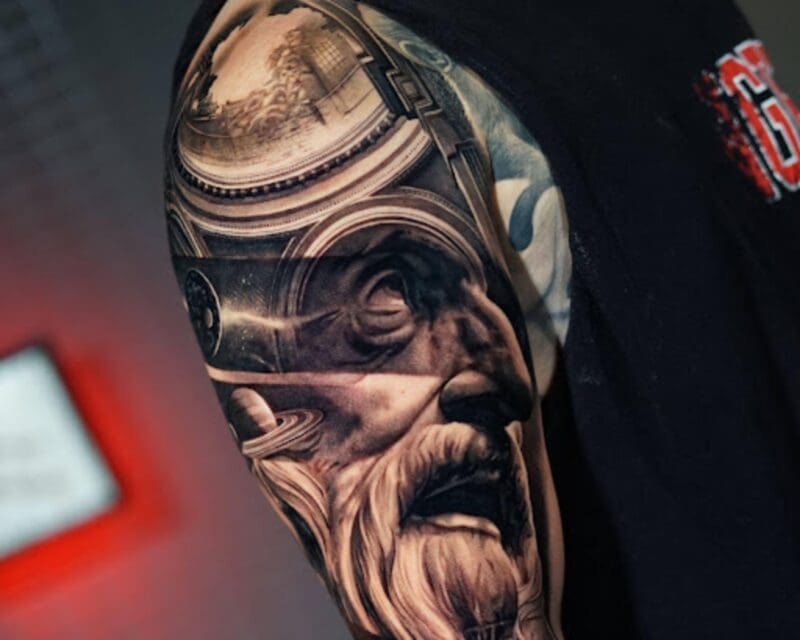

Some tattoo artists find the trade. Sergio Salas grew up inside it. The Madrid based artist, who has over 66,000 followers on Instagram, is known globally for his tattoo work. The Spanish tattoo artist has been inking for half his life, a career that began long before he picked up an ink gun. Instead, he was watching his father work.
“My father is a tattoo artist, and every day, I would sit next to him and watch how he drew the next design,” Salas says. “I would sit and draw alongside him. I always drew from a young age.”
His father, tattoo artist Ángel Salas, who still works as a tattoo artist under the moniker Angel Grial, runs the Grial Tattoo Parlor in Madrid, which he founded 25 years ago.
As a teenager, Salas painted graffiti and murals with friends. He never did it professionally. He was a kid who liked the idea of painting a wall that would stay on view for a while. Then, at 16, his father tattooed him for the first time, probably the coolest thing that can happen to a teenager. “All my friends wanted to get tattooed,” Salas recalls. What drew him to tattooing was being able to create something on a person’s skin that would endure over time. He never started out trying to succeed at anything. He just liked it, and it held his attention. He entered the trade that same year.
At 19, Salas began working the tattoo convention circuit, which provides international exposure, a steady clientele and networking benefits for tattoo artists. It was at a moment when the industry still ran on handshakes, rather than social feeds. “It was 2013, so Instagram had just started,” he says. “The conventions were for getting to know tattoo artists from all over the world, since social media was not booming yet.”
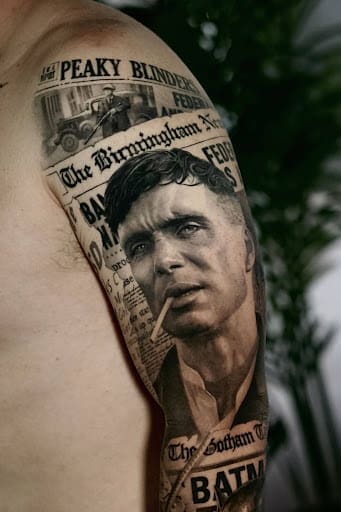

His audience grew the slow way, one healed piece at a time, across conventions in Spain, Italy, Switzerland and Germany. The turning points, when they came, were people rather than platforms. In 2020 Spanish influencer Juan Faro, known for fitness and his luxury car raffles, with over 350,000 followers, became the first famous client Salas tattooed. Faro commissioned a full body project of film actors and movie scenes, and Salas set the portraits against newspaper backgrounds so the work would hold its contrast on Faro’s skin. Piece after piece went viral.
“Every tattoo I did on him went viral, and many clients wanted to get the same thing, because it attracts so much attention,” he says. The newspaper style cinema pieces are what clients ask him for, and they are what went most viral for him, though Salas is known above all for his realism and his large scale compositions, not for cinema figures alone. Salas’ own hyper realistic tattoo style is bold, cinematic, and Film Noir-esque. He takes inspiration from his father’s own realistic portraiture, but gives them his own edge.
His personal path explains why. First came his father, the artist he still names before all others. Then the realism masters he studied as a young tattooist, among them Carlos Torres, Gogüe and Dmitriy Samohin, followed by the composition driven work of Florian Karg and Tommy Lee Wendtner. “I have always liked creating something, not realism on its own, taking a photo and copying it exactly as it is,” Salas says. “I have always liked composition and shadows.”
Artists such as Arlo Tattoos and Jak Connolly, he says, opened his mind to what a composition could be. Among Spanish artists he names Okami Tattoo, a longtime collaborator, Franky Lozano, Jumilla Olivares, Miguel Bohigues and Matías Noble.
His client list now runs to celebrities. He has tattooed barber and influencer Luis Andrés Rivera, who has over 1.5 million followers, and wildlife expert Mike Holston, who has more than 17 million followers, and his friendships with both have introduced his work to a broader American audience.
He has also tattooed Puerto Rican singer Arcángel, and the photographs of that work travelled across the Americas. Work with NFL player Sauce Gardner and YouTuber Willy Rex followed, and singer Mike Bahía has contacted Salas, by message and in person, about a full leg project he has not yet begun.
Ask Salas what clients actually ask for, and the answer is not a design. It is time. “My goal as an artist is always for the tattoo to flow on their body, that everything is connected, that it can be seen and understood well from far away and up close, and that the tattoo still holds its visual power, even after 20 years has passed,” he says. “Skin is not a sheet of paper. It changes with the passing of the years, the ink expands a little, the micro details disappear. It is like making a made to measure suit.”
That patience is also his position in an industry flooded with copied and filtered images. “Nowadays, if you have your own style and originality, you can manage to be someone recognised,” he says. “If a person alters the final photo and the tattoo looks better in the photo than in person, clients will stop coming when they see their tattoo is not the same. The good thing about tattooing is that it speaks for itself with the passing of time.”


