


How AI is exposing the hidden cost of fragmented software and why millions of small businesses need a new digital foundation
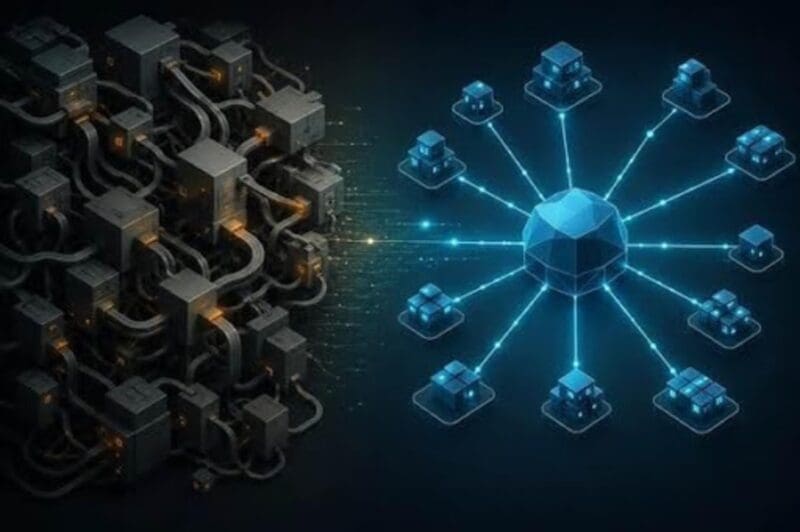
From fragmented software systems to unified business infrastructure: AI is accelerating the need for connected operational data and workflows. Illustration generated using OpenAI’s ChatGPT.
Why This Moment Matters
As artificial intelligence transitions from a subject of boardroom experimentation to the engine of everyday business operations, millions of small and medium-sized businesses (SMBs) are confronting a new reality. The defining challenge of this era is no longer merely about accessing AI; it is about possessing the digital infrastructure required to use it effectively.
For decades, every major shift in computing has created a new layer of business infrastructure. The internet changed how companies reached customers. Cloud computing changed where software operated. Mobile technology changed how people interacted with businesses. Now, artificial intelligence is poised to create the next major transformation.
However, the bottleneck may not be the creation of increasingly powerful AI models. The challenge lies in enabling millions of organizations to actually deploy those capabilities in their daily operations.
This shift is attracting significant institutional attention. Goldman Sachs recently announced a $500 million commitment to expand its 10,000 Small Businesses initiative, including the launch of its Small Business AI Institute. The initiative reflects growing recognition that helping small businesses adopt and implement AI will be an important part of the next phase of economic growth.
At the same time, much of the early enterprise AI deployment effort has been concentrated among organizations with significant technical resources. Large corporations are increasingly investing in dedicated AI teams, specialized engineering capabilities, and customized implementation programs to integrate AI into their operations. For these organizations, the challenge is often scaling deployment.
For small and medium-sized businesses, the challenge is fundamentally different. The bottleneck is rarely access to AI models themselves. The challenge is implementation: connecting business data, integrating existing systems, and creating reliable workflows that allow AI to operate within the context of the business.
Most small businesses cannot realistically justify hiring dedicated AI engineers to evaluate models, build integrations, maintain agent infrastructure, and continuously optimize workflows. The challenge is not AI capability. The challenge is business context. When critical information is fragmented across disconnected applications, AI systems cannot reliably understand the complete picture required to execute meaningful business processes.
This highlights an emerging reality: AI adoption is moving from isolated experimentation toward broad economic participation.
Yet a fundamental gap remains between simply having AI tools and being truly AI-ready. A business can subscribe to a generative AI assistant to draft emails or summarize meetings, but that is fundamentally different from having an operational environment where AI can manage workflows, analyze connected business data, and execute meaningful business logic.
The question facing millions of businesses is no longer simply, “What can AI do?”
The more practical, and far more difficult, question is: “How can a business actually put AI to work?”
The answer requires looking backward at the hidden costs of the software systems businesses have accumulated over time.
The Integration Tax: The Hidden Cost of Fragmented Software
Every generation of business software has solved one problem while creating another. Over the last two decades, the prevailing philosophy for business technology was specialization. Companies built and sold excellent individual tools for specific functions: one for customer relationship management (CRM), another for accounting, another for e-commerce, and another for team communication. This created a powerful ecosystem of best-of-breed applications.
For large enterprises with dedicated IT departments, data engineers, and systems architects, this model remains highly effective. They have the resources to evaluate, deploy, and maintain complex webs of APIs, middleware, and custom integrations. But for the average small business, this model has created a silent crisis of complexity.
Businesses have accumulated software one application at a time. A CRM is added because customer management becomes difficult. An e-commerce system is added because sales expand. A project management tool is introduced to track operations. Each decision makes sense individually, but the complexity emerges over time. Because these applications were not originally designed around a shared operational context, the business itself becomes responsible for connecting the information between them.
In many small businesses, employees have effectively become the integration layer between disconnected systems. They copy information between systems, reconcile conflicting records, and maintain manual workflows that software was originally supposed to simplify. For years, this approach was acceptable because humans could interpret missing context. A salesperson could look at several disconnected applications and intuitively understand the complete customer relationship.
The hidden cost of maintaining dozens of disconnected applications is increasingly described as the “integration tax.” This tax is not only the financial cost of purchasing and connecting applications; it includes the massive operational cost of maintaining those connections, ensuring data accuracy, and adapting workflows every time one system updates. Small businesses often absorb this burden through duplicated data, broken automations, and manual reconciliation. AI has not created this problem, but it is making the cost far more visible because autonomous systems depend on consistent business context.
Why AI is Forcing a Software Architecture Shift
The emergence of artificial intelligence is forcing the software industry to reconsider a fundamental question: Should businesses continue connecting more applications, or should they rethink how business software itself is designed?
AI introduces a new architectural requirement. Software must do more than store information; AI-powered workflows need access to the relationships between information. Traditional SaaS applications were often designed around individual business functions, with humans responsible for interpreting missing context and connecting processes.
Large enterprises can often overcome fragmented systems by investing in data teams, AI engineers, consultants, and custom integrations. They have the resources to connect systems, maintain data pipelines, and build specialized AI workflows.
For small and medium-sized businesses, this approach is often impractical. The technical resources needed to connect applications, maintain reliable data flows, and support AI-driven operations may exceed what smaller organizations can reasonably manage.
This is where the gap between having AI tools and being AI-ready becomes most visible.
For enterprises, this gap can often be closed through investment in specialized teams and infrastructure. For SMBs, the solution may increasingly come from platforms that make these capabilities accessible by design.
Consider the modern CRM. In a fragmented system, a customer may be represented primarily by a name and an email address in a database. But in reality, a customer’s relationship with a business is multidimensional. That same customer may also be a previous buyer, an active community member, an event participant, and a business partner interacting across multiple channels.
An AI assistant managing that relationship needs more than a static contact record. It requires access to relevant communication history, purchase behavior, service information, contracts, and financial context to understand the complete relationship.
If that information is fragmented across multiple SaaS applications, reliable autonomous workflows become significantly more difficult because the AI must first reconstruct the missing business context. The result is that businesses often need additional human intervention, integration work, and technical resources before AI can deliver meaningful operational value.
The software industry is responding to this architectural challenge in several ways. Some vendors continue expanding their integration ecosystems, relying on APIs and middleware to connect disparate tools. Others are exploring interoperability standards such as the Model Context Protocol (MCP), which can help AI systems interact with external applications. Integration platforms are evolving to support AI-driven workflows. Meanwhile, some companies are redesigning products around unified business data models intended to reduce internal handoffs and provide a more consistent operational context.
The Emergence of the Business Operating System
If the integration tax represents the problem, the business operating system represents one possible response.
The idea of a business operating system marks a shift in how companies think about software. Instead of asking, “Which application should solve this individual problem?” businesses are beginning to ask, “What digital foundation allows all parts of my business to work together?”
A business operating system is not simply another application added to an already crowded tech stack. It is a connected foundation designed to eliminate the friction between core business capabilities. It brings together areas such as customer relationships, commerce and transactions, communication, collaboration and operations, community engagement, digital identity, analytics, and automation.
The value of this approach is not found in having more features, but in reducing the friction between them. When information flows naturally across the organization within a single operational data model, businesses can operate with fewer manual processes. More importantly, they create the structured, context-rich environment that AI requires to function effectively. This does not mean every business will abandon specialized tools, but the core business environment increasingly requires a connected foundation where critical functions operate together seamlessly.
idhubs: One Example of a Unified Business Platform Approach
One company pursuing this unified architecture approach is idhubs, a platform focused on helping small and medium-sized businesses operate through a connected digital environment.

idhubs describes its platform as a “Growth OS,” designed to bring together multiple business capabilities within one connected ecosystem. According to the company, CRM, contracts, invoicing, commerce, projects, and community capabilities share one operational data model.
Rather than positioning itself as another individual application, the platform brings together capabilities across business operations, community management, commerce, professional presence, and digital identity.
According to Rojit Sorokhaibam, AI performs more reliably when business information resides in one operational environment rather than being synchronized across multiple systems. He believes the industry has historically focused on connecting applications after they were built, rather than designing business systems around shared context from the beginning. “Most of the industry taught separate databases to talk to each other and called it integration,” Sorokhaibam notes.
This broader challenge is also reflected in the observations of Brandon Fears, who works with idhubs on growth strategy and engages with business owners navigating increasingly complex digital environments. “Business owners didn’t choose complexity. They inherited it one application at a time,” Fears observes, highlighting the broader industry challenge of software fragmentation.
A common concern with unified platforms is flexibility. Businesses have unique workflows, and a rigid system may fail to accommodate them. idhubs addresses this by combining a standardized platform foundation with targeted custom development and integration services for organizations with specialized operational requirements. The company positions these capabilities as an extension layer that allows organizations with specialized requirements to adapt the platform while preserving the benefits of a standardized architecture.
Why Distribution May Define the Winners
Building the right technology is only one part of the small business AI adoption challenge. The second, and perhaps equally critical, challenge is distribution.
Unlike large enterprises, which have dedicated technology teams evaluating new platforms, many small businesses discover technology through trusted relationships. A local business owner may not be searching for a “new operating system.” They simply know that customer information is scattered, administrative work consumes too much time, and software subscriptions continue to increase.
This creates an important question for companies building small business technology: How do you reach millions of businesses that do not have the time or resources to evaluate complex software decisions?
One potential answer lies in organizations that already connect businesses together. Chambers of commerce, industry associations, and business communities have historically played an important role in helping businesses access resources and education. As digital transformation accelerates, these organizations are becoming increasingly vital distribution channels for business technology.
A platform that enables a chamber or association to modernize its own operations can create value beyond a single organization. It creates a shared digital environment where members, partners, and communities participate together. For small businesses, trust is often as important as technology capability. A business owner may hesitate to adopt a new platform discovered through digital advertising, but will be far more receptive when the recommendation comes through an organization they already know and trust. Technology alone is not enough; distribution through trusted networks may ultimately define the winners in the SMB software market.
The Investor Questions Defining the Category
As the market for AI-enabled business software develops, investors are evaluating companies in this category through a different lens. The question is no longer simply whether a company has AI capabilities. Almost every software company will eventually answer yes.
The more important questions are beginning to focus on whether these companies are building durable infrastructure, solving a meaningful adoption barrier, and creating a platform that can scale across millions of businesses.
Is this another SaaS category or a new infrastructure layer?
One of the first questions investors will consider is whether these companies represent another generation of SaaS applications or a new infrastructure layer for business operations.
Many software companies compete by adding features to an existing, fragmented technology stack. Infrastructure companies compete by becoming the foundation on which organizations operate.
If a platform becomes deeply connected to customer relationships, workflows, transactions, operational data, and business processes, its value extends beyond individual features. It becomes part of the organization’s operating environment.
The long-term opportunity in this category is based on the idea that the next generation of business software may not be defined by the number of applications a company uses, but by how effectively those applications, people, and intelligent systems work together.
Can AI infrastructure efficiently reach the SMB market?
The small and medium-sized business market represents a substantial opportunity for AI-enabled business platforms. However, the size of the market alone does not establish whether a company can serve it profitably.
For investors, the critical question is whether customer acquisition and onboarding costs can remain economically sustainable as adoption expands. A platform may offer compelling technology, but its growth potential depends on how efficiently it converts market demand into paying customers and recurring revenue.
Traditional direct sales models can be expensive when serving smaller organizations with relatively modest software budgets. This makes alternative distribution strategies, including partnerships with chambers of commerce, industry associations, and professional networks, particularly relevant.
The investment case for these channels depends on measurable performance. How many member businesses become active users? What percentage convert into paying customers? How much does onboarding cost? Can the platform expand across additional organizations without proportionally increasing sales and support expenses?
These questions distinguish a promising distribution strategy from a scalable business model. Companies that demonstrate repeatable customer acquisition, efficient onboarding, strong retention, and sustainable expansion economics may be better positioned to translate the SMB market opportunity into long-term growth.
Can the company scale while maintaining flexibility?
Scalability is one of the central challenges facing business operating system platforms.
The next generation of business software cannot be purely rigid. Every organization has unique workflows, existing processes, and industry-specific requirements.
However, it also cannot become an unscalable custom development model where every customer requires a completely different solution.
The balance lies in maintaining a standardized platform foundation while allowing controlled customization and extensions where necessary.
Successful platforms will likely need a common architecture that enables reliability, security, and AI readiness, while providing enough flexibility for organizations to adapt the system to their operational reality.
Can one platform support different types of businesses?
Small businesses are not a single market.
A professional services firm operates differently from a retailer. A chamber of commerce operates differently from an e-commerce company. A nonprofit operates differently from a growing technology business.
A successful business operating system must provide common infrastructure while allowing different organizations to configure workflows around their specific needs.
The objective is not to create one identical operating model for every business. It is to provide a connected foundation where different organizations can build their own digital operating environment.
This balance between common infrastructure and business-specific flexibility will likely be a defining factor in determining which platforms can expand across diverse markets.
What creates long-term defensibility?
As AI models become increasingly accessible, artificial intelligence itself is unlikely to be the primary competitive advantage.
The deeper advantage may come from accumulated operational context, connected data, embedded workflows, and trusted relationships developed over time.
A company with an AI interface alone may be easier to replicate as models continue to evolve. A company that understands how a business operates, how information flows, and how decisions are made creates a more difficult foundation to replace.
The competitive advantage in the AI economy may not belong only to companies with the most advanced models.
It may belong to companies that create the most effective environments for AI to operate inside real businesses.
The Road Ahead
The technology industry has experienced several major transitions, each requiring more than a new technology; each required supporting infrastructure. The internet required networks. Cloud computing required scalable platforms. Mobile technology required new application ecosystems. The AI economy will similarly require business systems capable of turning intelligence into action.
For millions of small businesses entering this new era, the integration tax they have accepted for years may become increasingly difficult to justify. As AI moves deeper into everyday operations, disconnected applications, inconsistent data, and manual workflows could become more than operational inconveniences. They may limit how effectively businesses can adopt and benefit from intelligent automation.
The next generation of business software may therefore be defined less by the number of applications it offers and more by the quality of the digital foundation connecting people, operational data, workflows, and intelligent systems.
The companies that successfully bridge this gap may help define the next generation of business infrastructure for the AI economy.
