


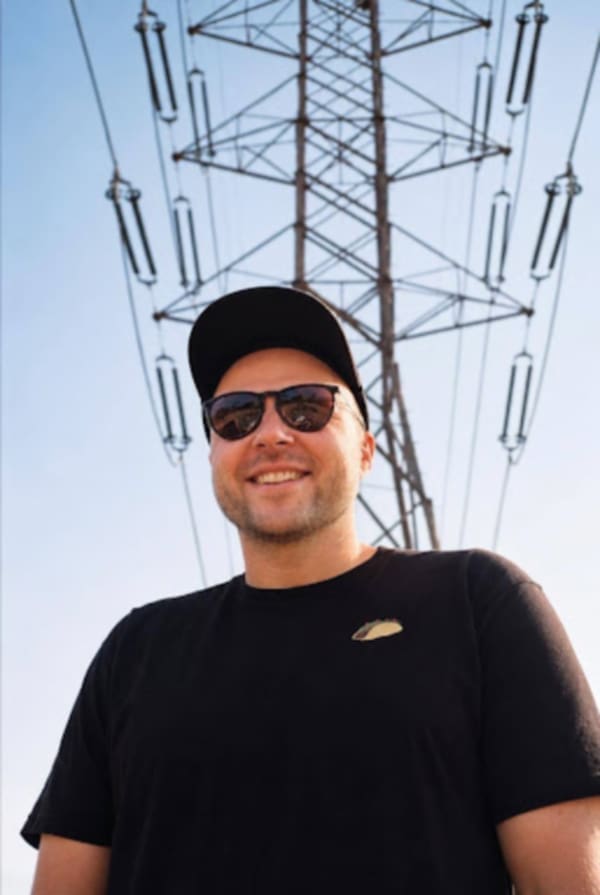

As Los Angeles navigates one of its toughest production slowdowns in years, producer Daniel Shapovalov takes us inside the economics of mounting “Override,” starring Joe Cole and Teagan Croft, and explains how seemingly ordinary moments on screen can require layers of crews, equipment, preparation and infrastructure to make them look effortless.
October 29, 2026
There is a certain kind of movie that looks inexpensive on the page.
Two central characters. A car. Contemporary Los Angeles. No distant planets to build, armies to assemble or period streets to recreate. For Daniel Shapovalov and his production company 552 FILMS, Override initially had many of the characteristics of a contained independent thriller.
Then you start putting a price on what is actually written on those pages.
“A screenplay might say somebody gets into a car, they drive and have a conversation,” Shapovalov says. “You read that sentence in three seconds. Producing those three seconds is a completely different exercise. Where is the car? Is it actually moving? Are you towing it? Are you on a process trailer? Are you on a stage? What is outside the windows? Is it day or night? How many people and how much equipment does each solution require? You start making those decisions and suddenly a very ordinary piece of human activity has an entire economy behind it.”
That became one of the defining realities of Override, the contemporary thriller starring Joe Cole and Teagan Croft that recently completed principal photography in Los Angeles, with 552 FILMS running the physical production.
The movie’s relatively contained premise ultimately required day and night exteriors, practical locations, soundstages, stunt driving, special effects, virtual production and green-screen work. None of those techniques is unusual in filmmaking. The economics come from requiring many of them within the same production.
“You’re not necessarily spending money because something looks spectacular,” Shapovalov says. “You’re spending money because making something look completely normal can require a surprising amount of infrastructure. And every time you change the way you’re shooting, there is another department, another piece of equipment, another crew requirement or another block of preparation behind it.”
One of the clearest examples came from a pivotal action sequence involving Cole’s character and eight other performers, designed to unfold in a single continuous take.
Without conventional edits separating individual pieces of action, Joe Cole, eight performers, camera movement, stunt work and effects had to function as one coordinated sequence. Stunt choreographer Daniel Levitt designed the action around that requirement.
“Danny approached it almost like a dance,” Shapovalov says. “What the audience sees should feel spontaneous and chaotic. Economically, what you’re paying for is everything required to make that spontaneity possible: the stunt team, rehearsals, preparation, the time to coordinate the camera with the performers and effects. If one element doesn’t work, you’re not fixing that individual piece in an edit. You’re doing the sequence again.”
For Shapovalov, it illustrates a counterintuitive part of independent film economics. Preparation costs money, but insufficient preparation can cost considerably more once a production is on the clock.
“Sometimes spending more before the camera rolls is what allows you to spend less while it is rolling,” he says. “That’s why experienced department heads matter so much. The cheapest-looking decision on a spreadsheet isn’t necessarily the cheapest decision by the end of the shooting day.”
Another sequence presented an entirely different calculation.
For a violent car tumble, Special Effects Supervisor James Lorimer and his team employed a massive mechanical rotisserie capable of securing and physically rotating the vehicle. The equipment transformed something designed to appear uncontrolled on screen into an engineered process behind the camera.
“The rotisserie was probably one of my favorite things we did,” Shapovalov says. “You look at this enormous piece of machinery with a car mounted inside it and immediately understand how much exists behind a few seconds of screen time. James and his team can make something that is supposed to feel completely out of control happen in a very controlled way.”
The audience sees a car tumble.
The production sees specialized equipment, transportation, rigging, technicians, safety procedures, preparation, performers and shooting time.
“The audience sees chaos,” Shapovalov says. “We see marks, timing, engineering and dollars.”
Then there are scenes where virtually nothing extraordinary appears to happen at all.
For portions of the film’s dialogue and driving material, 552 FILMS moved production onto a large virtual production stage, placing the vehicle and performers in front of a massive LED wall. Elsewhere, the film returned to practical streets, conventional stages and green-screen work.
To an audience, the result may simply be two people sitting in a car.
“That is probably the funniest part of filmmaking economics,” Shapovalov says. “Sometimes the least impressive sentence when you’re reading the script becomes one of the more complicated things you’re budgeting. Two people driving through Los Angeles and talking sounds free because we all do it every day. Then you’re producing it and suddenly you’re talking about the car, actors, camera, lighting, sound, background, traffic control, permits, safety, transportation, overtime, or whether it makes more sense to bring the whole thing onto a virtual stage.”
The producer’s calculation, he says, is rarely as simple as choosing the least expensive method.
A stage costs money. Moving a company through Los Angeles costs money. Specialized equipment costs money. Crew time costs money. Losing shooting time costs money. The job is deciding which combination makes sense for the sequence and for the production as a whole.
“Complex doesn’t mean impossible,” Shapovalov says. “It means understanding where the money is actually going. You need the right department heads, the right crew and enough prep time. When you have those things, complexity becomes manageable.”
Those calculations are particularly relevant in Los Angeles at a difficult moment for the city’s production economy. Following the prolonged industry shutdowns of 2023, local production has struggled to regain momentum. FilmLA reported in April that first-quarter on-location production remained 8.7 percent below the same period in 2023, despite feature-film activity showing signs of improvement.
Yet having taken Override through locations, stages, specialized equipment, stunt work and multiple production methodologies, Shapovalov argues that Los Angeles’ greatest economic advantage remains its concentration of filmmaking infrastructure and experienced labor.
“There is an enormous concentration of people here who know how to make movies,” he says. “On something like Override, what you need on Tuesday can be completely different from what you need on Wednesday. Having access to experienced crews and vendors across all of those disciplines has an economic value of its own.”
Shapovalov says FilmLA was extremely helpful throughout production and describes working with SAG-AFTRA and IATSE as “a pleasure, as always,” adding that he hopes production in Los Angeles and California continues to recover.

For 552 FILMS, Override ultimately became an exercise in something audiences are rarely supposed to notice: the amount of money, labor and infrastructure required to make filmmaking disappear.
A virtual production wall can ultimately become two people having a conversation in a car. A mechanical rotisserie becomes a few violent seconds. Days of stunt preparation can become a continuous burst of apparently spontaneous action.
That, Shapovalov says, is where the strange economics of filmmaking become clearest.
“The viewer shouldn’t be thinking about our LED wall, how we rotated the car or how we built the stunt. They should believe the car is tumbling. They should believe the action is happening. You can spend an enormous amount of money and employ an enormous number of people to make something look completely natural and effortless. And if we did our jobs right, nobody watching it will ever know.”
