


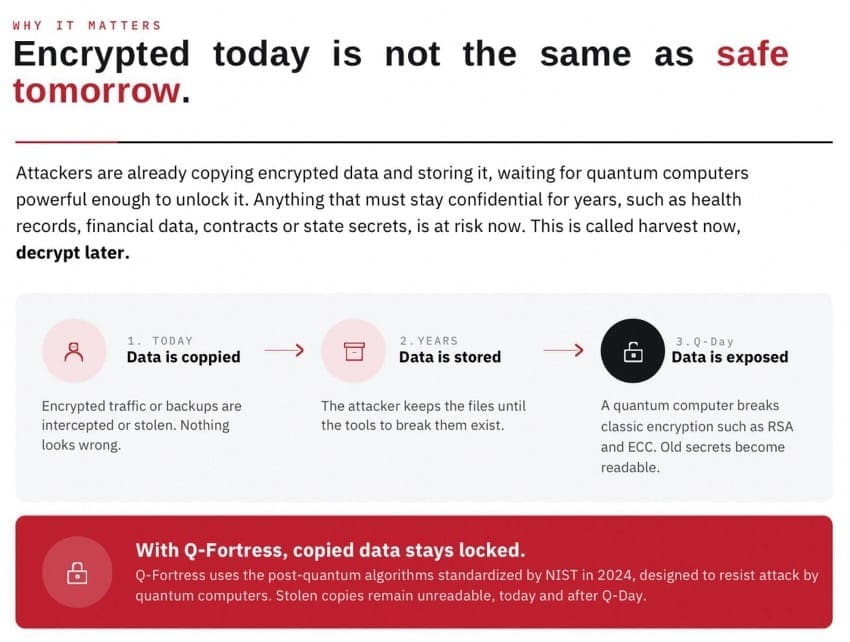
Security teams have a phrase for a threat that has already started but will not pay off for years: harvest now, decrypt later. Attackers copy encrypted data today, store it, and wait for a quantum computer strong enough to open it. For records that must stay secret for a decade or more, such as health files, contracts or state secrets, the damage is in a sense already being done.
Ameritec IPS, a company with its headquarters in Irving, Texas, has built its entire product line around that idea.
From Intrusion Prevention to Post-Quantum
Ameritec says it was founded in 2015 in Houston and describes itself as an intrusion prevention system company. According to its website, it has since added offices in Vietnam and India. Its latest product catalogue presents the business as next-generation security infrastructure for the AI and quantum era.
The portfolio has four parts. Q-Fortress covers data storage, Q-AmFatec handles biometric identity, Q-AMCHAIN is the blockchain layer, and QB-CURE secures digital assets and wallets. The idea is that each product closes a different gap, from the files a hospital keeps for decades to the face a bank uses to verify a customer.
Why the Timing Matters
In August 2024, NIST published its first finalised post-quantum standards, including FIPS 203 (ML-KEM) for key exchange and FIPS 204 (ML-DSA) for digital signatures. Governments have started attaching dates to them. The NSA’s CNSA 2.0 guidance expects new national security system acquisitions to be compliant from January 1, 2027, a deadline Ameritec’s own materials point to.
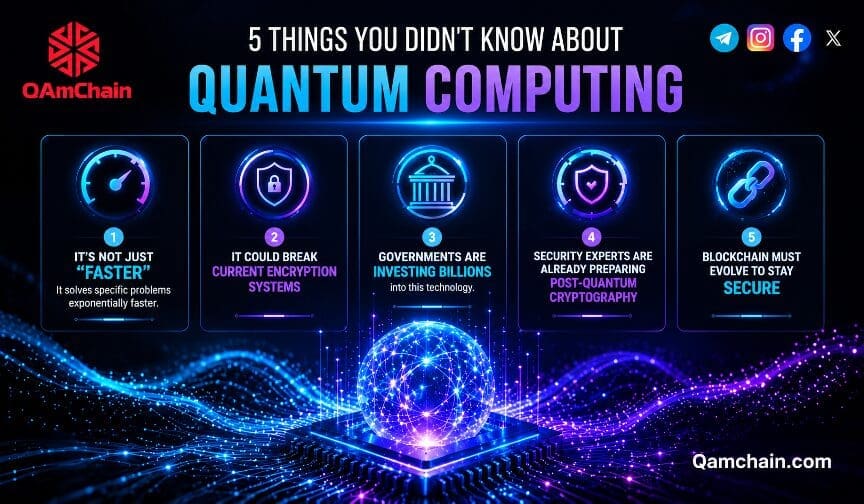 Five points about quantum computing, from Q-AMCHAIN’s social media series. Image: Q-AMCHAIN.
Nobody knows exactly when a quantum computer capable of breaking today’s encryption will arrive, and estimates differ by years. But the harvest-now logic means the arrival date matters less than how long the data needs to stay private.
 Q-AMCHAIN’s own take on the idea: threats that stay hidden until it is too late. Image: Q-AMCHAIN.
Public blockchains are an especially awkward case. Most of them, including the largest networks, secure accounts with elliptic-curve signatures, the kind a powerful quantum computer running Shor’s algorithm could in theory break. And because ledgers are permanent and public, the data an attacker would need is already sitting in plain view. Unlike a company database, a blockchain cannot quietly be locked away while it is upgraded.
What Ameritec Is Building
On the storage side, Q-Fortress sits between applications and their databases. It encrypts records with AES-256-GCM, protects connections with ML-KEM-1024 and ML-DSA-87, and writes every action to a tamper-evident, hash-chained log. ML-KEM-1024 and ML-DSA-87 are the strongest parameter sets in NIST’s standards, rated at its highest security category.
For the blockchain, Q-AMCHAIN replaces the elliptic-curve signatures common across today’s networks with lattice-based primitives. The project says it can reach up to 30,000 transactions per second in optimised benchmark conditions, with sub-second finality targets for simple transfers. Those are design targets rather than independently measured results.
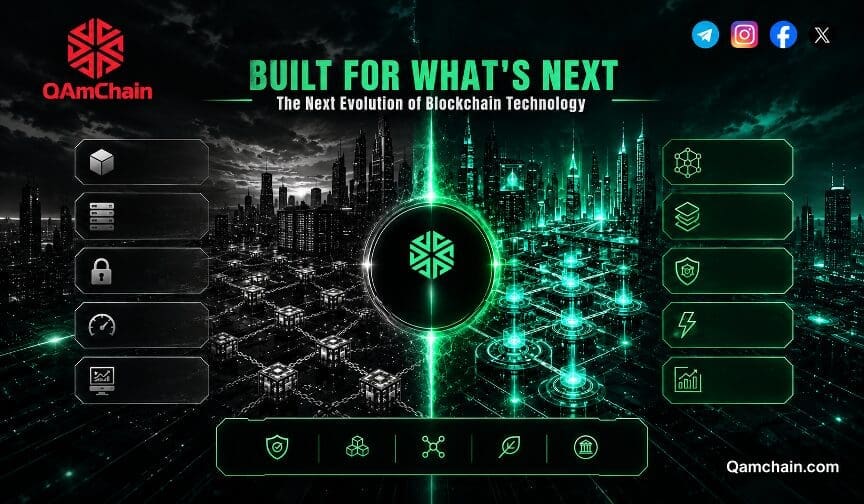 Q-AMCHAIN frames its chain as the next step in blockchain design. Image: Q-AMCHAIN.
The chain’s code went through a CertiK audit this autumn. The report, delivered on October 14, lists 79 findings, all but one of them resolved.
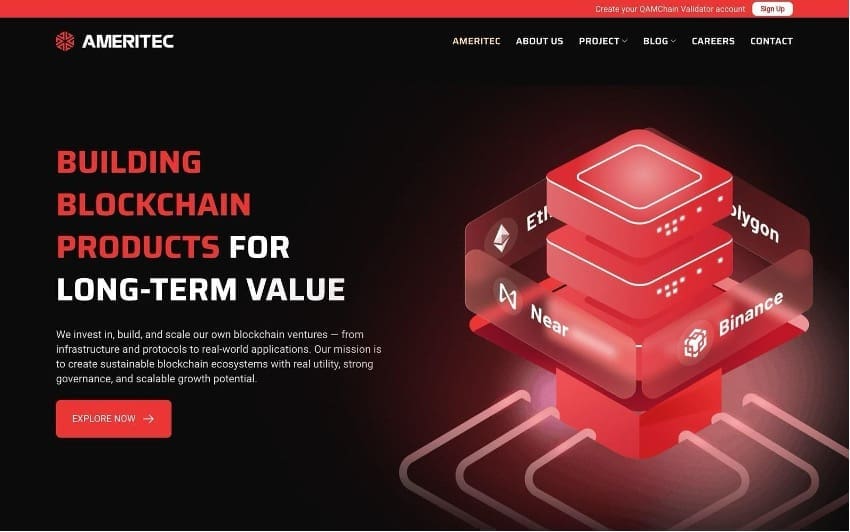 The Ameritec IPS website, which presents the company’s blockchain and post-quantum work. Screenshot: ameritecps.com, October 2026.
The Open Questions
Moving to post-quantum cryptography is not a simple swap. Keys and signatures are larger, which affects storage and bandwidth. Existing systems have to keep running during a migration, which is why Q-AMCHAIN talks about hybrid compatibility for phased adoption. And real deployments, not catalogues, will be the true test of any vendor’s claims.
What stands out about Ameritec’s approach is its breadth. Rather than selling a single encryption library, the company is trying to cover storage, identity, payments and the ledger underneath them with the same set of standards. Whether that works will depend on adoption by the banks, hospitals, data centres and government agencies it is targeting.
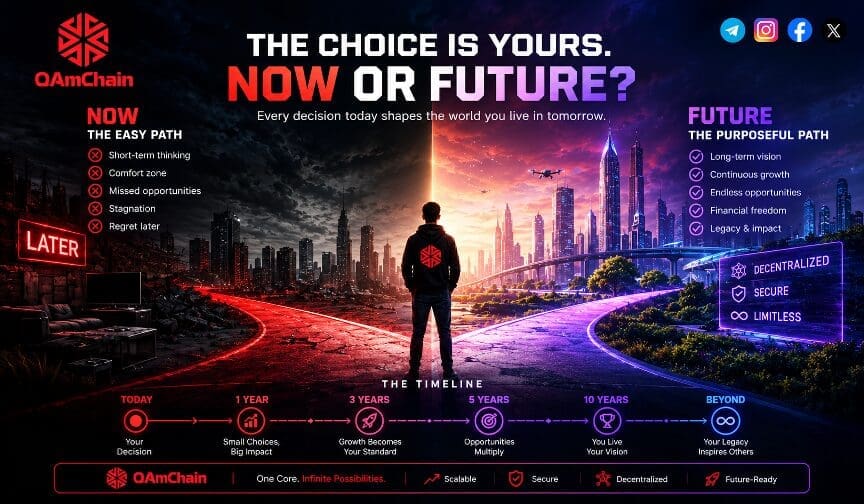 A Q-AMCHAIN graphic on acting now versus later, set out as a timeline. Image: Q-AMCHAIN.
The blockchain side of the business, including its roadmap and technical overview, is described on qamchain.com.
