





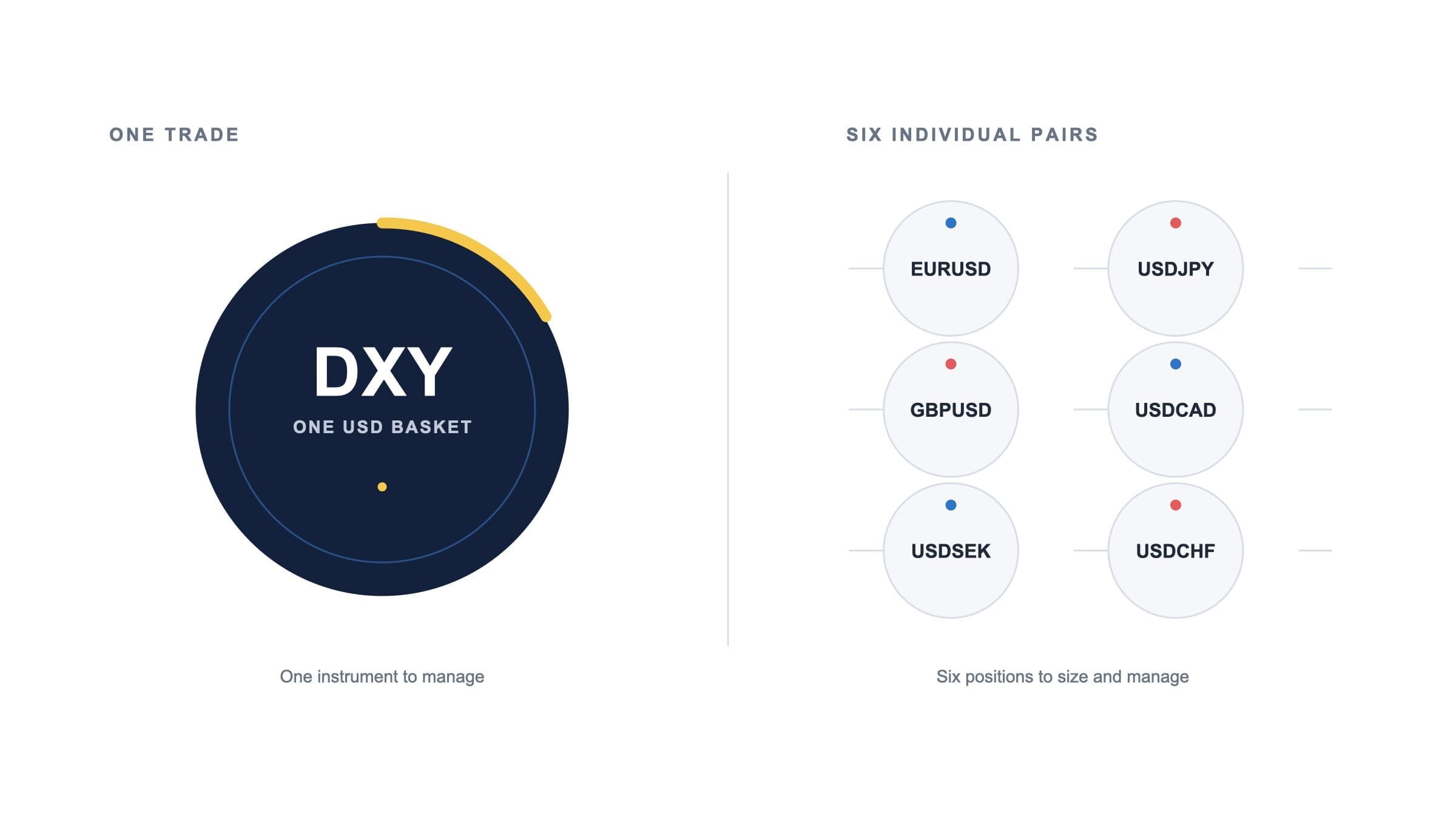
A trader expecting the US dollar to strengthen can express that view through one DXY position or several individual currency pairs. The first option concentrates the idea in one instrument. The second divides it among EURUSD, USDJPY, GBPUSD, USDCAD, USDSEK and USDCHF.
One DXY trade is generally simpler to open, monitor and close. It involves one chart, one position and one applicable spread. Six currency-pair trades provide more control, but require separate position sizes, orders and cost calculations.
The two approaches are not automatically equivalent. Reproducing DXY with forex pairs requires the direction and size of every position to reflect the index’s currency weights.
The short comparison
| Factor | One DXY position | Six USD-pair positions |
| Number of positions | One | Six |
| Instruments to monitor | One index | Six currency pairs |
| Initial spreads | One applicable DXY spread | One applicable spread on each opened pair |
| Position sizing | One trade size | Six independently calculated sizes |
| Exposure | Fixed DXY currency basket | Customisable |
| Order management | One stop, target and exit | Up to six stops, targets and exits |
| Main advantage | Operational simplicity | Greater control |
| Main limitation | Fixed currency weights | More execution and cost variables |
| Best suited to | A broad view on dollar strength | A selective or customised USD strategy |
The operational answer is therefore straightforward: one DXY trade is simpler. The strategic answer depends on whether the trader wants the fixed DXY basket or customised exposure to individual currencies.
What one DXY position represents
The ICE U.S. Dollar Index measures the dollar against six currencies using a geometrically weighted calculation. According to ICE index information, the basket consists of:
| Currency | Approximate DXY weight |
| Euro | 57.6% |
| Japanese yen | 13.6% |
| British pound | 11.9% |
| Canadian dollar | 9.1% |
| Swedish krona | 4.2% |
| Swiss franc | 3.6% |
The euro accounts for more than half of the index. DXY is consequently much more sensitive to EURUSD than to USDSEK or USDCHF.
A trader buying DXY is taking a broad position that the dollar will strengthen against this weighted basket. When trading DXY as a CFD, the trader does not buy all six underlying currencies. The CFD tracks changes in the index price.¹
This produces a relatively simple workflow:
- Analyse one DXY chart.
- Select one position size.
- Pay one applicable bid–ask spread.
- Manage one stop-loss and one profit target.
- Close one position.
The simplicity does not remove market risk. It only reduces the number of operational decisions involved in expressing the view.
Six equal forex trades do not recreate DXY
To approximate a long DXY position using forex pairs, the corresponding dollar directions would be:
| DXY component | Direction for a long-dollar basket |
| EURUSD | Sell |
| USDJPY | Buy |
| GBPUSD | Sell |
| USDCAD | Buy |
| USDSEK | Buy |
| USDCHF | Buy |
Opening the same position size in all six pairs would not accurately reproduce the index. The euro requires substantially more weight than the Swedish krona or Swiss franc. Pip values, contract specifications and currency conversion effects can also differ between pairs.
A closer replication would require the trader to calculate six position sizes reflecting the index weights and the monetary exposure of each contract. Those sizes would need to be reviewed as prices changed.
The six-pair approach is therefore better described as a custom dollar basket unless the positions are deliberately weighted to follow the DXY methodology.
One spread does not mean the trade is automatically cheaper
Trading DXY directly means one position carries one applicable DXY spread. Opening six forex positions means every pair carries its own bid–ask spread.
That does not prove that DXY will always have the lower total monetary cost. The result depends on:
- The live spread on each instrument
- The position size assigned to each pair
- The account’s commission structure
- Currency conversion
- Execution prices
- How long the positions remain open
- Any applicable overnight swap
The correct comparison is the estimated cash cost of the complete DXY position against the combined cash cost of all six forex positions.
Facts relevant to the cost comparison
| Fact | Why it matters |
| DXY combines six currencies in one fixed-weight index | A trader can express a broad dollar view through one instrument. |
| Six forex trades create six separate positions | Each pair must be sized, executed and managed independently. |
| Every opened pair has its own bid–ask spread | Six positions introduce several cost components rather than one. |
| Equal forex trade sizes do not replicate DXY | The euro represents approximately 57.6% of the index. |
| Exness Pro Account recorded average DXY spreads 83% below the industry average in the stated comparison period² | Broker pricing can materially change the cost of choosing the single-instrument approach. |
| DXY and forex spreads are floating³ | The cheaper route can depend on liquidity, volatility and the time of execution. |
Six pairs create more execution points
Opening six positions introduces more opportunities for the intended basket and the executed basket to differ.
Quotes can change while orders are being submitted. The first pair may be filled before the sixth, leaving temporary exposure to individual currencies. One order may also experience different slippage from another.
This matters most during fast markets. A Federal Reserve decision, inflation report or employment release can move several USD pairs within seconds. Completing all six entries at the intended prices may be more difficult than opening one DXY position.
Closing the basket creates the same issue in reverse. If the six positions cannot be closed together, the trader remains exposed to the pairs that are still open.
One DXY order reduces these execution points to a single transaction. It does not guarantee a particular fill, but it removes the need to coordinate six separate entries and exits.
The six-pair approach offers greater control
Operational simplicity is not always the main objective. Individual pairs allow traders to decide which currencies they want to include.
A trader may expect the dollar to strengthen against the euro but weaken against the yen. Another may want to exclude USDSEK because the pair is less relevant to the strategy. Neither view fits neatly into the fixed DXY basket.
Separate pairs also allow the trader to:
- Give more weight to one currency
- Exclude unwanted currencies
- Use different entry times
- Set a separate stop for each pair
- Take profit on one position while retaining others
- React to country-specific economic developments
The global importance of individual dollar pairs is clear in the 2025 BIS foreign-exchange survey. The US dollar was on one side of 89.2% of reported FX transactions, while USD/EUR and USD/JPY remained the two largest pairs by turnover.
The six-pair method is therefore more flexible, but its additional decisions make it less simple.
The positions may duplicate the same risk
Six trades can look diversified because they involve six currencies. In practice, all of them may depend heavily on the same dollar scenario.
Selling EURUSD and GBPUSD while buying USDJPY, USDCAD, USDSEK and USDCHF creates several positions that can benefit from dollar strength. If the dollar weakens sharply, the positions may move against the trader together.
The apparent number of trades should not be confused with the number of independent ideas.
DXY makes this shared exposure more obvious because it appears as one position. With six pairs, the trader must calculate the combined dollar exposure across the portfolio.
Choosing the simpler route
| Trading objective | More direct approach |
| Trade broad dollar strength through one position | DXY |
| Minimise the number of orders and charts | DXY |
| Pay and monitor one applicable spread | DXY |
| Exclude one or more DXY currencies | Individual pairs |
| Change the basket weights | Individual pairs |
| Trade a specific bilateral economic view | Individual pair |
| Manage each currency exposure separately | Individual pairs |
| Approximate the official DXY basket precisely | Six correctly weighted pairs, with greater complexity |
For a trader who simply wants a directional position on the dollar against the established DXY basket, one DXY trade is the more straightforward option.
For a trader who has different expectations for the euro, yen, pound or other component currencies, individual pairs provide more precision. That precision comes with additional sizing, execution, monitoring and cost requirements.
The practical conclusion
One DXY position is simpler than six USD-pair positions because it reduces a broad dollar view to one instrument, one order and one applicable spread.
Six forex pairs are more flexible, but they are not a simple substitute for DXY. Accurate replication requires different trade directions, weighted position sizes and coordinated execution. Every opened pair also introduces its own spread and potentially separate commission or overnight cost.
The choice is therefore between convenience and control. DXY packages the currency basket. Individual pairs allow the trader to redesign it.
For more coverage of financial technology and markets in South Africa, readers can visit the TechFinancials Finance section.
¹ A DXY CFD provides exposure to movements in the index without ownership of its component currencies. CFDs are leveraged products and carry a high risk of loss.
² Exness Pro Account had the lowest average DXY spreads among ten brokers during the week of 29 March–4 April 2026, comparing the tightest spread-only accounts available across the brokers. The reported result was 83% below the industry average for that comparison period. Historical comparative results do not guarantee current or future spreads.
³ Spreads are floating and may fluctuate or widen because of liquidity, volatility, news releases, economic events, market opening or closing periods, and the instrument being traded. Website prices and calculator outputs are indicative; executable costs can only be established at execution.
⁴ This article explains market structure and trading-cost mechanics. It does not recommend a strategy or constitute investment advice. Opening multiple correlated positions can increase rather than diversify total risk.


