Let me introduce you to *Vino Skhosana. In the dusty streets of eMba, Secunda – the town dominated by Sasol plant in Mpumalanga, he is known as “Mr Buy Me Data.”
Every single morning, he performs a ritual familiar to millions of South Africans surviving on the margins of the digital economy.
He digs out out his phone, waits for the daily blessing of that 50MB Facebook bundle from Vodacom, and uses those precious free minutes to comment, to react, to exist in the social media world.
He always asks his friends for R50 to get just a little more access. Not for calls. Not for SMS. Just for data.
Vino dreams of a day when Vodacom and the other mobile operators will make data affordable.
He does not know who Frogfoot is. He has never heard of Maziv or Herotel even Amazon Leo. To him, the internet is a daily ration of 50 megabytes, and the suppliers are only the big mobile networks.
And now, I find myself asking whether the Frogfoot deal and others before it would ever benefit Vino one day or not, or is just a pipedream being sold to township people hungry for data access.
Let’s look at the numbers first, because the scale is staggering. In a deal meant to reshape South Africa’s digital landscape, Frogfoot, Vox, and Hypa have secured a massive capital injection that values the combined entities at a staggering R14.4 billion. The strategic investment is set to accelerate fibre access across the country, with a specific focus on bridging the digital divide in previously underserved and lower-income township communities. The transaction introduces significant equity capital and additional leverage to strengthen the companies, enabling them to quadruple their annual fibre rollout to an ambitious 360,000 connected homes. Beyond connectivity, the expansion is projected to create over 5,000 direct jobs in local communities over the next 12 months, delivering a dual punch of economic empowerment and digital inclusion.
The newly formed shareholder structure brings together a powerful consortium of financial and strategic heavyweights: The largest shareholder grouping is the DNI Consortium, which comprises DNI 4PL Contracts (DNI), JSE listed Sabvest Capital Limited (Sabcap), Masimong Group Holdings (Masimong), and Draper Gain International. The second major shareholder grouping consists of two partnerships managed by the general partners of Metier Capital Growth Fund III. EM-Three Investment Holdings (EM3), is the third largest direct shareholder and is a private investment company founded by Simphiwe Mehlomakulu.
Reading this, it is easy to get lost in the M&A jargon.
But we have to stop and feel this.
Abraham van der Merwe, who will lead the companies as Chief Executive Officer alongside Gert Koen as Chief Financial Officer, highlighted the societal stakes of the rollout. He said:
“This capital raise is designed for societal impact at scale. Every additional home we reach in a township or lower-income community represents another family gaining access to the digital opportunities made possible by fibre.
Broadband. Image by Michal Jarmoluk from Pixabay
“Closing the digital divide is critical because it enhances access to education, financial inclusion, remote work, and local micro-enterprises. “The additional capital raised strengthens the companies materially and allows us to significantly step up our rollout velocity.”
Those are compelling words.
But I look at those words and I picture Vino. Does he know what a “micro-enterprise” is?
He knows what hunger is. He knows what it feels like to be on the outside looking in.
And then there is the Amazon Leo play. In a decisive power play for South Africa’s connectivity future, Amazon’s satellite internet venture (formerly Project Kuiper) has sidestepped regulatory gridlock to partner with the nation’s largest ISP, firing a direct shot across the bow at a rival that remains conspicuously absent from the market.
While Elon Musk’s Starlink has successfully rolled out across neighboring African nations, it continues to face a regulatory standstill with South Africa’s Independent Communications Authority (ICASA), having failed to secure the necessary operating license.
Enter Amazon Leo, which is capitalising on this vacuum by securing a first-mover advantage through a strategic, localised distribution agreement with Herotel.
The deal, unveiled in July 2026, aims to connect the unconnected by 2027 through a new consumer-facing service called evry and it comes with a built-in battlefield advantage: boots on the ground.
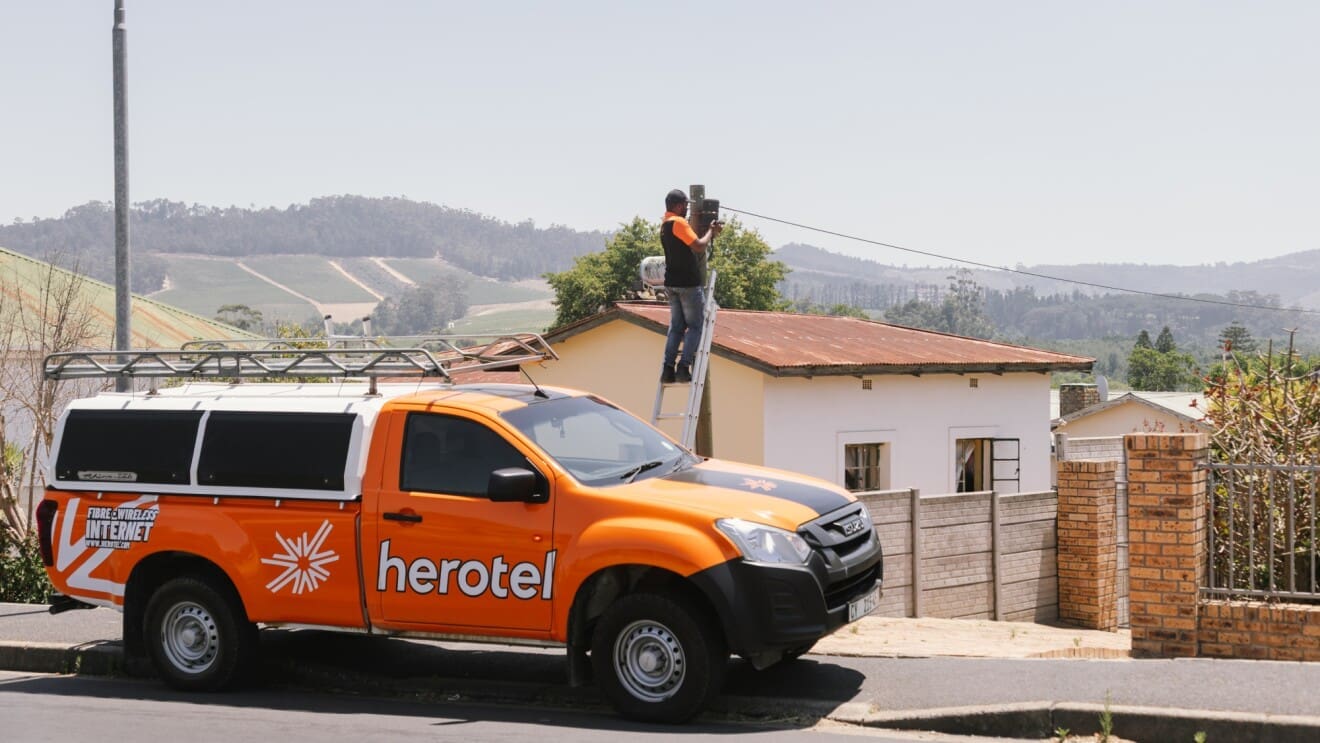
Herotel, a Maziv company and South Africa’s largest fixed internet service provider, will serve as the authorised distributor of Amazon Leo for residential customers.
Through evry, the partnership targets the millions of South Africans living on farms, in small towns, townships, and rural communities where distance, difficult terrain, and low population density have historically made fiber and fixed wireless infrastructure financially unviable. Unlike pure-play satellite providers that operate remotely, Herotel brings an immediate, tangible edge to the table. With over 350,000 active customers, a footprint spanning more than 550 towns, and 120 local offices nationwide, the ISP can offer local installation, field operations, and customer support from day one.
Herotel
Van Zyl Botha, CEO of Herotel, stated:
“evry represents the next chapter in what Herotel has been building for more than a decade. We have always believed that South Africans outside the major metros – whether on farms, in small towns, in townships, or in rural communities – deserve reliable, affordable internet. With evry, powered by Amazon Leo, we will reach the customers that even fibre and fixed wireless cannot serve.”
Do you see the imagery here?
Fibre cannot reach Vino’s shack because the density is too low. Fixed wireless might not cut it. But a satellite beam in the sky and a local installer from Bethal? That is the World Builder in me dreaming.
But let me ground this in the reality of the Data Interpreter again.
In March 2026, Maziv, South Africa’s leading open-access fibre infrastructure provider, announced a landmarkR9 billioninvestment pledge at the sixth South Africa Investment Conference. This significant capital commitment, spanning the next five years, is set to accelerate the country’s high-speed digital rollout and includes a dedicated pledge to create 10,000 direct and indirect job opportunities over 7 years, emphasising Maziv’s role as a primary driver of South Africa’s digital economy and infrastructure development.
The pledge follows the approval of Vodacom’s acquisition of a 30% stake in Maziv by the Competition Commission and ICASA and marks a transformative chapter for Maziv and the millions of citizens who will benefit from enhanced connectivity.
Maziv CEO Dietlof Maré said:
“The investment is a powerful catalyst for digital inclusion. This is much more than infrastructure; it’s about changing lives. By bringing high speed connectivity to every corner of the country, we are ensuring that more people than ever before can participate in the digital economy.”
As part of its social mandate, Maziv will also provide 1 (one) Gbps free, uncapped access to every public or private school, public clinic and public library passed by its network. That is a textbook definition of turning infrastructure into social upliftment.
So, back to the question: Are we selling Pyza a pipedream?
Here is the emotional truth, and the Human Observer in me must be brutally honest.
Vino does not care about the DNI Consortium. He does not care about Sabcap’s JSE listing. He cares about the cost of a gigabyte. Right now, he is surviving on 50MB of Facebook data. That is not access. That is digital starvation.
If these fibre lines are laid in eMzinoni, and the retail packages cost R1,000 per month, then Vino will remain in the dark. If evry offers satellite internet but requires a R2,000 router, Vino will not be “evry”where. He will be nowhere.
But here is the opinion: This time, it must be different.
The World Builder in me looks at the Herotel footprint, 120 local offices. I see the Maziv mandate —prioritising lower-income areas. I see the Frogfoot capital – specifically tagged for township rollout. This is not just one CEO giving a speech. This is a concerted, multi-billion rand ecosystem converging on the peripheries.
The deals are structured.
The money is real.
The quotes are aspirational.
But the real test is not the multi-billion valuations. The test is whether Abraham van der Merwe, Van Zyl Botha, and Dietlof Maré can sit in a room and figure out how to sell a 100Mbps fibre line to Vino for the price of his daily R50 airtime.
Can they make the business case for the poor? Or will the fibre cables simply run through the townships, bypassing the shacks, connecting only the spaza shops that can afford the installation?
I want to believe this is not a pipedream.
I want to believe that these billions are the end of the era of the 50MB Facebook bundle. I want to believe that one day soon, Vino will not have to beg.
He won’t have to ask “Please Buy Me Data,” because the data will find him.
But hope without affordability is just a PowerPoint slide.
These companies have the data.
They have the cash.
They have the world-building vision.
But they need the empathy to reach Vino where he lives, literally and financially. If they can do that, they won’t just be connecting homes. They will be restoring dignity. And that is the only story worth telling, similar to what the smartphone did to millions of South Africans – thanks to Vodacom, MTN and Telkom, plus the latecomers.