


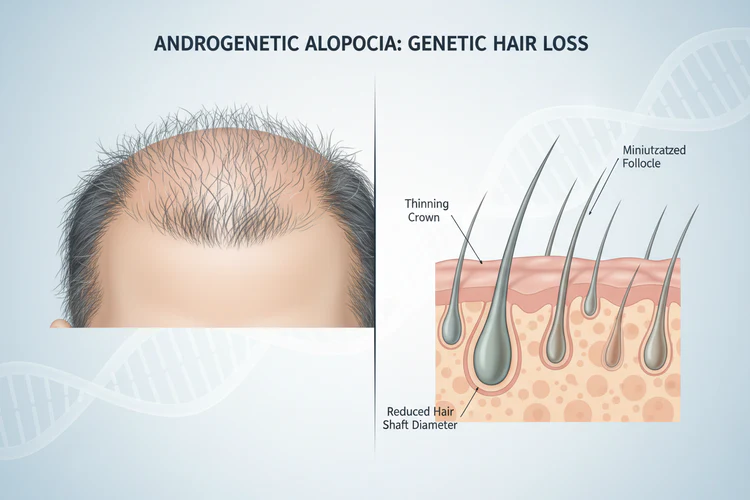
Most people notice it gradually. A little more hair on the pillow. A slightly wider part. A hairline that seems to have quietly moved back. If you have a parent or grandparent who went through the same thing, you’ve probably already connected the dots. Hereditary balding is one of the most common reasons people lose hair — and yet, finding the right kind of help for it is surprisingly confusing.
What Hereditary Balding Actually Is
Hereditary hair loss, also known as androgenetic alopecia, is not simply about having “weak” hair. It’s a condition rooted in genetics and hormonal sensitivity. Specifically, hair follicles in certain areas of the scalp are genetically programmed to respond to a hormone called DHT (dihydrotestosterone). Over time, this sensitivity causes the follicles to shrink, produce thinner strands, and eventually stop growing hair altogether.
The pattern is usually predictable — receding temples and crown thinning in men, diffuse thinning across the top of the scalp in women. Understanding that this is a biological process, not a hygiene or lifestyle failure, is important. It changes how you approach treatment.
Why Most People Wait Too Long
There’s a window where intervention works best, and most people miss it. Hair follicles that have been dormant for years are much harder to reactivate than follicles that are still partially active. The common mistake is waiting until the thinning becomes obvious before seeking help.
Early signs — increased hair fall during washing, less density at the crown, a scalp that’s more visible in photographs — are worth taking seriously even if no one else has noticed them yet. The earlier you understand what’s happening, the more options you have.
Which Type of Specialist Should You See
This is where many people get stuck. There’s no single obvious door to knock on when genetic hair loss is the concern. Here’s a practical breakdown of who does what:
- A dermatologist specializes in skin and scalp conditions. They can diagnose androgenetic alopecia, rule out other causes, and prescribe medications like minoxidil or finasteride where appropriate.
- A trichologist focuses specifically on hair and scalp health. They often take a more detailed look at hair density, scalp condition, and contributing factors like nutrition or stress.
- An endocrinologist is relevant if there’s a hormonal imbalance involved — particularly in women where conditions like PCOS can accelerate genetic hair thinning.
- A hair transplant surgeon is typically consulted when non-surgical options haven’t provided enough results, or when hair loss is in an advanced stage.
For most people at early to mid stages, starting with a dermatologist or a trichologist makes the most sense. The goal isn’t jumping straight to surgery — it’s understanding the extent of the problem and choosing an evidence-based path forward.
What a Good Consultation Should Look Like
A thorough consultation for hereditary balding should involve more than a quick visual inspection. A proper evaluation typically includes a scalp examination, sometimes a trichoscopy (a non-invasive magnified scalp scan), and a review of your family history and lifestyle. Blood tests are often recommended to rule out nutritional deficiencies or hormonal factors that may be making the genetic condition worse.
Be cautious of any consultation that immediately pushes products without this kind of baseline understanding. Good care starts with clarity about what’s actually driving the hair loss.
The Role of Integrated Care
One thing that’s becoming clearer in hair health is that genetics rarely acts alone. Stress, poor sleep, iron deficiency, thyroid imbalances, and scalp inflammation can all accelerate a genetic predisposition. Platforms like Traya address this by combining medical expertise with lifestyle and nutritional support — the idea being that treating only the symptom, while ignoring the body’s internal environment, tends to give limited results.
If you’re exploring options and wondering where to begin, looking into Traya clinics in your area can be a useful starting point for a structured, root-cause evaluation.
Final Thoughts
Hereditary balding is manageable, especially when approached early and with the right guidance. The key is not to treat it as a cosmetic inconvenience but as a health condition with real biological mechanisms. Finding a specialist who takes that approach — one who looks at the full picture rather than offering a quick fix — makes all the difference. Take the first step with curiosity, not urgency. Understanding your hair loss is already half the solution.
