



Building a proprietary financial or gaming platform from scratch used to be a badge of honor. Founders would spend eighteen months raising capital, hiring engineering teams, and arguing over database architecture before writing a single line of client-facing code. In the current market, that approach is financial suicide. Investors are exhausted by long development cycles, and consumer attention spans are shorter than ever. If you take a year to deploy a product, a faster competitor will have captured your target demographic before you even clear QA testing.
The industry is shifting toward modular architectures. Companies are realizing that owning the entire tech stack is no longer a competitive advantage. It is mostly a liability. The real value lies in user acquisition, brand positioning, and unique feature sets. Everything beneath that surface layer, from payment routing to regulatory compliance reporting, is effectively a commodity.
The shift away from legacy development
Building infrastructure in-house requires massive upfront capital. You need infrastructure engineers, security experts, and compliance attorneys just to get to a baseline starting point. For an iGaming operator or a niche fintech startup, these expenses burn through runway before the product even faces a real customer.
The smarter alternative is deploying pre-built ecosystems. Utilizing a reliable BAAS turnkey framework allows businesses to acquire a fully functional, compliant backend infrastructure within weeks. This lets development teams bypass the grueling process of building ledger systems, user management modules, and basic transactional pipes. Instead of managing a massive, sprawling codebase, a lean team can focus entirely on optimizing the frontend user experience and building proprietary features that actually drive retention.
This is not about cutting corners. It is about capital efficiency. When a startup uses a pre-packaged framework, they inherit years of optimization, security patching, and stress-testing that they could never replicate on a seed-stage budget.
Navigating the regulatory minefield
Compliance is usually where ambitious fintech and igaming projects go to die. Securing licensing, setting up anti-money laundering frameworks, and passing third-party security audits takes an immense amount of time. The Financial Conduct Authority and other global regulatory bodies have steadily increased their scrutiny on digital asset platforms and alternative payment providers over recent years. Navigating these requirements independently requires a specialized legal team and months of back-and-forth correspondence with regulators.
Pre-configured infrastructure solutions usually eliminate these headaches right from the jump. Instead of building identity verification or anti-money laundering modules from scratch, you tap into setups that already talk to regional regulators. Operating under an established partner’s umbrella structure cuts down the legal barrier to entry to almost zero. More importantly, it keeps your startup from imploding due to a single compliance mistake you didn’t see coming.
Technical scalability without the overhead
Every founder dreams of viral growth, but few backend frameworks actually survive it. A random surge in active players or users can instantly tank a poorly optimized database, and fixing your reputation after a launch-day crash is brutal. Handling horizontal scaling without things breaking requires the kind of senior engineering talent that most early-stage projects simply can’t afford yet.

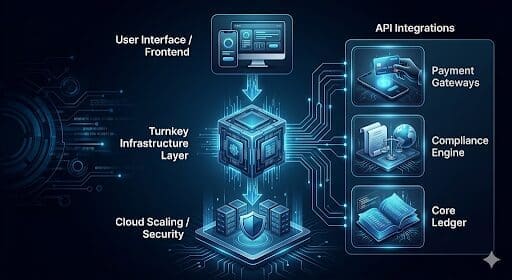
Offloading the weight of server management, load balancing, and constant database tweaks to an external vendor changes the game. These platforms live and die by their uptime, meaning they handle high transaction volumes as standard practice. If your traffic spikes tenfold over a weekend, the system shifts automatically. You don’t have to drag your lead developer out of bed at three in the morning to fix broken database queries or manually spin up new servers.
Smart allocation of capital and focus
Consider where your revenue actually comes from. A customer does not choose a fintech app because they like the way the internal ledger handles double-entry bookkeeping. They choose it because the onboarding is frictionless, the interface is intuitive, and the service solves a specific pain point. An iGaming player does not care about the underlying database architecture. They care about instant payouts, game selection, and platform stability.
When you buy rather than build your core infrastructure, you redirect your limited capital toward growth engines. You can spend more on targeted marketing campaigns, build a superior customer support apparatus, and experiment with novel product features.
The businesses surviving and thriving today are those that launch quickly, gather real user data, and iterate based on actual market feedback. Spending a year building invisible infrastructure in a vacuum is a luxury the market no longer tolerates. Speed, agility, and aggressive focus on the end-user experience are the only metrics that correlate with long-term survival.


