





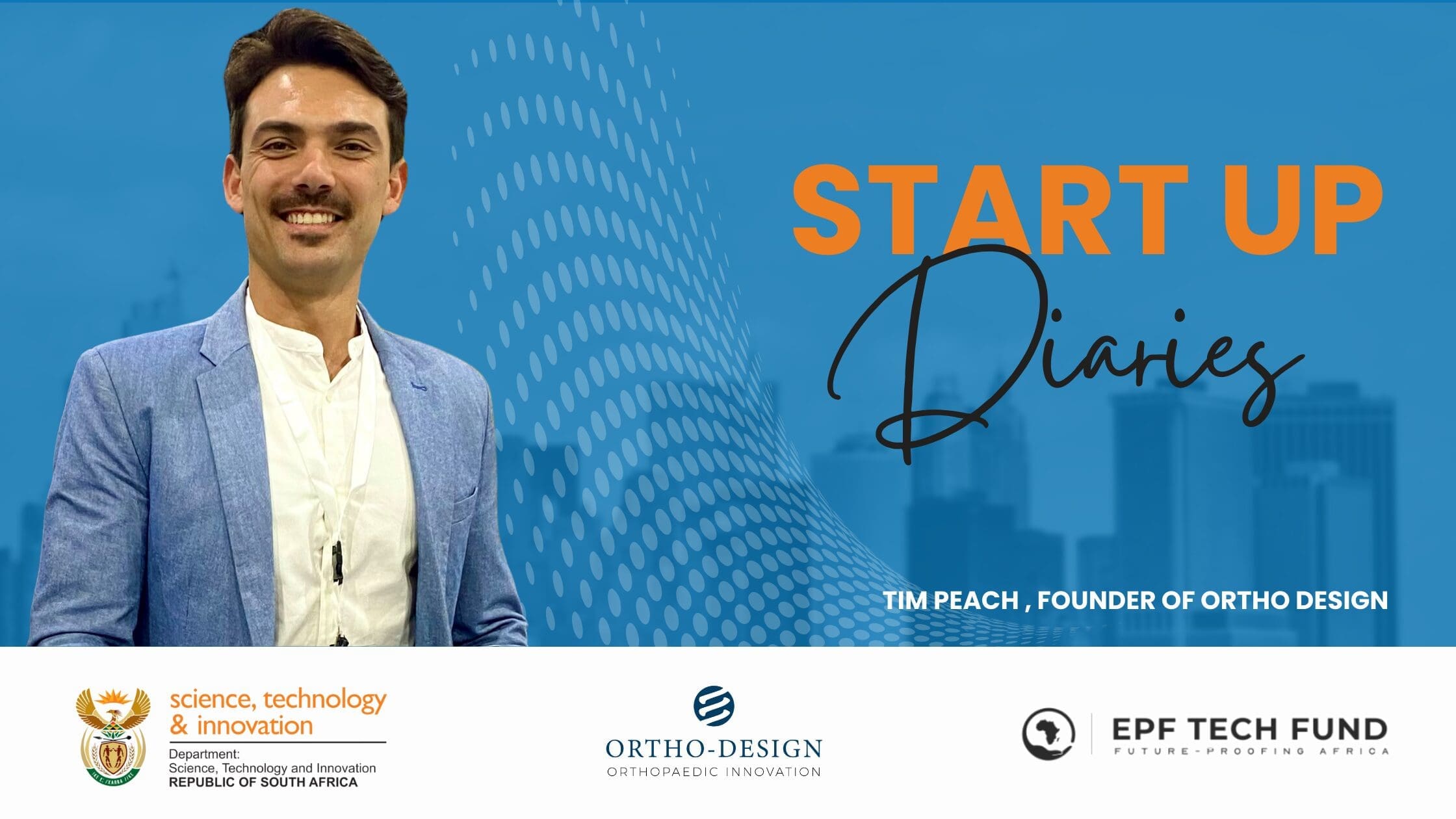
Orthopaedic devices are rarely associated with African innovation, and Ortho-Design wants to change that narrative. Moving from a strong engineering idea to a scalable business that designs and manufactures orthopaedic tools for South Africa and beyond. Proving that world-class medical technology does not have to arrive in a box from somewhere else.
Founded by engineer and entrepreneur Tim Peach and partner, Ortho-Design develops high-precision orthopaedic devices that are intuitive for surgeons, effective for patients, and realistic for health systems under pressure.
Dating back, entrepreneurship has always been a part of Tim’s identity, but it was during his university and early professional years in orthopaedics that the opportunity became clear.
The company’s first product came from a specific technical shortcoming he noticed in an existing device, and fixing that problem revealed a bigger pattern. Such as, inefficient tools, impractical devices, imports priced beyond reach, and hospitals forced to rely on solutions designed for very different clinical environments.
“Once you notice that level of waste and missed opportunity, it becomes difficult to look away,” he says.
Ortho-Design’s response is to design and manufacture orthopaedic instruments and implants that are clinically robust and context-aware. For surgeons, that means stronger fixation, more reproducible procedures, and streamlined workflows in theatre. For patients, it means shorter operations, faster recovery, fewer complications, and access to care that might otherwise be unaffordable. The aim is simple but demanding, meaning that its lower costs without lowering standards.
According to Tim, choosing to manufacture locally is a deliberate challenge and further adds that, in a market where more than 90% of orthopaedic implants are imported, it would be easier to design in South Africa and produce elsewhere.
Instead, Ortho-Design has chosen to build capability at home. Some specialized components are still made abroad due to limited local capacity, but the long-term ambition is to bring every component in-house and become a world-class OEM partner for innovators globally.
As Tim puts it, “If it were easy, we probably wouldn’t have done it.” For him, local manufacturing is as much about resilience as it is about efficiency.
A key turning point came with the Aspen GIBS Route to Market award. The recognition pushed Ortho-Design to tighten its operations, formalizing systems, processes, and a clear commercial strategy.
Tim knew that strong engineering and early traction were not enough to scale and that led Ortho-Design to join the DSTI × EPF Venture Building Program, not as an idea on paper, but as a trading company ready to grow. Within the program Ortho-Design has been challenged to interrogate its strategy, refine its commercial approach, and strengthen its investment case. Assumptions are tested with data, not just optimism, and the company is building a more disciplined foundation for expansion.
Through all of this, the focus remains on real-world impact. Ortho-Design’s design philosophy starts in the operating room, not the boardroom. Devices must be straightforward to use, durable in demanding settings, and compatible with constrained budgets. When procedures are easier to perform consistently and tools are built for local realities, outcomes improve and access widens.
Looking ahead, Ortho-Design aims to be recognized globally as a leading sports-medicine company and innovation hub, built on performance, quality, and education. The roadmap includes scaling manufacturing, broadening regulatory approvals, deepening partnerships and distribution networks, and expanding access across Africa and into key global markets.
“We’ve spent the past years laying the foundation,” Tim says. “Now it’s time to scale.”
In partnership with the DSTI × EPF Venture Building Program, that ambition is no longer just a founder’s conviction, it is becoming a structured path for African-built orthopaedic innovation to reach the world.


