

by Siddhartha Bandyopadhyay, University of Birmingham
The recent news that BT would reduce its workforce by as many as 55,000 by 2030, including about 10,000 jobs replaced by artificial intelligence (AI), is part of a growing trend of job losses globally due to various forms of automation.
This is borne out by several industry reports, including one from McKinsey Global Institute (MGI) acknowledging that as many as 800 million jobs may be lost globally due to changes in technology by 2030.
In our book Work 3.0, the author and business adviser Avik Chanda and I contend that, due to automation as well as newer ways of working, workplaces can become “anti-human” and centred instead around AI and technology.
While the term “anti-human” can be interpreted in different ways, surveys on workplace happiness provide compelling evidence on just how unhappy workers are. For example, The Global Workplace 2022 published by Gallup states that on the whole, workers seem to be significantly worse off in their overall wellbeing than they were in 2020. In fact, only 20% of respondents reporting they were engaged at work.
There has been an unprecedented increase in technological disruption in recent years. At the same time, work by Gallup has revealed a global rise in unhappiness. Gallup’s latest Positive Experiences Index showed a decline in happiness, even from 2020 levels. “Enjoyment”, “smiling” and “feeling well-rested” seemed to have almost vanished. On the other hand, the survey’s negative experience index continues to record a rise, with “sadness”, “stress” and “worry” reaching record levels.
Historical biases
AI is being used in the workplace as an evaluative and decision-making tool — which would be a positive development if it eliminated human error. But, as eloquently analysed in Cathy O’Neil’s book Weapons of Math Destruction, most of these decision-making algorithms use data that contains biases against historically disadvantaged groups. If these biases are incorporated into algorithms that help determine who gets bank loans or that screen job applications, they can perpetuate an already unjust situation.
Suwin / Shutterstock
However, it remains the case that more jobs are being created than are being destroyed due to automation. The size of the net impact is widely debated, but theories suggest job roles that complement automation will do well, at least in terms of better wages. Nevertheless, surveys such as the one by Gallup suggest that stress and unhappiness in the workplace will affect almost all workers.
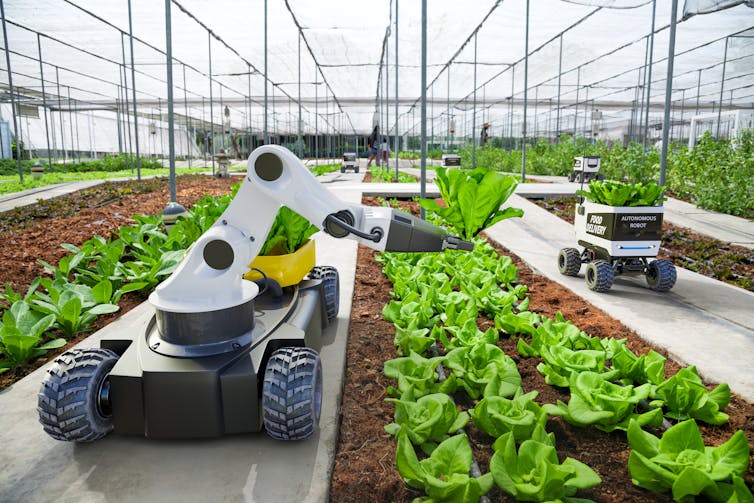
Perhaps unsurprisingly, those workers that perform tasks capable of being completely automated will stand to lose most. This last category of worker includes many blue collar roles, though a number of white collar middle management jobs will also disappear.
A recent study by the economists Daron Acemoğlu, Hans Koster and Ceren Ozgen, using data from the Netherlands, supports suggestions from theoretical work that automation affects different groups of workers in different ways. The team argues that “directly affected workers seem to lose from robot adoption, while indirectly affected workers gain (from it)”.
Be adaptable
When workplaces become anti-human, they become focused on automated processes and the use of technological solutions rather than around the well-being of employees. This suggests that those with skills suited for this new workplace will thrive, while the future may be bleak for others, whose salaries may stagnate or fall.
This warning echoes what Brynjolfsson and McAfee predicted in their book, The Second Machine Age:
There’s never been a better time to be a worker with specialist skills or the right education, because these people can use technology to create and capture value. However, there’s never been a worse time to be a worker with only ‘ordinary’ skills and abilities to offer, because computers, robots, and other digital technologies are acquiring these skills and abilities at an extraordinary rate.
This separation of workers into two categories could spread around the globe very quickly. As a result, inequality could become more pronounced within countries than between countries. In Work 3.0, we noted that inequality between nations represented only 32% of total global inequality in 2020, while inequality within economies accounted for an astonishing 68%. Back in 1980, the situation was very different, with inequality between countries accounting for as much as 57% of the global total.
Falling wages
While this trend makes for grim reading, governments can have an important influence. In India, which has recorded large rises in inequality over past decades, polices such as the National Rural Employment Guarantee Act 2005 (MGNREGA) have helped reduce the gap. MNGREGA offers guaranteed employment as well as a food subsidy as part of an effort to boost livelihoods in rural areas.
The economists Surjit Bhalla, Karan Bhasin and Arvind Virmani analysed extreme poverty (defined as an income of US$1.9 per person per day, at purchasing power parity of the 2011 dollar) in India and found that it had fallen to quite low levels in 2019 and had remained so despite the pandemic. This was put down to the impact of the food subsidy.
While this has been contested, other studies have also found a decline in poverty – though they differ in the magnitude of that reduction. This suggests that countries can manage the worst effects on workers through active state intervention.

PRASANNAPIX / Shutterstock
But subsidies are a short-term fix to protect those workers most at risk of losing their jobs or seeing their wages fall. Longer-term solutions need to focus on reskilling workers to adapt to the changing nature of demand. Educational institutions, from schools to universities, need to play a lead role in this regard.
The skills needed in the workplace are changing at a blistering pace. We argue in Work 3.0, that the challenge today for educational institutions is to instil in the workers of the future a highly adaptable mindset.
This mindset would be assisted by an educational curriculum that is more multi-disciplinary and augments traditional STEM skills. This will be a major step for many educational institutions as it will force them to step outside disciplinary silos.
However, the effort would pay off by creating an adaptable and diverse workforce able to meet the changing demands of the 21st-century workplace.
Siddhartha Bandyopadhyay, Professor of Economics, University of Birmingham
This article is republished from The Conversation under a Creative Commons license. Read the original article.
