

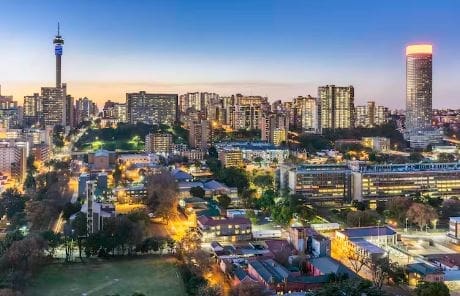
South Africa’s major cities in the Gauteng Province – the country’s economic heartland – are experiencing major water shortages. In Johannesburg and Tshwane taps have run dry, with numerous areas experiencing intermittent supply while some areas have no water at all.
The province has metropolitan areas – the City of Johannesburg, Tshwane and Ekurhuleni. All are affected. Rand Water, the water authority for the region, has imposed restrictions of 30%. This will be revisited when the system recovers.
The last water shutdown was in November 2021 when Rand Water cut off water for 54 hours so that it could to do infrastructure maintenance. There were also restrictions during the drought in 2015-2017.
The province serves as a perfect example of how an area can experience water shortages and intermittent supply even though dams are full.
The biggest problem lies with decaying infrastructure. This includes water storage, water supply and treatment. In addition water resources are poorly managed. And there’s been poor planning, a lack of financing to maintain ageing infrastructure and to keep up with rapid urbanisation.
The crisis in Gauteng has been developing over many decades. The water and sanitation infrastructure in Johannesburg is old – some water
pipes were installed nearly a century ago. In addition, there’s been exponential growth – of businesses and the population.
Gauteng is South Africa’s smallest province, but contributes 45% to the country’s total economic output. All economic sectors have expanded in the past decades.
The province’s population has also increased to just over 16 million – up from 12 million in 2011.
Rand Water has indicated that high water consumption is to blame for the current shortages. Estimates suggest that water consumption in Gauteng per person per day is over 300 litres, well above the global average of 173 litres. Importantly, this estimate includes non-revenue water – water that’s lost before it reaches the consumer.
The Gauteng Province is unfortunately finding itself in a perfect storm of major intermittent water supply due to continued power blackouts, high temperatures leading to above average water use as well as major continued water losses through bursting pipes and major leaks due to dilapidated infrastructure.
There’s an urgent need to put water higher on the country’s agenda. Various water problems are escalating at a rapid rate.
The decline
The quality of water infrastructure in South Africa is deemed to be below average and deteriorating in comparison to comparable countries such as Nigeria and Zambia.
A number of factors have contributed to the current state of affairs.
Firstly, the poor quality of infrastructure. This is attributed to insufficient long-term planning, poor construction techniques and materials as well as the poor maintenance of existing infrastructure.
South Africa’s infrastructure is mostly aged (more than two decades old), in a state of decay. In its 2017 infrastructure report card the South African Institution of Civil Engineering concluded that the country’s infrastructure was at risk due to its low overall grade of D+.
Secondly, the management of consumption has been poor. South Africa is a water scarce country. Yet the average domestic water use is estimated at 237 litres per person per day, 64 litres higher than the international benchmark of 173 litres per person per day.
High consumption is partly attributed to high municipal non-revenue water. This stands at 41% This means that 41% of water is lost due to leakages owing to poor operation and maintenance of existing aged water infrastructure, commercial losses caused by meter manipulation or other forms of water theft and lastly, unbilled authorised consumption such as firefighting.
Thirdly, a lack of institutional capacity at a local level has limited the capability of local governments to provide infrastructure. Low expenditure levels on infrastructure investment is evidence of these capacity deficits despite the national government continuously emphasising the need for more investment.
Fourthly, there has been massive under funding for decades. This has led to decay and in some instances a collapse of infrastructure. Government spending on infrastructure reached its peak in the 1960s to late 1970s. There was then a steady decline from 1977. In 2000, the country’s per capita spending on infrastructure reached a 40-year low and warnings were issued about the condition of bulk water and sanitation infrastructure.
By 2002 the country’s infrastructure stock was at similar levels to that of 1973.
Other factors contributing to the current crisis include poor management (at national and local level), delays in implementation, insufficient institutional capacity and competence and a lack of political will.
Fifth, a multi-layered and complex system of managing water resources. Numerous stakeholders at different levels of government play a role in the management of water resources.
The Department of Water and Sanitation is the custodian of the country’s water. It is ultimately responsible for ensuring that water resources are protected, used, developed, conserved, managed and controlled effectively. The development and management of national water resource infrastructure also forms part of the department’s functions.
Other managing agents include catchment management agencies (managing water resources at a regional or catchment scale), water user institutions (providing the institutional structure) as well as water service authorities which include local government and municipalities, water utilities and private firms responsible for governing domestic water supply services.
Johannesburg Water therefore sources water from Rand Water, which supplies potable water to the Gauteng Province and other areas. The City of Johannesburg and Johannesburg Water, for example, are responsible for dealing with growing demands and the management of the delivery and services.
What’s needed
The following steps should be considered to try and ensure continued suitable water supply within the Gauteng Province as well as other areas experiencing the same issues:
- A suitable budget needs to be made available immediately to address priority
areas. Proper planning and informed actions, not just promises, is a major
requirement. Johannesburg Water estimated in 2020 that R88 billion was required for the replacement of infrastructure with a total renewal backlog of R20.4 billion.
The entity has been allocated a R3.3 billion multi-year capital budget aimed at replacing water and sewer pipes, upgrading water storage infrastructure, a wastewater treatment works programme and lastly, repairing and maintaining outdated
infrastructure. A further R2.3 billion has also been allocated to address burst pipes across the province.
This amount of money might be a suitable investment to address the dilapidated state of infrastructure. But it should have been assigned much sooner.
- Dilapidated infrastructure needs to be upgraded and properly maintained. The lack of maintenance has contributed to leaking pipes and faulty infrastructure which now needs to be fixed as a matter of urgency as it contributes to major physical water losses. This won’t solve the problem overnight given that there have been decades of neglect. But a start needs to be made.
- Capacity constraints or lack of skills need to be identified and addressed.
- Private sector investment in water infrastructure needs to be incentivised
together with the promotion of private-public partnerships. - Implementation of water conservation and demand management.
- Political will to move away from simply providing infrastructure to
maintenance, rehabilitation and upgrading of existing infrastructure.

Anja du Plessis, Associate Professor and Research Specialist in Integrated Water Resource Management, University of South Africa
This article is republished from The Conversation under a Creative Commons license. Read the original article.
