

As historians, we have both been immersed for many years in trying to understand and write about South Africa’s complex, conflictual history. Conquest, colonial domination and racial division in the shape of apartheid played a central role. So too did the rise of black opposition and the transition in 1994 to an African National Congress government.
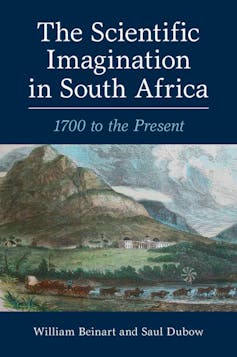
There were many strands in the weaving of this history, some neglected in the focus on race and political power. These include the profound role that science and technology played in shaping South Africa’s history. In our new book, The Scientific Imagination in South Africa, 1700 to the Present, we offer a historical overview of scientific ideas, practices and institutions in South Africa over more than three centuries.
We refer in the title to the “scientific imagination”. That’s because we link science both with power and with ideas about how human society can be reshaped. We also aim to discuss science as an expression of human curiosity, ingenuity, and the ability to make unlikely connections.
This book is a history of individuals, ideas and institutions that were at the fulcrum of important scientific developments. Writing history is bounded by what has happened. Our text explores the complexity of the colonial era and its indelible legacies. We argue that science and technology both facilitated colonialism and to some degree stood outside such processes.
Racial policies and modernist approaches privileged the narratives of formal, written, largely disciplinary-based sciences. The book incorporates discussion of indigenous and local knowledge when it fed into scientific discussion, such as in understanding the local environment in the eighteenth century. We also explore alternative approaches and conflicts over knowledge.
Innovation testing ground
South Africa has been a regional rather than a world power. In global terms it was not a major centre for invention. Yet its geographic position at the southern foot of the African continent made it a staging post for Portuguese, Dutch and British maritime empires. It became part of an expanded European and global imaginary. Colonisation by Britain from 1806 brought the region into tight connection with one of the most powerful – and technologically advanced – world empires.
From the late eighteenth century, the Cape became an important site for botanical and zoological exploration. The wealth of its plant species, as well as the extraordinary diversity of wildlife, attracted sustained attention. By the early twentieth century, the discovery of ancient fossils, stone implements and hominin remains suggested that the country may have constituted a “cradle” of modern human evolution.
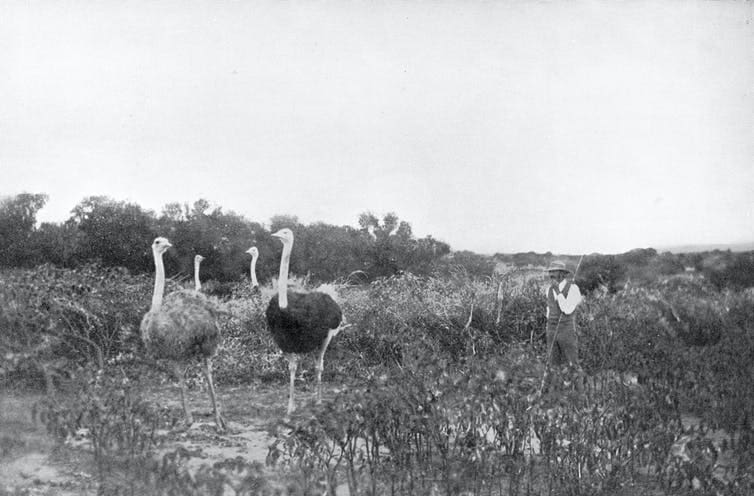
South Africa was not a core zone of invention. But it was, at key moments, a significant incubator and testing ground of innovation. Application could be as important as discovery. In the nineteenth century, improved breeds and new agricultural technology, including dams, wells, fodder and fencing, underpinned exports of wool and ostrich feathers. Devastating new rifles helped to change the balance of power in favour of colonial regimes.
In the twentieth century the mineral revolution necessitated developments in applied geology and the chemistry of gold extraction. The scientific imagination was also more exploratory in curiosity-driven fields such as astronomy, palaeontology, and wildlife conservation.
Our text also builds on many individual stories. James Barry, who came to the Cape in the 1810s, was probably the first formally trained woman doctor in Britain. She made a significant contribution to modernising Cape Town’s early medical institutions. She also performed one of the first successful Caesarean operations in the British empire, for an ancestor of the man who became the first Afrikaner nationalist Prime Minister. It was in commemoration of this operation that he carried the unusual name James Barry Munnik Hertzog.
Elsewhere in South Africa, rich mineral resources gave impetus to a sequence of discoveries. Hans Merensky, son of a German missionary, was sent to train as a geologist in Prussia. Returning to South Africa, he played a major role in identifying coastal diamond deposits, as well as platinum, and phosphates. Platinum group minerals have outstripped gold in their value. Merensky invested his wealth in a farm, Westfalia, which became an important site for scientific work in improving avocado pears.
Thinking creatively
South Africa gave birth both to Afrikaner and African nationalism, which affected the trajectory of scientific endeavour. White South Africans were also carriers of a darker tradition – the attempts to justify racial segregation in scientific terms. In the relatively brief era of African nationalist rule after 1994, the state has espoused more universalist goals and the segregationist drive to account for racial difference has yielded to an emphasis on common humankind.
We explore the circulation of ideas, recognising that many originate in the north but are not trapped in the social context of their origin. Scientific ideas are potentially universal and can be appropriated and modified everywhere.
Today, it is clear that scientific work in multiple sites with diverse backing is important for South Africa to address its socio-economic and environmental problems. There are signs that its scientists are up to the challenge: after all, it was in South Africa that the Omicron variant of COVID was first identified. Scientists were sufficiently inserted in global networks to identify this variant and sufficiently open to publicise it.
The scientific imagination needs to be nurtured in the country, along with the capacity to think creatively about history and society.
The Scientific Imagination in South Africa, 1700 to the Present, is published by Cambridge University Press (2021).
William Beinart, Professor, University of Oxford and Saul Dubow, Smuts Professor of Commonwealth History, University of Cambridge
This article is republished from The Conversation under a Creative Commons license. Read the original article.THE C
