
Close Menu
  • Homepage
  • News
  • Cloud & AI
  • ECommerce
  • Entertainment
  • Finance
  • Opinion
  • Podcast
  • Contact

Subscribe to Updates

Get the latest technology news from TechFinancials News about FinTech, Tech, Business, Telecoms and Connected Life.

What's Hot

Digitap ($TAP) Crushes NexChain with Real Banking Utility: Best Crypto to Buy in 2026

2026-02-05

Bridging Financial Frontiers: ZOOMEX Launches “February XAUT Airdrop Event”

2026-02-05

More Profitable Than SHIB or SOL? Digitap’s Big-Time Deposit Upgrade Gains Worldwide Attention

2026-02-05
Facebook X (Twitter) Instagram
Trending
  • Digitap ($TAP) Crushes NexChain with Real Banking Utility: Best Crypto to Buy in 2026
Facebook X (Twitter) Instagram YouTube LinkedIn WhatsApp RSS
TechFinancials
  • Homepage
  • News
  • Cloud & AI
  • ECommerce
  • Entertainment
  • Finance
  • Opinion
  • Podcast
  • Contact
TechFinancials
Home»Trending News»How Social Media Forces Stand-Up Comedians Like Trevor Noah And Basket Mouth To Self-Censor
Trending News

How Social Media Forces Stand-Up Comedians Like Trevor Noah And Basket Mouth To Self-Censor

The ConversationBy The Conversation2022-02-02No Comments5 Mins Read
Share Facebook Twitter Pinterest LinkedIn Tumblr Email
Trevor Noah
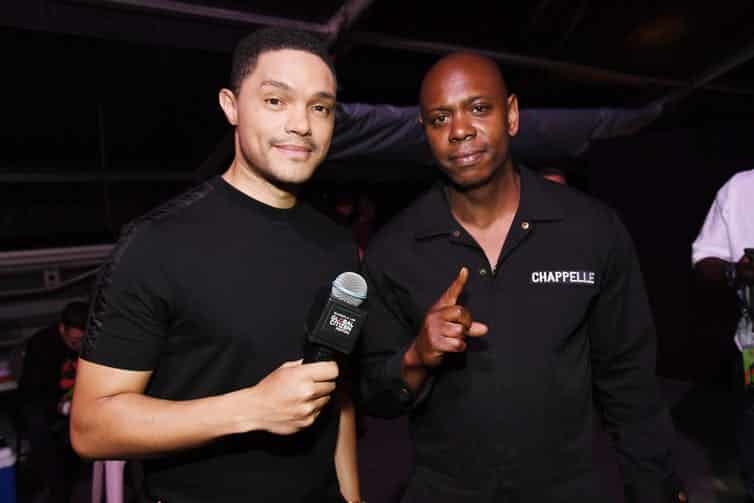
Comedians Trevor Noah (L) and Dave Chappelle (R) Kevin Mazur/Getty Images Izuu Nwankwọ, Johannes Gutenberg University of Mainz
Share
Facebook Twitter LinkedIn Pinterest Email Copy Link

The essence of stand-up comedy is that you have a comedian performing to a live audience with the goal of entertaining through eliciting humour. Comedians hold social, cultural, and political phenomena up to ridicule. Jokes can instigate re-evaluations, reversals and replacements of the status quo – or dominant beliefs of the day.

As an art form based on abuse and amusement, comedy uses potentially offensive material. One would expect the audience to be either delighted or infuriated.

But stand-up comedy creates a space where a kind of agreement is reached, which renders most offensive gags inoffensive. This happens through elements like audiences choosing to attend, the venue and shared socio-cultural knowledge. Stand-up comedy has its own norms about how jokes are made and received. The synergy between comedians and live audiences allows for a momentary suspension of offence.

But when these jokes start to circulate in a separate space – like social media – they are subjected to other sets of appraisal and questioning. There is a growing backlash against comedians who supposedly tell unpleasant (or offensive) jokes. The social media audience is not present like the live audience. They participate less and jokes are more easily evaluated by sensitivities like political correctness.

This is a limitless, impersonal, and more diverse audience. They are more critical and more consumerist in nature. And the voice of dissent, even when it is just one person, is more amplified in new media encounters than in real-time encounters. This “bad press” can easily cause outbursts like this one from comedian David Baddiel:

Everyone has a voice now, so anyone can object to a joke. What you often see on Twitter is manufactured outrage … Comedy is a focal point for all that, being highly monitored by the dying-to-be-outraged.

Comedians are exposed to what I call “shifting cognitions of offence”, or a change in the ideas of what’s offensive. The result is a tendency to censor their own material. I’ve explored the ways in which two famous African comedians, Trevor Noah and Basket Mouth (Bright Okpocha), self-censor while performing for live audiences. They do so, in part, to anticipate the responses they will receive from their online viewers. I interrogate newer ways that comedians navigate this treacherous new terrain.

Trevor Noah and Basket Mouth

Trevor Noah and Basket Mouth are comedians whose influence has grown beyond physical venues. Their comedy shows and jokes are routinely shared via social media, to audiences who can interpret them in various ways.

South African-born Trevor Noah became internationally popular after succeeding Jon Stewart as the presenter of the US late-night TV event, The Daily Show.

Basket Mouth is one of Nigeria’s foremost comedians. He is popular across Africa and its diaspora, performing to live audiences in multiple African countries, as well Africans in North America and Europe.

Trevor Noah and Basket Mouth share two common traits: they weave recollections of their childhood environments and experiences into their jokes. They’ve also been embroiled in controversies over jokes that were considered too sensitive. This has affected their routines.

A man with shaggy hair and designer shades smiling.
Nigerian comedian Basketmouth performing in Johannesburg, South Africa.
Frennie Shivambu/Gallo Images/Getty Images

In stand-up comedy jokes are, by their nature, primarily offensive and politically incorrect. But the shifting cognitions of offence on social media demand self-censorship from comedians. A great way to self-censor is to give people the impression that you are “punching up”. Comedian Patti Harrison beautifully describes the technique:

If you want to make a joke, you want to punch someone. It should be punching up. You should attack people who are getting away with stuff; who are very powerful and influential, that like have it coming.“ (New York Times 2017)

As their performances are exposed to a wider audience lacking adequate context, Basket Mouth and Noah can defend themselves against criticism by punching up. When Basket Mouth is on stage, he deploys boastful tales, coercing his audience into realising their gullibility at the end of his set.

Trevor Noah intensifies the use of accent and embodied representations of people of different nationalities, mostly underrepresented and formerly colonised peoples, as a way of validating his representations of their realities.

In this way Noah has managed to keep his local audience on his side, while also passing the social media test. This shows that with more creativity, you can side-step cancel culture – in other words being ostracised – while staying funny.

A new future

Times are changing, and so is comedy.

Jokes exist for societal acceptance. The audience calls the shots on what to accept and forbid. And right now, society has moved to a place where everyone is held accountable if their jokes are found offensive.

Stand-up artists can still throw jabs during performances, but they now have a new set of rules to follow. They have to stay within the dynamic bounds of political correctness to attract humour, rather than anger. It takes immense creativity and improvisation to navigate this new world.The Conversation

Izuu Nwankwọ, Postdoctoral Research Fellow, Johannes Gutenberg University of Mainz

This article is republished from The Conversation under a Creative Commons license. Read the original article.

Basket Mouth comedian comedy Self-censor Social media Trevor Noah
Share. Facebook Twitter Pinterest LinkedIn Tumblr Email
The Conversation
  • Website

Related Posts

Volvo EX60 – It’s A Middle Finger To The Petrol Price

2026-01-09

WeThinkCode_ Announces New CEO As It Enters Its Second Decade

2026-01-07

AI Unlocks A R3 Trillion Treasure in SA’s Townships

2025-12-23

Australia’s Social Media Ban Is Now In Force. Other Countries Are Closely Watching What Happens

2025-12-11

Vodacom Bets R36 Billion For Control of Kenya’s Telecom Crown Jewel, Safaricom

2025-12-04

Can AI Be Inclusive Without Africa?

2025-12-01

Humanising Tech Means Designing For African Reality, Says Telkom CMO

2025-12-01

Africa Has A Moral Voice In AI, Says Telkom CEO, Championing Continent As Co-Creator, Not Consumer

2025-12-01

Huge TNS To Enable Organisations To Launch MVNO Services in South Africa With Zero Capex

2025-11-25
Leave A Reply Cancel Reply

DON'T MISS
Breaking News

Dutch Entrepreneurial Development Bank FMO Invests R340M In Lula To Expand SME funding In SA

South African SME funding platform Lula has secured R340 million in local currency funding from…

Paarl Mall Gets R270M Mega Upgrade

2026-02-02

Huawei Says The Next Wave Of Infrastructure Investment Must Include People, Not Only Platforms

2026-01-21

South Africa: Best Starting Point In Years, With 3 Clear Priorities Ahead

2026-01-12
Stay In Touch
  • Facebook
  • Twitter
  • YouTube
  • LinkedIn
OUR PICKS

Vodacom Reports Robust Q3 Growth, Driven By Diversification And Strategic Moves

2026-02-04

South Africa’s First Institutional Rand Stablecoin, ZARU, Launches

2026-02-03

The EX60 Cross Country: Built For The “Go Anywhere” Attitude

2026-01-23

Mettus Launches Splendi App To Help Young South Africans Manage Their Credit Health

2026-01-22

Subscribe to Updates

Get the latest tech news from TechFinancials about telecoms, fintech and connected life.

About Us

TechFinancials delivers in-depth analysis of tech, digital revolution, fintech, e-commerce, digital banking and breaking tech news.

Facebook X (Twitter) Instagram YouTube LinkedIn WhatsApp Reddit RSS
Our Picks

Digitap ($TAP) Crushes NexChain with Real Banking Utility: Best Crypto to Buy in 2026

2026-02-05

Bridging Financial Frontiers: ZOOMEX Launches “February XAUT Airdrop Event”

2026-02-05

More Profitable Than SHIB or SOL? Digitap’s Big-Time Deposit Upgrade Gains Worldwide Attention

2026-02-05
Recent Posts
  • Digitap ($TAP) Crushes NexChain with Real Banking Utility: Best Crypto to Buy in 2026
  • Bridging Financial Frontiers: ZOOMEX Launches “February XAUT Airdrop Event”
  • More Profitable Than SHIB or SOL? Digitap’s Big-Time Deposit Upgrade Gains Worldwide Attention
  • UK Financial Ltd Deploys On-Chain Whitelisting to Transform SMPRA into Institutional-Grade Security
  • Mr. Liu Xiaojun, on Behalf of Fufeng Group, has Fully Completed the Acquisition of Viva World Trade, Inc.
TechFinancials
RSS Facebook X (Twitter) LinkedIn YouTube WhatsApp
  • Homepage
  • Newsletter
  • Contact
  • Advertise
  • Privacy Policy
  • About
© 2026 TechFinancials. Designed by TFS Media. TechFinancials brings you trusted, around-the-clock news on African tech, crypto, and finance. Our goal is to keep you informed in this fast-moving digital world. Now, the serious part (please read this): Trading is Risky: Buying and selling things like cryptocurrencies and CFDs is very risky. Because of leverage, you can lose your money much faster than you might expect. We Are Not Advisors: We are a news website. We do not provide investment, legal, or financial advice. Our content is for information and education only. Do Your Own Research: Never rely on a single source. Always conduct your own research before making any financial decision. A link to another company is not our stamp of approval. You Are Responsible: Your investments are your own. You could lose some or all of your money. Past performance does not predict future results. In short: We report the news. You make the decisions, and you take the risks. Please be careful.

Type above and press Enter to search. Press Esc to cancel.

Ad Blocker Enabled!
Ad Blocker Enabled!
Our website is made possible by displaying online advertisements to our visitors. Please support us by disabling your Ad Blocker.