

Close Menu
  • Homepage
  • News
  • Cloud & AI
  • ECommerce
  • Entertainment
  • Finance
  • Opinion
  • Podcast
  • Contact

Subscribe to Updates

Get the latest technology news from TechFinancials News about FinTech, Tech, Business, Telecoms and Connected Life.

What's Hot

Ethereum Traders Increase Leverage On-Chain As HFDX Liquidity Hits New Highs

2026-01-31

New To On-Chain Perps? HFDX Is Rapidly Emerging As The Beginner-Friendly Option

2026-01-31

Standard Chartered GBA Business Confidence Indices reveal steady business sentiment

2026-01-31
Facebook X (Twitter) Instagram
Trending
  • Ethereum Traders Increase Leverage On-Chain As HFDX Liquidity Hits New Highs
Facebook X (Twitter) Instagram YouTube LinkedIn WhatsApp RSS
TechFinancials
  • Homepage
  • News
  • Cloud & AI
  • ECommerce
  • Entertainment
  • Finance
  • Opinion
  • Podcast
  • Contact
TechFinancials
Home»Opinion»How Explainable Artificial Intelligence Can Help Humans Innovate
Opinion

How Explainable Artificial Intelligence Can Help Humans Innovate

The ConversationBy The Conversation2021-01-15No Comments6 Mins Read
Share Facebook Twitter Pinterest LinkedIn Tumblr Email
AI
Artificial intelligence. Andrey Suslov / Shutterstock.Com
Share
Facebook Twitter LinkedIn Pinterest Email Copy Link

by Forest Agostinelli, University of South Carolina

The field of artificial intelligence (AI) has created computers that can drive cars, synthesize chemical compounds, fold proteins and detect high-energy particles at a superhuman level.

However, these AI algorithms cannot explain the thought processes behind their decisions. A computer that masters protein folding and also tells researchers more about the rules of biology is much more useful than a computer that folds proteins without explanation.

Therefore, AI researchers like me are now turning our efforts toward developing AI algorithms that can explain themselves in a manner that humans can understand. If we can do this, I believe that AI will be able to uncover and teach people new facts about the world that have not yet been discovered, leading to new innovations.

AI
A humanoid robot reading a book.
When machines are left to learn and solve problems through their own experience, this is called reinforcement learning.
Gremlin/E+ via Getty Images

Learning from experience

One field of AI, called reinforcement learning, studies how computers can learn from their own experiences. In reinforcement learning, an AI explores the world, receiving positive or negative feedback based on its actions.

This approach has led to algorithms that have independently learned to play chess at a superhuman level and prove mathematical theorems without any human guidance. In my work as an AI researcher, I use reinforcement learning to create AI algorithms that learn how to solve puzzles such as the Rubik’s Cube.

Through reinforcement learning, AIs are independently learning to solve problems that even humans struggle to figure out. This has got me and many other researchers thinking less about what AI can learn and more about what humans can learn from AI. A computer that can solve the Rubik’s Cube should be able to teach people how to solve it, too.

Peering into the black box

Unfortunately, the minds of superhuman AIs are currently out of reach to us humans. AIs make terrible teachers and are what we in the computer science world call “black boxes.”

AI
An open black case
Researchers have been trying for decades to understand how AIs solve problems.
rockz/iStock via Getty Images Plus

A black-box AI simply spits out solutions without giving reasons for its solutions. Computer scientists have been trying for decades to open this black box, and recent research has shown that many AI algorithms actually do think in ways that are similar to humans. For example, a computer trained to recognize animals will learn about different types of eyes and ears and will put this information together to correctly identify the animal.

The effort to open up the black box is called explainable AI. My research group at the AI Institute at the University of South Carolina is interested in developing explainable AI. To accomplish this, we work heavily with the Rubik’s Cube.

The Rubik’s Cube is basically a pathfinding problem: Find a path from point A – a scrambled Rubik’s Cube – to point B – a solved Rubik’s Cube. Other pathfinding problems include navigation, theorem proving and chemical synthesis.

My lab has set up a website where anyone can see how our AI algorithm solves the Rubik’s Cube; however, a person would be hard-pressed to learn how to solve the cube from this website. This is because the computer cannot tell you the logic behind its solutions.

Solutions to the Rubik’s Cube can be broken down into a few generalized steps – the first step, for example, could be to form a cross while the second step could be to put the corner pieces in place. While the Rubik’s Cube itself has over 10 to the 19th power possible combinations, a generalized step-by-step guide is very easy to remember and is applicable in many different scenarios.

Approaching a problem by breaking it down into steps is often the default manner in which people explain things to one another. The Rubik’s Cube naturally fits into this step-by-step framework, which gives us the opportunity to open the black box of our algorithm more easily. Creating AI algorithms that have this ability could allow people to collaborate with AI and break down a wide variety of complex problems into easy-to-understand steps.
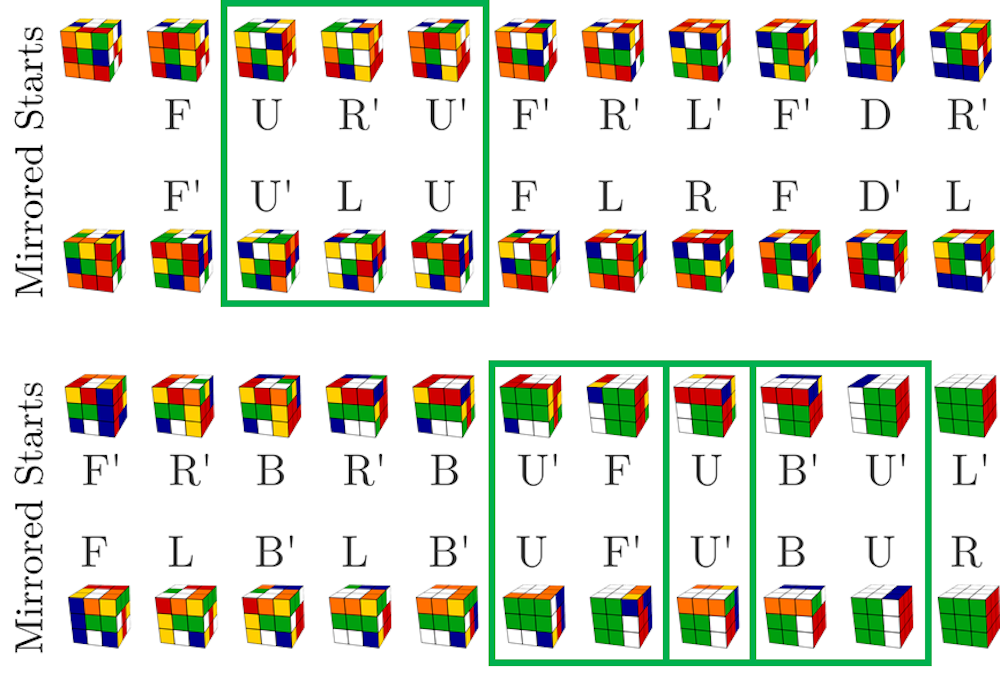
AI
An image showing the thought process of a Rubik’s Cube-solving AI algorithm
A step-by-step refinement approach can make it easier for humans to understand why AIs do the things they do.
Forest Agostinelli, CC BY-ND

Collaboration leads to innovation

Our process starts with using one’s own intuition to define a step-by-step plan thought to potentially solve a complex problem. The algorithm then looks at each individual step and gives feedback about which steps are possible, which are impossible and ways the plan could be improved. The human then refines the initial plan using the advice from the AI, and the process repeats until the problem is solved. The hope is that the person and the AI will eventually converge to a kind of mutual understanding.

[Deep knowledge, daily. Sign up for The Conversation’s newsletter.]

Currently, our algorithm is able to consider a human plan for solving the Rubik’s Cube, suggest improvements to the plan, recognize plans that do not work and find alternatives that do. In doing so, it gives feedback that leads to a step-by-step plan for solving the Rubik’s Cube that a person can understand. Our team’s next step is to build an intuitive interface that will allow our algorithm to teach people how to solve the Rubik’s Cube. Our hope is to generalize this approach to a wide range of pathfinding problems.

People are intuitive in a way unmatched by any AI, but machines are far better in their computational power and algorithmic rigor. This back and forth between man and machine utilizes the strengths from both. I believe this type of collaboration will shed light on previously unsolved problems in everything from chemistry to mathematics, leading to new solutions, intuitions and innovations that may have, otherwise, been out of reach.The Conversation

Forest Agostinelli, Assistant Professor of Computer Science, University of South Carolina

This article is republished from The Conversation under a Creative Commons license. Read the original article.

AI Artificial intelligence
Share. Facebook Twitter Pinterest LinkedIn Tumblr Email
The Conversation
  • Website

Related Posts

South Africa Could Unlock SME Growth By Exploiting AI’s Potential Through Corporate ESD Funds

2026-01-28

How Local Leaders Can Shift Their Trajectory In 2026

2026-01-23

Why Legal Businesses Must Lead Digital Transformation Rather Than Chase It

2026-01-23

Directing The Dual Workforce In The Age of AI Agents

2026-01-22

The Productivity Myth That’s Costing South Africa Talent

2026-01-21

The Boardroom Challenge: Governing AI, Data And Digital

2026-01-20

Ransomware: What It Is And Why It’s Your Problem

2026-01-19

AI Can Make The Dead Talk – Why This Doesn’t Comfort Us

2026-01-19

Can Taxpayers Lose By Challenging SARS?

2026-01-16
Leave A Reply Cancel Reply

DON'T MISS
Breaking News

Meet The €2.95M Capricorn 01 Zagato Hypercar Rebel

capricorn GROUP (capricorn), the German-based industry leader in automotive and motorsport lightweight technology, presented two…

SARB Holds Repo Rate Steady in Cautious Monetary Policy Decision

2026-01-29

Huawei Says The Next Wave Of Infrastructure Investment Must Include People, Not Only Platforms

2026-01-21

South Africa: Best Starting Point In Years, With 3 Clear Priorities Ahead

2026-01-12
Stay In Touch
  • Facebook
  • Twitter
  • YouTube
  • LinkedIn
OUR PICKS

How a Major Hotel Group Is Electrifying South Africa’s Travel

2026-01-29

Volvo C70: 30 Years Of The Car That Changed The Way Volvo Looked

2026-01-29

The EX60 Cross Country: Built For The “Go Anywhere” Attitude

2026-01-23

Mettus Launches Splendi App To Help Young South Africans Manage Their Credit Health

2026-01-22

Subscribe to Updates

Get the latest tech news from TechFinancials about telecoms, fintech and connected life.

About Us

TechFinancials delivers in-depth analysis of tech, digital revolution, fintech, e-commerce, digital banking and breaking tech news.

Facebook X (Twitter) Instagram YouTube LinkedIn WhatsApp Reddit RSS
Our Picks

Ethereum Traders Increase Leverage On-Chain As HFDX Liquidity Hits New Highs

2026-01-31

New To On-Chain Perps? HFDX Is Rapidly Emerging As The Beginner-Friendly Option

2026-01-31

Standard Chartered GBA Business Confidence Indices reveal steady business sentiment

2026-01-31
Recent Posts
  • Ethereum Traders Increase Leverage On-Chain As HFDX Liquidity Hits New Highs
  • New To On-Chain Perps? HFDX Is Rapidly Emerging As The Beginner-Friendly Option
  • Standard Chartered GBA Business Confidence Indices reveal steady business sentiment
  • AFF draws 4,000+ global political and business leaders, inaugural Global Business Summit
  • NSFW AI Chat with Advanced Memory Systems for Contextual Interaction Launches on Dream Companion
TechFinancials
RSS Facebook X (Twitter) LinkedIn YouTube WhatsApp
  • Homepage
  • Newsletter
  • Contact
  • Advertise
  • Privacy Policy
  • About
© 2026 TechFinancials. Designed by TFS Media. TechFinancials brings you trusted, around-the-clock news on African tech, crypto, and finance. Our goal is to keep you informed in this fast-moving digital world. Now, the serious part (please read this): Trading is Risky: Buying and selling things like cryptocurrencies and CFDs is very risky. Because of leverage, you can lose your money much faster than you might expect. We Are Not Advisors: We are a news website. We do not provide investment, legal, or financial advice. Our content is for information and education only. Do Your Own Research: Never rely on a single source. Always conduct your own research before making any financial decision. A link to another company is not our stamp of approval. You Are Responsible: Your investments are your own. You could lose some or all of your money. Past performance does not predict future results. In short: We report the news. You make the decisions, and you take the risks. Please be careful.

Type above and press Enter to search. Press Esc to cancel.

Ad Blocker Enabled!
Ad Blocker Enabled!
Our website is made possible by displaying online advertisements to our visitors. Please support us by disabling your Ad Blocker.