

By Scott C. Ratzan, Agnes Binagwaho, Heidi Larson, Jeffrey Lazarus, Kenneth Rabin, and Lawrence O. Gostin
It has been nine months since the World Health Organisation (WHO) declared the outbreak of COVID-19, caused by the SARS-CoV-2 virus, a “public health emergency of international concern”. Since then, more than 44 million cases have been recorded and over one million lives lost. Economic costs measure in trillions of dollars. Global recovery will take years.
A safe, effective COVID-19 vaccine is expected to be developed in record time and may be approved for production, distribution and acceptance some time in 2021. Public health experts say that at least 70% of any community must get vaccinated with a COVID-19 vaccine to achieve an acceptable level of immunity to protect its members.
We recently surveyed 13,426 people in 19 countries. We included two of Africa’s most populous and visible nations, Nigeria and South Africa, which are among the most affected by COVID-19 on the continent.
Overall, we found that 71.5% of participants said they would take a “proven safe and effective vaccine” while 14% would refuse it outright. An additional 14% said they would hesitate to take the vaccine.
But that average figure is deceptive. It was raised by favourable responses from two Asian countries that also recorded very high trust in government health recommendations. More than 80% of Chinese respondents and 75% of South Koreans said they would accept a vaccine. South Africans came closer than any other country to the 70% standard, at almost 65%. But only 46.3% of Nigerians said they would do so. This is slightly higher than the results we found in Spain, Sweden, Poland, Brazil and Ecuador.
Hesitancy
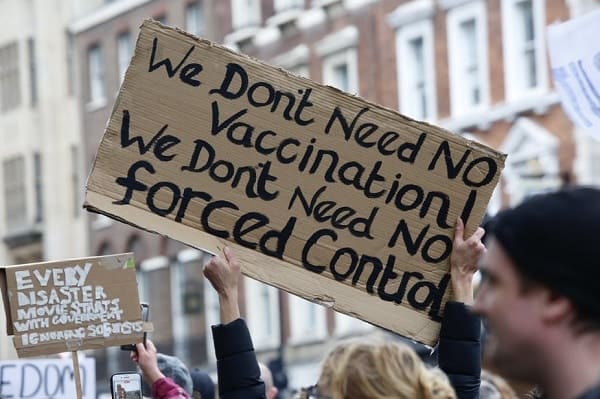
These vaccine hesitant people are not necessarily vaccine opponents. A large number of them consistently vaccinate their children against numerous childhood diseases. However, it must be noted that the increasingly well-coordinated global anti-vaccine movement has repurposed itself to challenge the very reality of COVID-19 as well as the usefulness of a new vaccine to prevent it. They have leveraged social media platforms to promote these doubts.
We also tried to determine how much trust people would have in a COVID-19 vaccine if their employer recommended it. Just more than three in five (61.4%) of all our respondents said they would do so. The numbers dropped to less than half of South Africans (46%) and Nigerians (44%).
Our data confirms a troubling trend towards vaccine hesitancy that has been found in other global and national studies. Professor Heidi Larson, a co-author of our paper, and her team at the Vaccine Confidence Project at the London School of Hygiene and Tropical Medicine recently reported on trends in vaccine confidence observed across 149 countries between 2015 and 2019. They found that political instability and religious extremism were critical factors in declining vaccine confidence in many of these countries.
Recent political unrest in Nigeria, Africa’s most populous country with over 200 million people, does not bode well for a successful COVID-19 vaccination campaign there. Only South Africa and Ethiopia have recorded more COVID-19 cases on the continent.
Many public health workers also recall a massive boycott against polio vaccination in northern Nigeria. It was caused by a single rumour, and not an adverse event. This boycott led to the years of more polio infections and deaths in Nigeria, and delayed polio eradication from the continent as a whole.
So what must be done to get on track for a successful African vaccination programme against COVID-19?
Moving forward
As scientists, we should help health leaders to prepare now with education and dialogue to set appropriate expectations for when a coronavirus vaccine may be available. We need to build vaccine literacy with effective communication and community engagement for acceptance country by country, village by village, taking into account community-specific issues, concerns or misconceptions and working with local religious and civil leaders and influencers.
We also need to help people become more fluent about vaccinations: Are they safe? Will they protect me and my family? Do I need to be vaccinated to be able to work? Will everyone be able to get it? Will vaccination sterilise me or my kids?
And we must be realistic that none of this information and advocacy will truly convince people to accept COVID-19 vaccination, or any other, in the absence of genuine societal trust. Without mutual trust, we may not be able to rebuild economies and return to anything approaching “normal” life.
It would be tragic if we developed, made and distributed safe and effective COVID-19 vaccines and people refused to take them, when health infrastructure and equipment levels cannot stem the pandemic.
Two authors of this study, Drs. Ratzan and Larson, are co-leaders of a recently launched global coalition – CONVINCE [COVID-19 New Vaccine Information Communication and Engagement]. This initiative is spearheaded by the CUNY Graduate School of Public Health, the Vaccine Confidence Project of the London School of Hygiene and Tropical Medicine, and Wilton Park, a part of the UK’s Foreign, Commonwealth and Development Office. A number of African public health leaders have already joined it.
Scott C. Ratzan, Distinguished Lecturer, , CUNY Graduate Center; Agnes Binagwaho, Vice Chancellor, University of Global Health Equity; Heidi Larson, Senior Lecturer in Epidemiology & Population Health, London School of Hygiene & Tropical Medicine; Jeffrey Lazarus, Associate Professor of Political Science, Georgia State University; Kenneth Rabin, Senior Scholar, CUNY Graduate Center, and Lawrence O. Gostin, University Professor; Founding Linda D. & Timothy J. O’Neill Professor of Global Health Law, Georgetown University
This article is republished from The Conversation under a Creative Commons license. Read the original article.
