

by Ralph Hamann and Scott Drimie
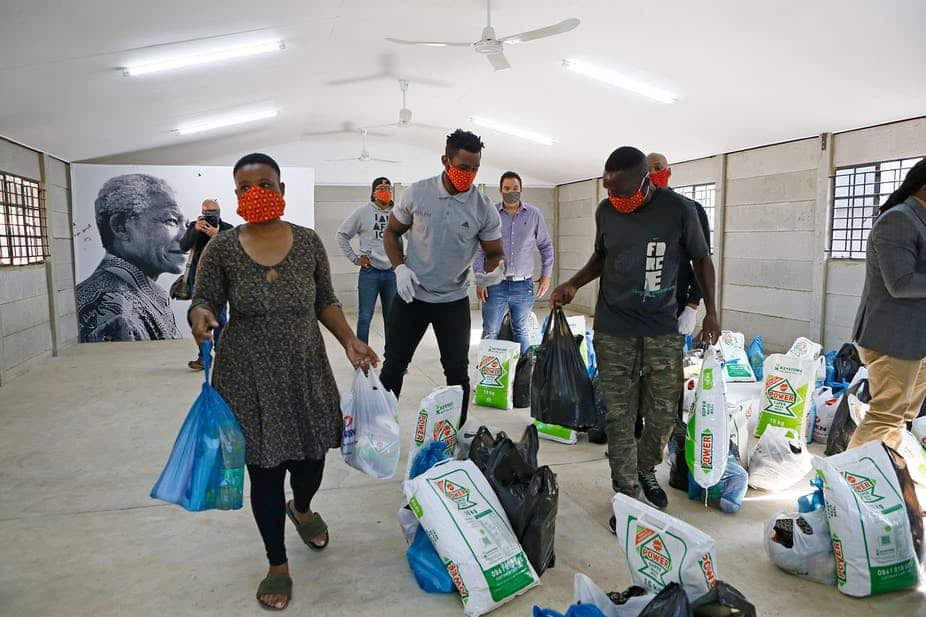
In South Africa a range of social solidarity networks have emerged to respond to the COVID-19 hunger crisis. They are a vital part of the societal response because of their speed, innovation, and local responsiveness. They complement the central role of government. Yet the government is struggling to develop this partnership and risks stifling solidarity networks with bureaucratic control.
Government responses to crises are crucial. But the scale and complexity of the current crisis are too great for the government acting alone. It is constrained by its prior way of working, which emphasises standardisation and control. It also lacks information about who is in need (beyond grant recipients), and it lacks the supply chains to get help to them quickly.
This is not necessarily a criticism of this particular government. All governments are struggling with the fallouts of COVID-19.
We know from the extensive scholarly literature on disasters that governments are inherently constrained in responding rapidly to the local impacts of disasters. For instance, after the Black Saturday fires in Australia, neighbourhood networks were crucial in alleviating suffering because the aid from the government and other large organisations was slow in coming and often inappropriate for local needs.
We have been participating in or studying a number of such emergent solidarity networks and “spontaneous venturing” efforts that are responding to the COVID-19 crisis in South Africa. They include the examples described below, as well as others, such as the responses by the Southern Africa Food Lab. These experiences and research have shown us how existing and new networks can play an important role and how this role needs to be strengthened.
Solidarity networks
Locally embedded actors can build on local knowledge and relationships developed prior to the crisis.
For example, Christine Fyvie has been working with the NGO Boost Africa for many years in one of Cape Town’s most vulnerable communities, Dunoon. She had set up after-school clubs to help children from particularly vulnerable households. This gave her useful information about which households were at particular risk and how to channel food and other essentials to them.
Even so, ensuring that the food was getting to those most in need has been a challenge. She told us:
Some individuals or groups make use of distributed food to enhance their power in the community. Others won’t put up their hand even though we know they really need it. It is only possible to navigate these tricky dynamics with some knowledge of the community and with some trust among its members.
This trust is especially vital in pre-empting competition within communities as the need for food grows. It is also crucial because the need for speedy responses makes traditional accountability mechanisms difficult to adhere to.
Read more:
Pandemic underscores gross inequalities in South Africa, and the need to fix them
Spontaneous venturing shows how innovation can match the growing need with diverse sources of supply. For example, the social enterprise Food Flow has created novel network connections in response to the crisis. It was established just before lockdown started in Cape Town, when Ashley Newell and her partner, Iming Lin, realised that small farmers in their area were losing their customers among hotels and restaurants, while vulnerable households were going hungry.
They came to know about this because of their local knowledge and networks: Iming is a farmer herself and both Ashley and Iming had been actively involved in local social development efforts.
Their response was to use donor funding to buy food from the local farmers and deliver it to local NGOs working in low-income communities.
The initiative struck a chord. They initially hoped to redirect about 150 bags of produce a week. But by the end of their first week, they had raised so much money that they had facilitated the delivery of 3,500. (Each provides for about 10 meals.)
This scaling-up required radical innovation, based on existing relationships. Ashley told us:
We thought we could use a mobile payment system like Snapscan to enable donations, but it was taking too long. I had a friend at Webtickets (an online events booking company) and they were willing to put us on their site, even though it was meant for something entirely different.
Our third example is the remarkable emergence of Community Action Networks (CANs) in diverse neighbourhoods in Cape Town (and now also elsewhere in the country). An initial objective of each CAN was to ensure that vulnerable members of the local community would be supported during lockdown. But given social and spatial inequalities in the city, their purpose soon grew to promote and show solidarity across communities. This has been expressed most strongly in the pairing of CANs in poorer and better-off areas, to support the exchange of information and ideas, and to ensure that essentials could be channelled to those most in need.
There are over 2,000 volunteers registered in about 150 such Community Action Networks in the Cape Town metropole, and there are about 20 pairings between CANs. They are connected in an overarching network called Cape Town Together, which emphasises that
we act locally, while also drawing on our collective experience and energy to share lessons and resources across the city.
The Community Action Networks have facilitated an impressive exchange of finance, food, and other physical resources. They are also exchanging information about local needs and how best to address them.
But there’s a risk that government could stifle initiatives like this. It has sought to exert control by, among other things, insisting that food parcels adhere to strict requirements and are vetted by local municipalities.
There are good reasons for such regulation. But the risk is that this impulse to control civil society responses ignores the magnitude, complexity, and human costs of the hunger crisis, as well as the inherent constraints that the government faces in responding. The bureaucratic limitations that have made the civil society response necessary may now impose themselves on the response.
The way forward
The examples above show the importance of the local knowledge and relationships, the innovation, and the local responsiveness that solidarity networks can bring to addressing the COVID-19 hunger crisis. A first step is to recognise and celebrate these vital contributions.
A second step is for the government and other large organisations to recognise the complementarity between their own efforts and those of emergent solidarity networks. Building this into a partnership requires efforts on both sides.
Protagonists in solidarity networks must show that they are diligent in abiding by strict standards of health and safety. Cape Town Together is showing how this can be done.
Government officials must help rather than hinder solidarity networks by sharing information, by expediting permits to allow appropriate movement, and by generally adopting a supportive posture. Such coordination and collaboration is already happening. But the scale and severity of the hunger crisis require a much stronger and ambitious partnership between the government and civil society.
This article has been written in a community of practice including Alecia Sewlal, Ashley Newell, Christine Fyvie, Jenny Soderbergh, Mandy Rapson, Sarita Sehgal, and Thanyani Ramarumo (all research students at the UCT Graduate School of Business).
Ralph Hamann, Professor, University of Cape Town; Annika Surmeier, Marie Sklodowska-Curie Global Fellow, University of Cape Town; Jody Delichte, Phd Candidate, Graduate School of Business, University of Cape Town, and Scott Drimie, Adjunct Professor, Stellenbosch University
This article is republished from The Conversation under a Creative Commons license. Read the original article.
