

Close Menu
  • Homepage
  • News
  • Cloud & AI
  • ECommerce
  • Entertainment
  • Finance
  • Opinion
  • Podcast
  • Contact

Subscribe to Updates

Get the latest technology news from TechFinancials News about FinTech, Tech, Business, Telecoms and Connected Life.

What's Hot

Digitap ($TAP) Crushes NexChain with Real Banking Utility: Best Crypto to Buy in 2026

2026-02-07

Football Fans Can Share Their ‘Super Bowl Spread’  With The Chance To Win an NFL Jersey

2026-02-07

Why Traditional Banks Need Mobile Money Solutions to Survive the Next 5 Years

2026-02-07
Facebook X (Twitter) Instagram
Trending
  • Digitap ($TAP) Crushes NexChain with Real Banking Utility: Best Crypto to Buy in 2026
Facebook X (Twitter) Instagram YouTube LinkedIn WhatsApp RSS
TechFinancials
  • Homepage
  • News
  • Cloud & AI
  • ECommerce
  • Entertainment
  • Finance
  • Opinion
  • Podcast
  • Contact
TechFinancials
Home»Opinion»Ashes to Ashes, Dust to … Compost? An Eco-Friendly Burial in Just 4 Weeks
Opinion

Ashes to Ashes, Dust to … Compost? An Eco-Friendly Burial in Just 4 Weeks

ContributorBy Contributor2020-01-03No Comments5 Mins Read
Share Facebook Twitter Pinterest LinkedIn Tumblr Email
Artist’s impression of the proposed ceremonial space of the Recompose facility in Seattle.
Artist’s impression of the proposed ceremonial space of the Recompose facility in Seattle. Images courtesy of Olson Kundig, CC BY-NC
Share
Facebook Twitter LinkedIn Pinterest Email Copy Link

by Emma Sheppard-Simms

In Australia, interment in a cemetery or a churchyard has been the most common choices for in-ground burial. Over the past 20 years, though, burial has become a less accessible and more costly option for many people. This is because increasing numbers of deaths have created a boom in demand for burial plots and cemeteries are fast running out of space.

Since the 1950s, cremation has gained in popularity. But, although a majority of Australians who died last year were cremated, it is far from sustainable. Each cremation releases about 50 kilograms of CO₂ as well as toxins into the atmosphere.


Read more:
Housing the dead: what happens when a city runs out of space?


The Australian way of death clearly needs to change, but arriving at solutions is a far more complicated matter.

Some people believe composting burial might provide one answer. Also known as “natural organic reduction”, composting burial is the brainchild of Katrina Spade, CEO of alternative burial company Recompose. The process involves decomposition of the corpse in soil — but not within a traditional cemetery.

How does it work?

The first step in the process of composting burial is to place the body into a vessel containing a mix of soil, wood chips, straw and alfalfa. As decomposition begins, microbial activity creates heat. This speeds things up and eliminates germs from the mix.

Over time the body is transformed into soil – around 760 litres of it. A portion of this soil will be returned to relatives for scattering, to make a memorial garden, or to use in public greening projects.


Read more:
Buried beneath the trees: a plan to solve our shortage of cemetery space
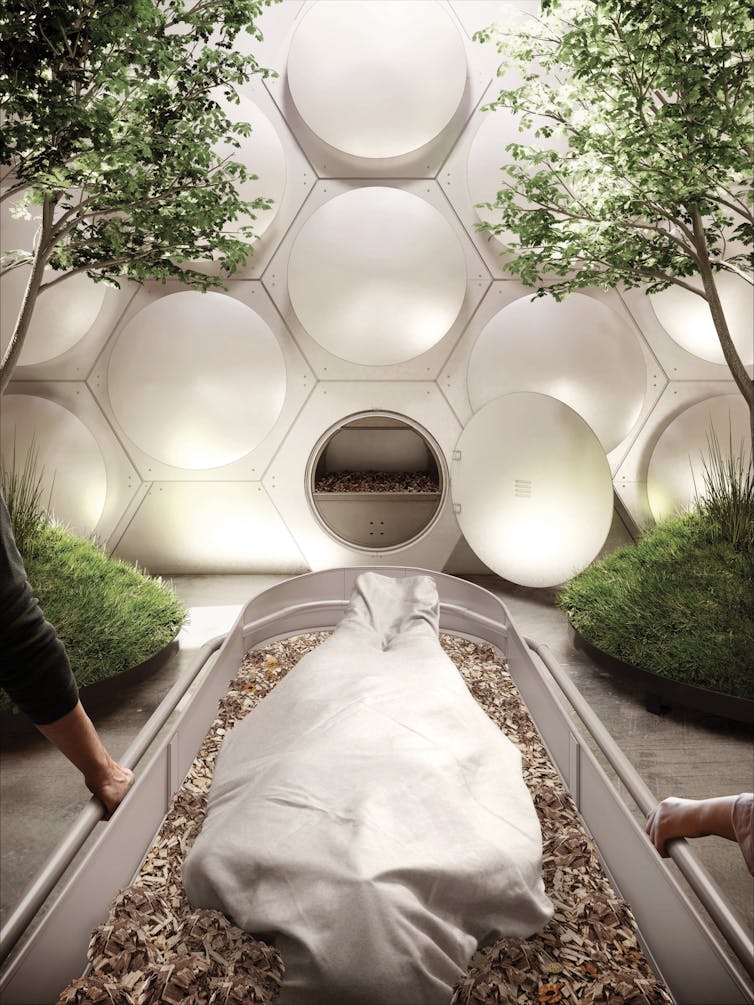

Artist’s impression of the proposed decomposition vessel in Seattle.
Images courtesy of Olson Kundig

A pilot interment program conducted by Washington State University showed the process takes about four weeks. This is a big difference to traditional burial. It can take up to hundreds of years before a grave can be reused.

The state of Washington recently legalised composting burial. The next step is implementation and Recompose has paired with architecture firm Olson Kundig to design the world’s first facility for composting burial in Seattle. It has 75 vessels. If these are reused every four weeks, the facility could process about 900 burials per year.

How does the cost compare?

These recent developments pave the way for its possible introduction in Australia. However, many questions remain to be answered. Is it really a more affordable or sustainable option than traditional modes of bodily disposal?

In 2019, Australian Seniors’ Cost of Death Report found the average cost of a basic burial is $8,048. A basic cremation costs $3,108 on average.

However, the cost of an individual burial depends on where you live. Exclusive beachside locales command the highest prices for burial real estate.

At Waverley Cemetery in Sydney a burial can cost upwards of $25,000.
Kgbo/Wikimedia Commons, CC BY-SA


Read more:
Losing the plot: death is permanent, but your grave isn’t


And, if you’re an Australian pensioner with no savings who has lived your whole life in the inner city, you’re going to struggle to afford a burial plot in your neighbourhood.

When the Recompose facility opens in 2021 in Seattle, composting burial will be on offer for about USD$5,500 (A$8,000) — about the same as a basic traditional burial in Australia. The costs might come down if the practice becomes widespread.

However, the technology is likely to be covered by patent. This means licensing agreements would limit its adoption. So, in the short term at least, composting burial is likely to be marketed towards those on average to high incomes.

Honouring the dead

Perhaps the main benefit of composting burial is the flexibility of having remains that are not attached to a traditional grave site. If you want to be buried in a particular place that holds personal meaning for you, but don’t mind being decomposed in a building, composting burial may allow this to happen.

Of course, local bylaws that govern the disposal of human remains in public places will continue to play an important role.

Related to this is an underexplored potential for composting burial businesses to partner with government, private industry, nonprofit organisations and local councils to create memorial parks where “human soils” might be interred. A drawback to this could be squeamishness in the community about playing frisbee on top of grandpa.
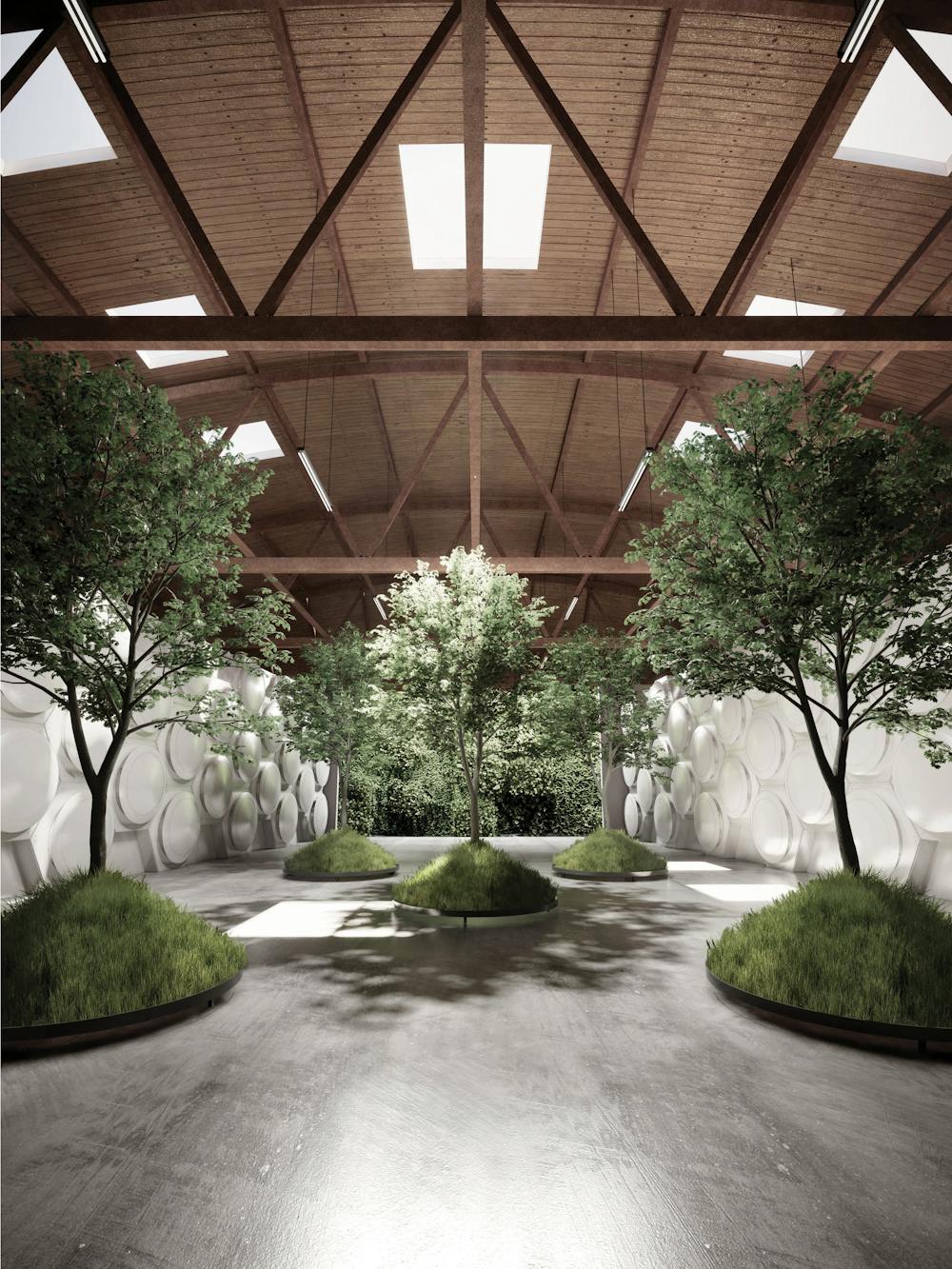
Artist’s impression of the interior of the proposed Recompose facility in Seattle.
Images courtesy of Olson Kundig

A greener alternative

Another potential benefit of composting burial is its sustainability. Founder Katrina Spade claims a metric ton of CO₂ will be saved every time someone chooses composting burial over traditional burial or cremation.

When seen in this light, composting burial makes more environmental sense than cremation. But, just like buying organic fruit, sustainability comes at a premium.

Beneath the practical considerations of space, cost and sustainability are the less visible questions about change and community resistance to burial practices that are new and confronting. It will take a lot to abandon traditional mourning practices that celebrate ideas of permanence, attachment to the grave and the notion of the loved one resting in an earthbound coffin.

There is hope, though, that composting burial will gain in appeal as a way of maintaining these important connections to traditional burial. By respecting each person’s desire to be returned after death to a place of their choosing, composting burial offers an intriguing and sensitive alternative.The Conversation

Emma Sheppard-Simms, PhD Candidate, School of Technology, Environments and Design, University of Tasmania

This article is republished from The Conversation under a Creative Commons license. Read the original article.

Ashes to Ashes Burial Compost Cremation Death Eco-Friendly Burial
Share. Facebook Twitter Pinterest LinkedIn Tumblr Email
Contributor

Related Posts

Private Credit Rating Agencies Shape Africa’s Access To Debt. Better Oversight Is Needed

2026-02-03

Why South Africa Cannot Afford To Wait For Healthcare Reform

2026-02-02

SA Auto Industry At Crossroads: Cheap Imports Threaten Future

2026-02-02

Stablecoins: The Quiet Revolution South Africa Can’t Ignore

2026-02-02

South Africa Could Unlock SME Growth By Exploiting AI’s Potential Through Corporate ESD Funds

2026-01-28

How Local Leaders Can Shift Their Trajectory In 2026

2026-01-23

Why Legal Businesses Must Lead Digital Transformation Rather Than Chase It

2026-01-23

Directing The Dual Workforce In The Age of AI Agents

2026-01-22

The Productivity Myth That’s Costing South Africa Talent

2026-01-21
Leave A Reply Cancel Reply

DON'T MISS
Breaking News

Digitap ($TAP) Crushes NexChain with Real Banking Utility: Best Crypto to Buy in 2026

The crypto presale market in 2026 has seen dozens of projects compete for investor attention.…

Dutch Entrepreneurial Development Bank FMO Invests R340M In Lula To Expand SME funding In SA

2026-02-03

Paarl Mall Gets R270M Mega Upgrade

2026-02-02

Huawei Says The Next Wave Of Infrastructure Investment Must Include People, Not Only Platforms

2026-01-21
Stay In Touch
  • Facebook
  • Twitter
  • YouTube
  • LinkedIn
OUR PICKS

Vodacom Reports Robust Q3 Growth, Driven By Diversification And Strategic Moves

2026-02-04

South Africa’s First Institutional Rand Stablecoin, ZARU, Launches

2026-02-03

The EX60 Cross Country: Built For The “Go Anywhere” Attitude

2026-01-23

Mettus Launches Splendi App To Help Young South Africans Manage Their Credit Health

2026-01-22

Subscribe to Updates

Get the latest tech news from TechFinancials about telecoms, fintech and connected life.

About Us

TechFinancials delivers in-depth analysis of tech, digital revolution, fintech, e-commerce, digital banking and breaking tech news.

Facebook X (Twitter) Instagram YouTube LinkedIn WhatsApp Reddit RSS
Our Picks

Digitap ($TAP) Crushes NexChain with Real Banking Utility: Best Crypto to Buy in 2026

2026-02-07

Football Fans Can Share Their ‘Super Bowl Spread’  With The Chance To Win an NFL Jersey

2026-02-07

Why Traditional Banks Need Mobile Money Solutions to Survive the Next 5 Years

2026-02-07
Recent Posts
  • Digitap ($TAP) Crushes NexChain with Real Banking Utility: Best Crypto to Buy in 2026
  • Football Fans Can Share Their ‘Super Bowl Spread’  With The Chance To Win an NFL Jersey
  • Why Traditional Banks Need Mobile Money Solutions to Survive the Next 5 Years
  • Spotify Brings Audiobooks to South Africa
  • Anjouan Corporate Services Reshapes Cross-Border Brokerage Licensing Strategy for UAE-Focused Firms
TechFinancials
RSS Facebook X (Twitter) LinkedIn YouTube WhatsApp
  • Homepage
  • Newsletter
  • Contact
  • Advertise
  • Privacy Policy
  • About
© 2026 TechFinancials. Designed by TFS Media. TechFinancials brings you trusted, around-the-clock news on African tech, crypto, and finance. Our goal is to keep you informed in this fast-moving digital world. Now, the serious part (please read this): Trading is Risky: Buying and selling things like cryptocurrencies and CFDs is very risky. Because of leverage, you can lose your money much faster than you might expect. We Are Not Advisors: We are a news website. We do not provide investment, legal, or financial advice. Our content is for information and education only. Do Your Own Research: Never rely on a single source. Always conduct your own research before making any financial decision. A link to another company is not our stamp of approval. You Are Responsible: Your investments are your own. You could lose some or all of your money. Past performance does not predict future results. In short: We report the news. You make the decisions, and you take the risks. Please be careful.

Type above and press Enter to search. Press Esc to cancel.

Ad Blocker Enabled!
Ad Blocker Enabled!
Our website is made possible by displaying online advertisements to our visitors. Please support us by disabling your Ad Blocker.