Close Menu
  • Homepage
  • News
  • Cloud & AI
  • ECommerce
  • Entertainment
  • Finance
  • Opinion
  • Podcast
  • Contact

Subscribe to Updates

Get the latest technology news from TechFinancials News about FinTech, Tech, Business, Telecoms and Connected Life.

What's Hot

Joshua Tate, Cofounder and CEO of ForumPay, on When the Blockchain Meets the Register

2026-07-19

Sequentum Cloud Wins 2026 CODiE Award for Best No-Code/Low-Code Platform

2026-07-18

SMSFAST Surpasses 1.29 Million Users With 96.4% SMS Delivery Rate

2026-07-17
Facebook X (Twitter) Instagram
Trending
  • Joshua Tate, Cofounder and CEO of ForumPay, on When the Blockchain Meets the Register
Facebook X (Twitter) Instagram YouTube LinkedIn WhatsApp RSS
TechFinancials
  • Homepage
  • News
  • Cloud & AI
  • ECommerce
  • Entertainment
  • Finance
  • Opinion
  • Podcast
  • Contact
TechFinancials
Home»Opinion»The Robot Wears Prada: What Happens When AI Starts Giving Out Fashion Tips?
Opinion

The Robot Wears Prada: What Happens When AI Starts Giving Out Fashion Tips?

ContributorBy Contributor2019-10-23Updated:2019-10-25No Comments5 Mins Read
Share Facebook Twitter Pinterest LinkedIn Tumblr Email
Fashion
Fashion. Photo by Martino Pietropoli on Unsplash
Share
Facebook Twitter LinkedIn Pinterest Email Copy Link

by Mark Liu

The tech giants Amazon, Google and Facebook have all begun to use machine learning to give you tips on what to wear. Is fashion styling the next field to be disrupted by artificial intelligence (AI), or will the human eye remain supreme?

It’s too soon to know for sure, but understanding what machine learning is good at and how that overlaps with what fashion is all about can help us make some educated guesses.

Get that look

One thing machine learning does very well is find patterns and common features among groups of items.

Taking advantage of this, Google Lens and Amazon Style Snap can each identify a garment from a photo or video and then tell you a bit more, like how other people have worn it or where you can buy it.

This serves the same function as a fashion magazine taking a celebrity look and breaking it down into pieces. By allowing consumers to recreate looks from movies, music videos, magazines and the runway, it democratises elements of styling.
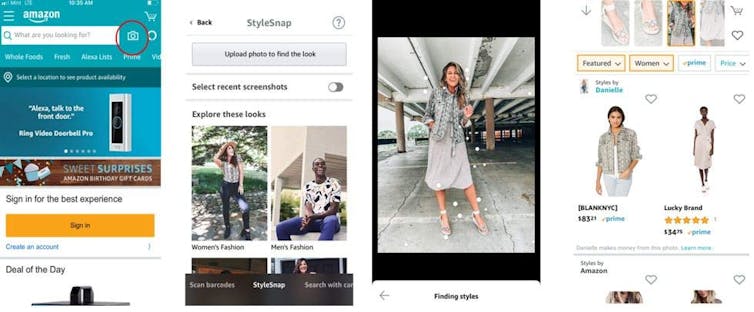
Amazon’s Style Snap service will find you clothes to buy that are similar to ones in a photo.
Amazon

Amazon also goes further, linking garments to a database of looks from popular fashion influencers. This offers the customer creative inspirations to build looks (and conveniently gives the influencers a cut if the customers buys the clothes).

This system has great potential, but it can only be as good as the data that’s fed into it. A large and diverse database could bring out cultures and beauty standards that are not often seen in magazines or television, allowing people to find their tribe. But a narrower collection of sources will only produce more of the same.


Read more:
When AI meets your shopping experience it knows what you buy – and what you ought to buy


The stylist in the machine

The next step in computer fashion – using AI to offer styling judgements – has so far been less successful.

Amazon’s Echo Look is a voice-controlled camera that aims to function as a style assistant, comparing two photos using a machine learning algorithm and telling you which one scores better. So far it has received lacklustre reviews.
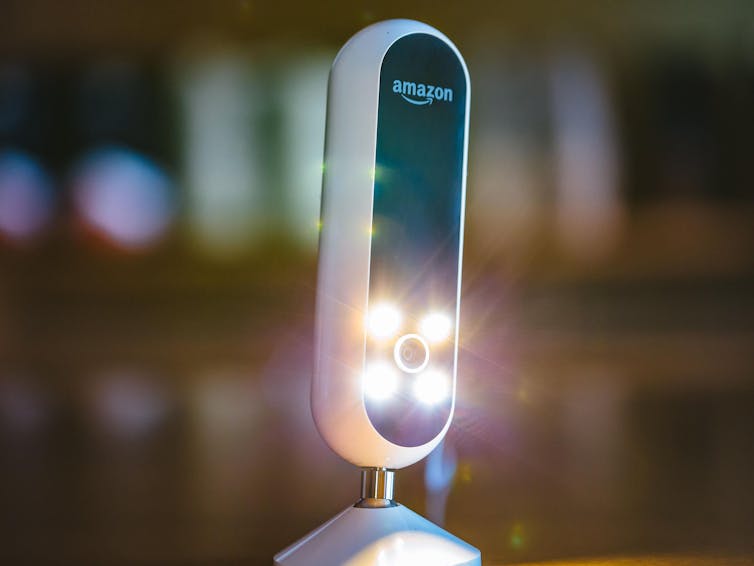
The Amazon Echo Look takes your photo and sends it off to the cloud for judgement.
Amazon

This service seems doomed to struggle, as it neglects many basic principles of fashion design.

For example, many looks from influencers only have a front view. How can you possibly style an outfit properly without the whole picture? Most principles of styling also take into account the wearer’s body shape, how well fitted their clothing is, their personality, and the occasion for which the garment is being worn. Context, symbolism, nostalgia, and personal preferences also play a role.

The AI assistant has no way to address these nuances. To succeed, the machine learning engineers will need to understand fashion better and find useful and tangible tasks for AI to perform.

Algorithmic zhooshing

Facebook’s experimental Fashion++ project goes further still, trying to tell you how to improve the outfit you’re wearing.

The idea behind the software is to make small changes (known as minimal edits) to an outfit, such as tucking in a shirt, rolling up a sleeve, changing the length of a hem, or removing an accessory. Garments are defined as “fashionable” if they are popular on a database and the AI learns to edit looks to make them score more highly in this regard.


Read more:
Why STEM subjects and fashion design go hand in hand


This relies on a massive oversimplification of how the craft of fashion design works. Simply mimicking elements of what is popular and putting them together is no guarantee for an aesthetically pleasing look.

There is no guarantee that the most popular look – the statistical “mode” – will be truly fashionable, or “à la mode”.
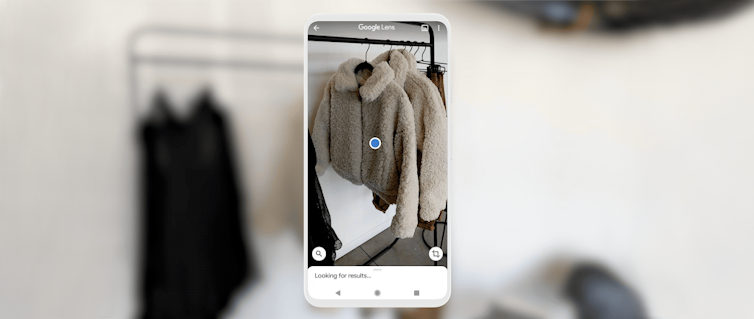
Google’s Lens image recognition system now offers similar looks from around the web when you upload an image of some clothes.
Google

A spy in your wardrobe

As we start taking photos and streaming videos of what we desire, or begin uploading photos of ourselves in our underwear, we should keep in mind that our data is being stored and mined. For data-mining corporations, we and our personal information that can be used to influence our behaviour and sold on to advertisers.

Even if you are unconcerned with your personal data being shared, AI products are likely to encourage needless consumption over the actual goal of making you look attractive. Often when people seek the help of a stylist or a second opinion on their appearance, it is not even about the clothing.

Some need validation or attention, or are set in their ways what makes them look attractive. Fashion styling serves a whole range of functions: creating a look of beauty, projecting power, attracting a romantic partner, or making the wearer feel special. There is no guarantee that even a stylist and some new clothing can achieve these goals – an app barely stands a chance.The Conversation

Mark Liu, Chancellors Postdoctoral Research Fellow, Fashion and Textiles Designer, University of Technology Sydney

This article is republished from The Conversation under a Creative Commons license. Read the original article.

Share. Facebook Twitter Pinterest LinkedIn Tumblr Email
Contributor

Related Posts

From Innovation To Application: AI In The Business Of Property

2026-07-14

What We Can Learn From AI Skeptics

2026-07-14

If Your Wallet Only Works In One Shop, It Isn’t Really Money

2026-07-09

The Case For Grid Defection – Why South African Residential Estates Are Choosing Energy Independence

2026-07-08

Every Year We Lose 12,000 South Africans On Our Roads. We Already Have The Tech To Change That

2026-07-08

The Risk Of AI Tunnel Vision In IT Efficiency

2026-07-03

South Africa: AI And Cyber Insurance: A Market In Transition

2026-07-01

African Expansion Still Appeals To Banks. The Real Risk Is Thinking The Old Playbook Still Works

2026-06-29

Cash Is Still King: The SARB’s Cash Smart Strategy

2026-06-29
Leave A Reply Cancel Reply

DON'T MISS
Breaking News

Eskom Green Secures Final PFMA Approvals, Targets 32GW Utility-Scale Renewable Push By 2040

South Africa’s energy landscape enters a transformative new chapter this week as Eskom Holdings secures…

From Innovation To Application: AI In The Business Of Property

2026-07-14

SA FinTech Float Exports Card-Linked Instalment Innovation To The UK

2026-07-08

South African AI Coding Startup HyperDev Secures R16 Million Pre-Seed Funding Amid Explosive User Growth

2026-07-06
Stay In Touch
  • Facebook
  • Twitter
  • YouTube
  • LinkedIn
OUR PICKS

Amazon Leo Names Herotel, Maziv As Distributors In Starlink Battle

2026-07-15

Giant Data Centres Get The First Green Light From Cape Town Tribunal

2026-07-15

Eskom Launches Eskom Green, A Dedicated Renewable Energy Business

2026-06-09

Why South Africans Are No Longer Switching Mobile Phone Operators?

2026-06-01

Subscribe to Updates

Get the latest tech news from TechFinancials about telecoms, fintech and connected life.

About Us

TechFinancials delivers in-depth analysis of tech, digital revolution, fintech, e-commerce, digital banking and breaking tech news.

Facebook X (Twitter) Instagram YouTube LinkedIn WhatsApp Reddit RSS
Our Picks

Joshua Tate, Cofounder and CEO of ForumPay, on When the Blockchain Meets the Register

2026-07-19

Sequentum Cloud Wins 2026 CODiE Award for Best No-Code/Low-Code Platform

2026-07-18

SMSFAST Surpasses 1.29 Million Users With 96.4% SMS Delivery Rate

2026-07-17
Recent Posts
  • Joshua Tate, Cofounder and CEO of ForumPay, on When the Blockchain Meets the Register
  • Sequentum Cloud Wins 2026 CODiE Award for Best No-Code/Low-Code Platform
  • SMSFAST Surpasses 1.29 Million Users With 96.4% SMS Delivery Rate
  • Scott IT Academy Launches Online Platform for Secure Agile Development Training
  • Huawei South Africa Connect 2026 to tackle the infrastructure needed for the AI era
TechFinancials
RSS Facebook X (Twitter) LinkedIn YouTube WhatsApp
  • Homepage
  • Newsletter
  • Contact
  • Advertise
  • Privacy Policy
  • About
© 2026 TechFinancials. Designed by TFS Media. TechFinancials brings you trusted, around-the-clock news on African tech, crypto, and finance. Our goal is to keep you informed in this fast-moving digital world. Now, the serious part (please read this): Trading is Risky: Buying and selling things like cryptocurrencies and CFDs is very risky. Because of leverage, you can lose your money much faster than you might expect. We Are Not Advisors: We are a news website. We do not provide investment, legal, or financial advice. Our content is for information and education only. Do Your Own Research: Never rely on a single source. Always conduct your own research before making any financial decision. A link to another company is not our stamp of approval. You Are Responsible: Your investments are your own. You could lose some or all of your money. Past performance does not predict future results. In short: We report the news. You make the decisions, and you take the risks. Please be careful.

Type above and press Enter to search. Press Esc to cancel.

Ad Blocker Enabled!
Ad Blocker Enabled!
Our website is made possible by displaying online advertisements to our visitors. Please support us by disabling your Ad Blocker.