


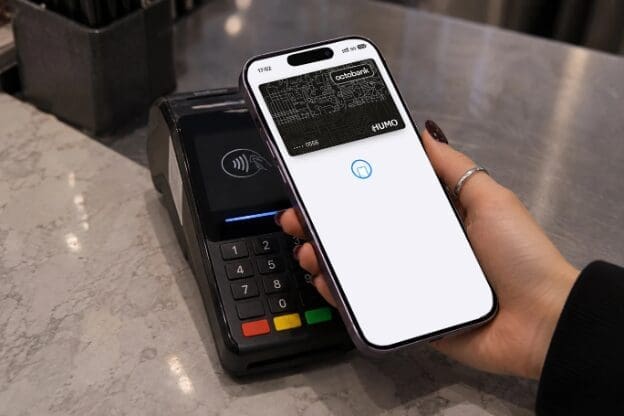

The development of digital payments in Central Asia is gradually extending beyond international bank cards. Uzbekistan has entered a new stage in the integration of its national payment systems with the global financial infrastructure: on November 17, 2026, HUMO and UZCARD cards began receiving Apple Pay support. Octobank became one of the first banks to introduce this functionality for HUMO cardholders.
Why the Integration of National Cards with Apple Pay Matters for Central Asia
In recent years, Central Asian countries have made significant progress in developing cashless payments. Banking applications, QR code payments, electronic wallets, and digital financial services are becoming an integral part of everyday life. At the same time, national payment systems continue to play an important role in facilitating domestic transactions.
In Uzbekistan, HUMO and UZCARD form the backbone of the domestic card payment infrastructure. These systems facilitate everyday transactions within the country, although their integration with international technology platforms requires dedicated technical solutions and alignment with security standards.
This is why the introduction of Apple Pay support for national cards is significant not only for Uzbekistan’s banking sector but also for the broader Central Asian market. Until recently, the use of Apple Pay in the region was primarily associated with international payment networks such as Visa and Mastercard. Now, similar technologies are becoming available to holders of domestic bank cards.
For the market, this represents a gradual alignment of national payment infrastructure with global digital payment standards. Consumers gain access to additional payment methods, while banks can develop their own services without having to move customers exclusively to international card products.
According to Urmatbek Tynaliev, Ph.D. from the University of Minnesota (USA) and a researcher in economics and management, enhancing interoperability between national payment systems and international technology platforms is significant for Central Asia’s entire financial infrastructure.
“For Central Asian countries, the development of national payment systems is not only about making everyday transactions more convenient but also about enhancing the technological interoperability of financial infrastructure. Integrating domestic cards with international digital platforms expands consumer opportunities and encourages banks to develop modern services. In the long term, these developments could help strengthen the competitiveness of the region’s financial sector,” the expert notes.
How Uzbekistan’s Banks Are Implementing the New Technology
One of the first practical examples of this integration was the introduction of Apple Pay support for HUMO cards issued by Octobank.
Since November 17, 2026, the bank’s customers have been able to add cards from the national payment system to Apple Wallet and use them for contactless payments with their iPhones and Apple Watches.
The technology allows customers to make purchases without using a physical card. Apple Pay employs tokenization, meaning that actual bank card details are not shared with merchants during transactions, while dedicated security mechanisms are used to authenticate payments.
For national cardholders, this primarily means an expansion of their everyday payment options. HUMO cardholders gain access to the same contactless payment capabilities that were previously available mainly to holders of international cards.
At the same time, integrating domestic cards with Apple Pay requires coordination among several stakeholders: issuing banks, national payment systems, the technology platform, and organizations responsible for transaction processing.
As a result, such solutions are typically implemented in phases, depending on the technological readiness of individual banks and the broader payment infrastructure.
Beyond HUMO: National Payment Systems Are Expanding Their Capabilities
Alongside the introduction of Apple Pay support for Octobank’s HUMO cards, the integration of UZCARD cards issued by the People’s Bank of Uzbekistan (Xalq Banki) with Apple Pay has also begun.
As a result, both of Uzbekistan’s major national payment systems are represented in the initial phase of the integration process.
This is an important development for the future of the market. Rather than being an isolated digital product offered by a single bank, it represents the establishment of technological capabilities that could eventually be adopted by other financial institutions.
Apple Pay support for HUMO and UZCARD cards is expected to expand as more banks become technologically ready for integration.
For consumers, this approach means a gradual increase in the number of available payment instruments. For the financial market, it provides an additional incentive to modernize card payment infrastructure and foster competition in digital financial services.
From Visa and Mastercard to National Cards: How Payment Infrastructure Is Evolving
The integration of HUMO with Apple Pay is part of a broader transformation driven by the digitalization of banking payments.
Uzbekistan’s banks have previously expanded their support for international payment instruments, including Visa and Mastercard, while also enhancing the capabilities of mobile banking applications and contactless payment services.
Before integrating HUMO, for example, Octobank had already enabled its customers to use Apple Pay with international Visa and Mastercard cards. The bank has also developed alternative payment solutions, including the integration of Alipay into its Octo-Mobile application.
This progression reflects a broader trend across the banking industry: financial institutions are seeking to bring different payment instruments together within a unified digital environment.
International cards provide access to the global payment infrastructure, national payment systems facilitate a significant share of domestic transactions, and mobile wallets make these instruments more convenient for customers.
Increasing interoperability between these systems is gradually reducing the technological disparities that previously determined the availability of individual payment methods.
What This Means for the Future of Digital Payments
The integration of national payment systems with international mobile wallets can be regarded as an indicator of the technological advancement of a financial market.
For Uzbekistan, where the adoption of digital banking services is expanding rapidly, such developments have several important implications.
First, they improve access to modern payment technologies for domestic cardholders. Consumers no longer necessarily need to obtain an international bank card solely to access a particular contactless payment method.
Second, integration creates additional opportunities for banks to offer advanced digital services within the existing national card payment infrastructure.
Third, the development of such technologies contributes to the alignment of domestic financial systems with international payment processing and security standards.
However, Apple Pay integration does not automatically eliminate all limitations associated with national bank cards. Their geographical coverage, the availability of specific transactions, and international payment capabilities continue to depend on the rules of the respective payment systems and the existing payment acceptance infrastructure.
Nevertheless, the initial integration of HUMO and UZCARD with Apple Pay demonstrates that the development of digital payments in Central Asia is gradually moving beyond the introduction of individual banking products toward deeper technological interoperability between different payment ecosystems.
The pioneering integrations implemented by Octobank and the People’s Bank of Uzbekistan could lay the practical groundwork for the wider adoption of similar solutions across Uzbekistan’s financial market.
