



Online slots have quietly become one of the most technologically sophisticated and commercially significant segments of the digital entertainment economy. What looks like a simple game of spinning reels is, under the hood, a complex system of random number generation, mathematical modelling, and real-time server infrastructure.
For a sector that now generates billions in revenue globally and is growing rapidly across emerging markets — including South Africa — understanding the technology behind these games is worth a closer look.
A fast-growing slice of the digital economy
The online gaming industry as a whole has expanded dramatically over the past decade, driven by smartphone adoption, faster mobile networks, and the maturation of digital payment systems. According to gaming market analysts at Newzoo, the global games and interactive entertainment market continues to grow year after year, with mobile platforms accounting for the largest share of players worldwide.
Online slots, as a subset of this broader ecosystem, have benefited enormously from the same trends — particularly in regions where mobile is the primary gateway to the internet.
South Africa and the wider African continent illustrate this shift well. With mobile-first internet usage and a young, digitally engaged population, the region has seen rapid growth in online entertainment across the board. The infrastructure that powers these experiences — cloud servers, payment gateways, and content delivery networks — is the same technology stack that underpins e-commerce and fintech, sectors that South African readers will recognise as central to the country’s digital transformation.
How random number generation actually works
At the core of every legitimate online slot is a random number generator, or RNG. This is a software algorithm that produces a continuous stream of random numbers, ensuring that each spin is independent and unpredictable. Unlike a physical slot machine with mechanical reels, an online slot’s outcome is determined the instant a player hits the spin button, based on the RNG’s output at that precise moment.
The integrity of this system is critical, which is why reputable operators submit their RNGs for independent testing. Organisations such as eCOGRA and similar testing agencies audit these algorithms to verify that outcomes are genuinely random and that advertised return rates are accurate. For players, the presence of such certification is one of the clearest markers distinguishing a trustworthy platform from an unregulated one — a form of due diligence not unlike checking the credentials of any financial service provider.
RTP and volatility: the numbers that matter
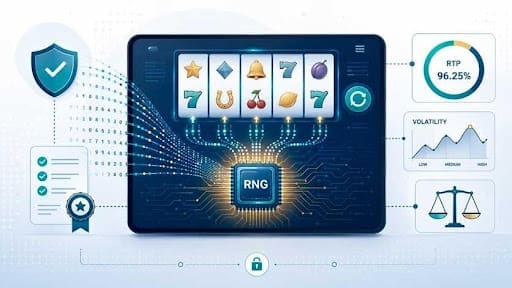
Two mathematical concepts define the economics of any online slot: return to player (RTP) and volatility. RTP is the percentage of wagered money a slot is designed to pay back over the long term. A slot with 96% RTP returns, on average, 96 units for every 100 wagered — with the remaining 4% representing the house edge. Volatility, meanwhile, describes the risk profile: high-volatility slots pay out less frequently but in larger amounts, while low-volatility slots offer smaller, more regular wins.
These numbers explain why certain titles achieve enormous popularity. Pragmatic Play’s Gates of Olympus, for example, became a global phenomenon largely because of its high-volatility design and its “pay anywhere” tumble mechanic, which appeals to players seeking the possibility of large payouts. The game’s success has spawned an entire category of similar titles, and resources that catalogue slots like Gates of Olympus help players compare RTP percentages, volatility levels, and bonus features across comparable games — applying the same analytical, data-driven approach that a careful consumer would bring to any purchasing decision.
Understanding these metrics turns what might look like pure chance into an informed choice about which games match a player’s preferences and risk tolerance.
The regulatory and consumer-protection dimension
As the sector grows, so does regulatory attention. Across many jurisdictions, authorities are working to establish frameworks that protect consumers, ensure fair play, and combat unlicensed operators. In South Africa, the regulatory landscape around online gaming continues to evolve, and consumer awareness has become increasingly important. The principles are familiar from other digital sectors: verify that a platform is licensed, understand the terms before committing money, and rely on independently verified information rather than marketing claims.
This consumer-protection angle is where the technology and the economics intersect most directly for everyday users. Just as fintech has pushed for greater transparency in financial products, the online gaming sector faces growing pressure to be clear about odds, payout rates, and the mechanics of its games. Informed players — those who understand RTP, volatility, and the role of RNG — are better positioned to engage with these products responsibly.
The takeaway
Online slots sit at an interesting intersection of technology, mathematics, and consumer behaviour. Behind the colourful graphics lies genuine engineering: certified random number generators, carefully modelled payout structures, and the same cloud and payment infrastructure driving the broader digital economy.
For a region like South Africa, where digital adoption is accelerating, understanding how these systems work is part of a wider digital literacy. Whether one engages with these games or simply observes the industry as a growing economic force, the underlying message is the same: knowledge transforms a seemingly random product into something that can be understood, evaluated, and approached with informed judgement.
