


Most marketing teams are sitting on a significantly larger video production opportunity than their current workflow allows them to act on. The product photography is strong. The brand imagery is professional. The campaign visuals are well-composed and on-brand. But none of it is video — and in 2026, that gap between having excellent static assets and having the video content that platforms reward and audiences engage with is one of the most consistent performance constraints in digital marketing.
Online sales continue to climb significantly during commercial peaks, and businesses that communicate through professional video content are consistently better positioned to capture that growth. The brands winning in paid social, organic reach, and e-commerce aren’t just producing more content — they’re producing content in the format that algorithms distribute most broadly and that consumers engage with most readily. Video is that format, and the businesses that have found efficient ways to produce it at scale have a structural advantage over those that haven’t.
Image-to-video AI addresses this directly for marketing teams that have strong static visual assets but lack the production infrastructure to convert them into video at the pace their strategy requires.
What Image to Video AI Does for Marketing Operations
The core capability is using existing photographs as the visual foundation for generated video — analyzing the depth, lighting, spatial relationships, and subject matter in a source image and generating motion that is contextually appropriate for what the image actually contains. The result is video content that maintains the visual quality and brand integrity of the source photography while adding the motion that makes content perform on video-native platforms.
Pollo AI’s dedicated image to video AI tool inside its Creative Studio applies this within a multi-model environment. Different generation models handle different image types and motion objectives with different strengths — product photography benefits from different motion treatment than lifestyle imagery, environmental shots respond differently than portrait content. Having access to multiple models within one platform on shared credits means routing each image type to the model that handles it best rather than accepting a single model’s output ceiling as the limit of what’s achievable.
For marketing teams with established photography libraries — product catalogs, campaign imagery, brand assets — this transforms existing investment into a video content pipeline without new production spend. The photography budget that’s already been allocated produces video content as an additional output, compounding the return on the original visual content investment.
The Commercial Application: From Product Images to E-Commerce and Advertising Video
The use cases where image-to-video generation delivers the most immediate commercial return are consistent across business types. Product video for e-commerce listings is the highest-impact application for product-based businesses: animated product content on listing pages consistently improves engagement and purchase confidence compared to static imagery alone, and generating that animation from existing product photography requires no additional production infrastructure.
Paid social advertising creative is the second major application. Static image ads have a performance ceiling in paid social environments where video consistently outperforms in click-through and conversion metrics. Generating video variations from existing campaign imagery — multiple motion treatments of the same product shot, different animation approaches for different audience segments — creates the creative volume needed for systematic testing without proportional increases in production cost.
Pollo AI’s Commerce Studio extends this further for product-specific visual content, handling product image enhancement, background generation, and e-commerce poster compositions within the same platform on shared credits. Marketing teams managing both product imagery and video advertising content can keep the full visual production workflow within one platform relationship rather than managing separate tools for each content type.
Marketing Studio: From Generated Video to Campaign-Ready Creative
The shift toward accessible digital tools for businesses of all sizes is reshaping what’s operationally possible with lean teams. Pollo AI’s Marketing Studio operationalises this for video advertising specifically — generating platform-ready ad formats from visual source material calibrated for the format specifications and attention dynamics of paid social campaigns rather than requiring post-production adaptation before deployment.
For marketing teams that use image-to-video generation to create video from existing photography and then need to adapt that video for multiple platform formats and campaign contexts, having both steps within the same platform eliminates the production handoff that typically adds time and friction between visual content creation and campaign deployment.
Canva AI and Building an Informed Visual Content Stack
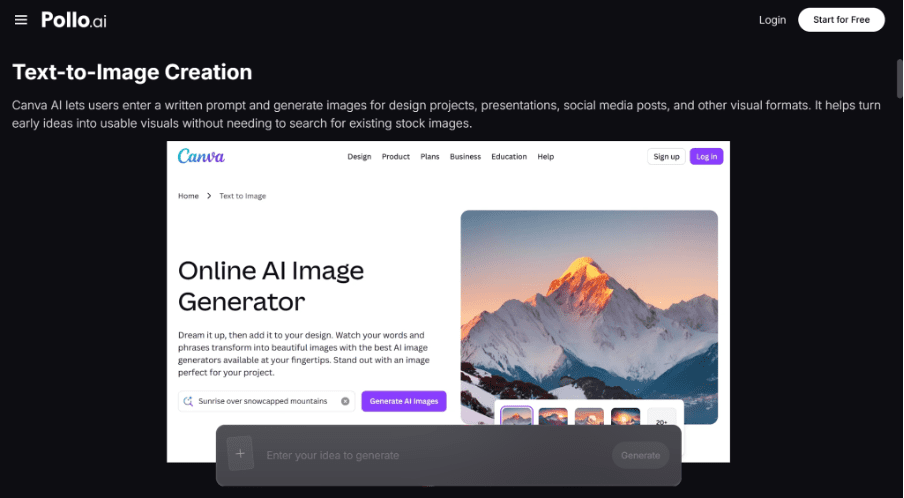
Covering AI as a core technology beat means understanding the full landscape of tools and how they differentiate from each other — and that’s equally true for marketing practitioners building their content production stacks. Canva AI has expanded its capabilities significantly within the Canva design environment, offering AI image generation and animation tools that suit teams already using Canva for social media graphics, presentations, and brand assets. For workflows where AI generation feeds into graphic design and template-based content, the integrated Canva environment reduces context switching and keeps assets within a familiar tool.
Where dedicated AI generation platforms like Pollo AI serve a different function is in the depth of the generated motion and the multi-model flexibility. Canva’s animation applies predetermined effects to design elements — which works well for graphic-based content. AI image-to-video generation produces motion that responds to what’s actually in the photograph, producing more realistic video output for photography-based content. Understanding which approach fits which content type helps marketing teams build a more intentional stack rather than defaulting to one tool for every visual content need.
The Compounding Case for Image-to-Video Integration
Technology convergence in digital marketing, e-commerce, and business communication is rewarding businesses that adopt tools early and build systematic workflows around them. Image-to-video generation earns its place in a marketing operation when the workflow is systematic rather than occasional — when strong images are routinely converted to video as a standard step in the content production process rather than as a special effort reserved for major campaign launches.
The businesses that build this systematically in 2026 are building a content production advantage that compounds over time: a larger video content library, more creative testing data from video campaigns, and a production workflow that scales content output without scaling production headcount. The photography investment has already been made. Image-to-video AI is what extends its reach into the format that drives the most performance across the channels that matter.
