Close Menu
  • Homepage
  • News
  • Cloud & AI
  • ECommerce
  • Entertainment
  • Finance
  • Opinion
  • Podcast
  • Contact

Subscribe to Updates

Get the latest technology news from TechFinancials News about FinTech, Tech, Business, Telecoms and Connected Life.

What's Hot

Digitap ($TAP) Crushes NexChain with Real Banking Utility: Best Crypto to Buy in 2026

2026-02-07

Football Fans Can Share Their ‘Super Bowl Spread’  With The Chance To Win an NFL Jersey

2026-02-07

Why Traditional Banks Need Mobile Money Solutions to Survive the Next 5 Years

2026-02-07
Facebook X (Twitter) Instagram
Trending
  • Digitap ($TAP) Crushes NexChain with Real Banking Utility: Best Crypto to Buy in 2026
Facebook X (Twitter) Instagram YouTube LinkedIn WhatsApp RSS
TechFinancials
  • Homepage
  • News
  • Cloud & AI
  • ECommerce
  • Entertainment
  • Finance
  • Opinion
  • Podcast
  • Contact
TechFinancials
Home»Opinion»What Is CrowdStrike Falcon And How Does It Ensure My Computer’s Safety?
Opinion

What Is CrowdStrike Falcon And How Does It Ensure My Computer’s Safety?

The ConversationBy The Conversation2024-07-19Updated:2024-07-30No Comments5 Mins Read
Share Facebook Twitter Pinterest LinkedIn Tumblr Email
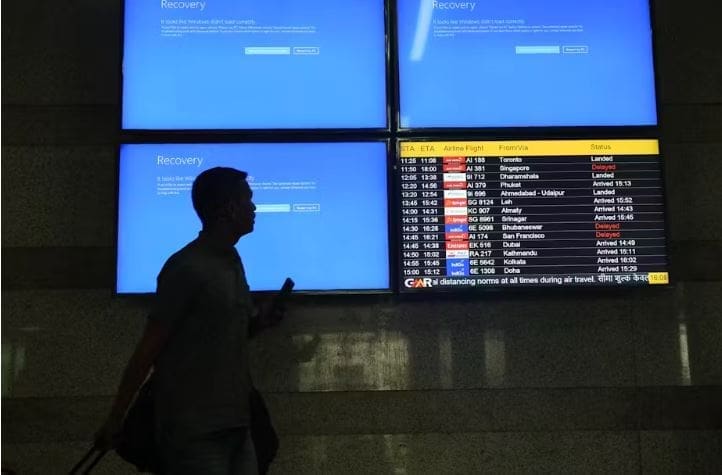
A passenger passes malfunctioning information screens at Delhi airport, India, July 19 2024. EPA/Rajat Gupta
Share
Facebook Twitter LinkedIn Pinterest Email Copy Link

A massive IT outage is currently affecting computer systems worldwide. In Australia and Aotearoa New Zealand, reports indicate computers at banks, media organisations, hospitals, transport services, shop checkouts, airports and more have all been impacted.

Today’s outage is unprecedented in its scale and severity. The technical term for what has happened to the affected computers is that they have been “bricked”. This word refers to those computers being rendered so useless by this outage that – at least for now – they may as well be bricks.

The widespread outage has been linked to a piece of software called CrowdStrike Falcon. What is it, and why has it caused such widespread disruption?

What is CrowdStrike Falcon?

CrowdStrike is a US cyber security company with a major global share in the tech market. Falcon is one of its software products that organisations install on their computers to keep them safe from cyber attacks and malware.

Falcon is what is known as “endpoint detection and response” (EDR) software. Its job is to monitor what is happening on the computers on which it is installed, looking for signs of nefarious activity (such as malware). When it detects something fishy, it helps to lock down the threat.

This means Falcon is what we call privileged software. To detect signs of attack, Falcon has to monitor computers in a lot of detail, so it has access to a lot of the internal systems. This includes what communications computers are sending over the internet as well as what programs are running, what files are being opened, and much more.

In this sense, Falcon is a bit like traditional antivirus software, but on steroids.

More than that, however, it also needs to be able to lock down threats. For example, if it detects that a computer it is monitoring is communicating with a potential hacker, Falcon needs to be able to shut down that communication. This means Falcon is tightly integrated with the core software of the computers it runs on – Microsoft Windows.
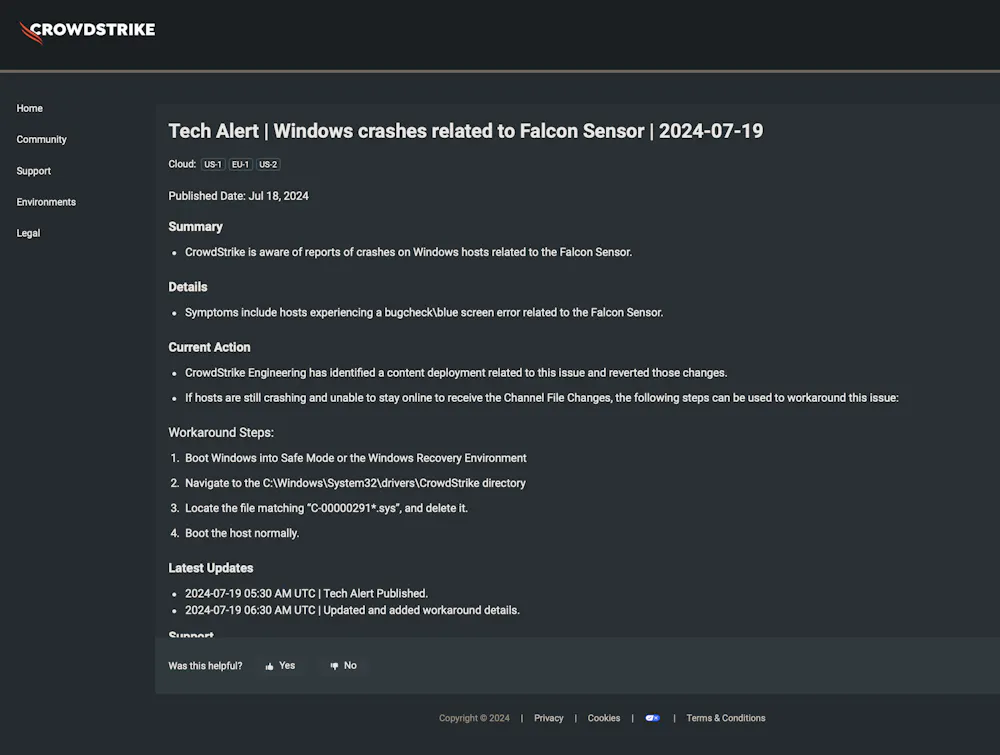
An update alert from the CrowdStrike website informing customers about the Windows crashes related to Falcon.
The Conversation/Crowdstrike

Why did Falcon cause this problem?

This privilege and tight integration makes Falcon powerful. But it also means that when Falcon malfunctions, it can cause serious problems. Today’s outage is a worst-case scenario.

What we currently know is that an update to Falcon caused it to malfunction in a way that caused Windows 10 computers to crash and then fail to reboot, leading to the dreaded “blue screen of death” (BSOD).

This is the affectionate term used to refer to the screen that is displayed when Windows computers crash and need to be rebooted – only, in this case, the Falcon problem means the computers cannot reboot without encountering the BSOD again.

Why is Falcon so widely used?

CrowdStrike is the market leader in EDR solutions. This means its products – such as Falcon – are common and likely the pick of the bunch for organisations conscious of their cyber security.

As today’s outage has shown, this includes hospitals, media companies, universities, major supermarkets and many more. The full scale of the impact is yet to be determined, but it’s certainly global.

Why aren’t home PCs affected?

While CrowdStrike’s products are widely deployed in major organisations that need to protect themselves from cyber attacks, they are much less commonly used on home PCs.

This is because CrowdStrike’s products are tailored for large organisations in which CrowdStrike’s tools help them monitor their networks for signs of attack, and provide them with the information they need to respond to intrusions in a timely way.

For home users, built-in antivirus sofware or security products offered by companies such as Norton and McAfee are much more popular.

How long will this take to fix?

At this stage, CrowdStrike has provided manual instructions for how people can fix the problem on individual affected computers.

However, at the time of writing there does not yet appear to be an automatic fix for the problem. IT teams at some organisations may be able to fix this problem quickly by simply wiping the affected computers and restoring them from backups or similar.

Some IT teams may also be able to “roll back” (revert to an earlier version) the affected Falcon version on their organisation’s computers. It’s also possible some IT teams will have to manually fix the problem on their organisation’s computers, one at a time.

We should expect that in many organisations it may take a while before the problem can be resolved entirely.

What is ironic about this incident is that security professionals have been encouraging organisations to deploy advanced security technology such as EDR for years. Yet that same technology has now resulted in a major outage the likes of which we haven’t seen in years.

For companies like CrowdStrike that sell highly privileged security software, this is a timely reminder to be incredibly careful when deploying automatic updates to their products.The Conversation

Toby Murray, Associate Professor of Cybersecurity, School of Computing and Information Systems, The University of Melbourne

This article is republished from The Conversation under a Creative Commons license. Read the original article.

CrowdStrike Falcon cybersecurity global IT outage
Share. Facebook Twitter Pinterest LinkedIn Tumblr Email
The Conversation
  • Website

Related Posts

Private Credit Rating Agencies Shape Africa’s Access To Debt. Better Oversight Is Needed

2026-02-03

Why South Africa Cannot Afford To Wait For Healthcare Reform

2026-02-02

SA Auto Industry At Crossroads: Cheap Imports Threaten Future

2026-02-02

Stablecoins: The Quiet Revolution South Africa Can’t Ignore

2026-02-02

South Africa Could Unlock SME Growth By Exploiting AI’s Potential Through Corporate ESD Funds

2026-01-28

How Local Leaders Can Shift Their Trajectory In 2026

2026-01-23

Why Legal Businesses Must Lead Digital Transformation Rather Than Chase It

2026-01-23

Directing The Dual Workforce In The Age of AI Agents

2026-01-22

The Productivity Myth That’s Costing South Africa Talent

2026-01-21
Leave A Reply Cancel Reply

DON'T MISS
Breaking News

Digitap ($TAP) Crushes NexChain with Real Banking Utility: Best Crypto to Buy in 2026

The crypto presale market in 2026 has seen dozens of projects compete for investor attention.…

Dutch Entrepreneurial Development Bank FMO Invests R340M In Lula To Expand SME funding In SA

2026-02-03

Paarl Mall Gets R270M Mega Upgrade

2026-02-02

Huawei Says The Next Wave Of Infrastructure Investment Must Include People, Not Only Platforms

2026-01-21
Stay In Touch
  • Facebook
  • Twitter
  • YouTube
  • LinkedIn
OUR PICKS

Vodacom Reports Robust Q3 Growth, Driven By Diversification And Strategic Moves

2026-02-04

South Africa’s First Institutional Rand Stablecoin, ZARU, Launches

2026-02-03

The EX60 Cross Country: Built For The “Go Anywhere” Attitude

2026-01-23

Mettus Launches Splendi App To Help Young South Africans Manage Their Credit Health

2026-01-22

Subscribe to Updates

Get the latest tech news from TechFinancials about telecoms, fintech and connected life.

About Us

TechFinancials delivers in-depth analysis of tech, digital revolution, fintech, e-commerce, digital banking and breaking tech news.

Facebook X (Twitter) Instagram YouTube LinkedIn WhatsApp Reddit RSS
Our Picks

Digitap ($TAP) Crushes NexChain with Real Banking Utility: Best Crypto to Buy in 2026

2026-02-07

Football Fans Can Share Their ‘Super Bowl Spread’  With The Chance To Win an NFL Jersey

2026-02-07

Why Traditional Banks Need Mobile Money Solutions to Survive the Next 5 Years

2026-02-07
Recent Posts
  • Digitap ($TAP) Crushes NexChain with Real Banking Utility: Best Crypto to Buy in 2026
  • Football Fans Can Share Their ‘Super Bowl Spread’  With The Chance To Win an NFL Jersey
  • Why Traditional Banks Need Mobile Money Solutions to Survive the Next 5 Years
  • Spotify Brings Audiobooks to South Africa
  • Anjouan Corporate Services Reshapes Cross-Border Brokerage Licensing Strategy for UAE-Focused Firms
TechFinancials
RSS Facebook X (Twitter) LinkedIn YouTube WhatsApp
  • Homepage
  • Newsletter
  • Contact
  • Advertise
  • Privacy Policy
  • About
© 2026 TechFinancials. Designed by TFS Media. TechFinancials brings you trusted, around-the-clock news on African tech, crypto, and finance. Our goal is to keep you informed in this fast-moving digital world. Now, the serious part (please read this): Trading is Risky: Buying and selling things like cryptocurrencies and CFDs is very risky. Because of leverage, you can lose your money much faster than you might expect. We Are Not Advisors: We are a news website. We do not provide investment, legal, or financial advice. Our content is for information and education only. Do Your Own Research: Never rely on a single source. Always conduct your own research before making any financial decision. A link to another company is not our stamp of approval. You Are Responsible: Your investments are your own. You could lose some or all of your money. Past performance does not predict future results. In short: We report the news. You make the decisions, and you take the risks. Please be careful.

Type above and press Enter to search. Press Esc to cancel.

Ad Blocker Enabled!
Ad Blocker Enabled!
Our website is made possible by displaying online advertisements to our visitors. Please support us by disabling your Ad Blocker.