


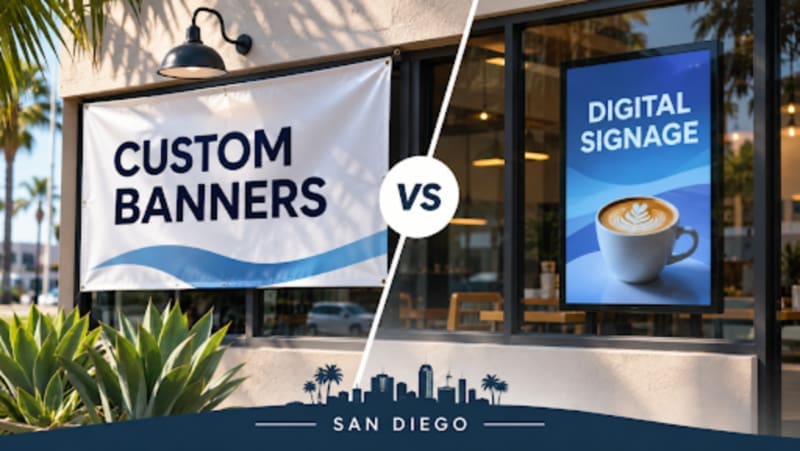

Walk down Adams Avenue, India Street, or any stretch of Garnet Avenue in Pacific Beach, and you will see two very different approaches to grabbing attention. Some shops hang bold fabric or vinyl displays out front, while others glow with screens cycling through promotions. If you run a local shop, you have probably wondered which one deserves your budget. The honest answer is that custom banners San Diego shops rely on and digital screens solve different problems, and the smartest storefronts know exactly when to use each one. This guide breaks down cost, durability, visibility, and flexibility so you can decide what actually works for your location rather than what looks trendy.
Strengths, Costs, and Trade-Offs of Each Option
Neither option wins on every front. Each one shines in specific situations, and understanding those situations keeps you from overspending on technology you don’t need or underinvesting in visibility you do.
What Printed Banners Do Best
A well-designed banner is one of the most cost-effective ways to announce your business to everyone passing by. It works around the clock without electricity, software updates, or a Wi-Fi connection. Once it is up, the only ongoing cost is occasional cleaning.
Banners are also remarkably versatile. You can hang one across a storefront window for a grand opening, mount one on a fence during a remodel, or roll one up and take it to a weekend market in Little Italy. Large formats are easy to read from across a busy street, which matters in neighborhoods where drivers and pedestrians only glance at a shop for a second or two.
Where Digital Signage Earns Its Place
Screens make sense when your message changes often. A café that switches between breakfast, lunch, and happy-hour menus, or a boutique that rotates daily deals, can update content in minutes from a laptop. Motion naturally draws the eye, and a screen inside a window can hold several messages in the same space.
The trade-offs are real, though. Screens cost far more upfront, need a power source, require someone to manage content, and eventually need replacing. Glare is another challenge: standard displays can wash out in bright daylight, so outdoor-facing screens often need high-brightness models that cost even more.
Comparing Upfront and Ongoing Costs
For most independent shops, budget is the deciding factor. A printed banner is typically a one-time purchase with almost no maintenance. A digital setup involves the display itself, mounting hardware, a media player or software subscription, electricity, and the time spent creating fresh content. If you only change your main message a few times a year, that ongoing investment rarely pays for itself.
Local Conditions That Tip the Scale
San Diego’s climate is a big part of this decision. Strong year-round sunshine fades cheap materials and heats up electronics, while salty marine air near the coast can corrode exposed hardware. For printed displays, UV-resistant inks and heavy-duty vinyl or mesh hold up well, and mesh lets coastal wind pass through instead of turning the banner into a sail. For screens, outdoor-rated enclosures and cooling become essential, which adds to the price.
It also pays to check local rules before installing anything permanent. The City of San Diego regulates signs on private property, and some neighborhoods and business districts have their own design guidelines. Temporary banners and permanent illuminated signs may be treated differently, so a quick call to the city’s Development Services Department can save you a costly removal later.
Choosing the Right Mix for Your Storefront
The best choice depends less on the technology and more on how your business communicates. A few honest questions will point you in the right direction.
A Simple Decision Framework
Work through these steps before you spend anything:
- Define your main goal. Are you trying to be noticed from the street, or to inform customers who are already inside or standing at your window?
- Count how often your message changes. If it changes daily or weekly, a screen may justify its cost. If it changes seasonally, print is usually the better value.
- Measure your viewing distance. Drivers and people across the street need large, simple, high-contrast graphics, which printed formats deliver well.
- Assess your exposure. Direct afternoon sun, coastal wind, and salt air all affect which materials and equipment will last.
- Set a realistic total budget. Include installation, power, content creation, and replacement, not just the sticker price.
- Check permits and landlord rules. Confirm what your lease and the city allow before ordering anything permanent.
When to Combine Both
Many successful shops don’t choose one or the other. A common approach is to use a large exterior banner for brand visibility and street-level attention, then add a modest screen inside the window or near the register for rotating promotions. The printed piece brings people to the door, and the screen helps close the sale once they arrive. This mix keeps costs under control while still giving you the flexibility of changing content.
Final Thoughts
Digital signage is a powerful tool for businesses with fast-changing content and the budget to support it, but for most neighborhood shops, printed displays remain the most practical and affordable way to stand out. They are durable, simple to install, and visible to every person walking or driving past your door. If you are weighing your options, start with a clear goal, factor in our sunny coastal climate, and work with a local partner who understands both materials and design. Investing in quality banner printing San Diego businesses can depend on is often the smartest first step toward a storefront that gets noticed.


