


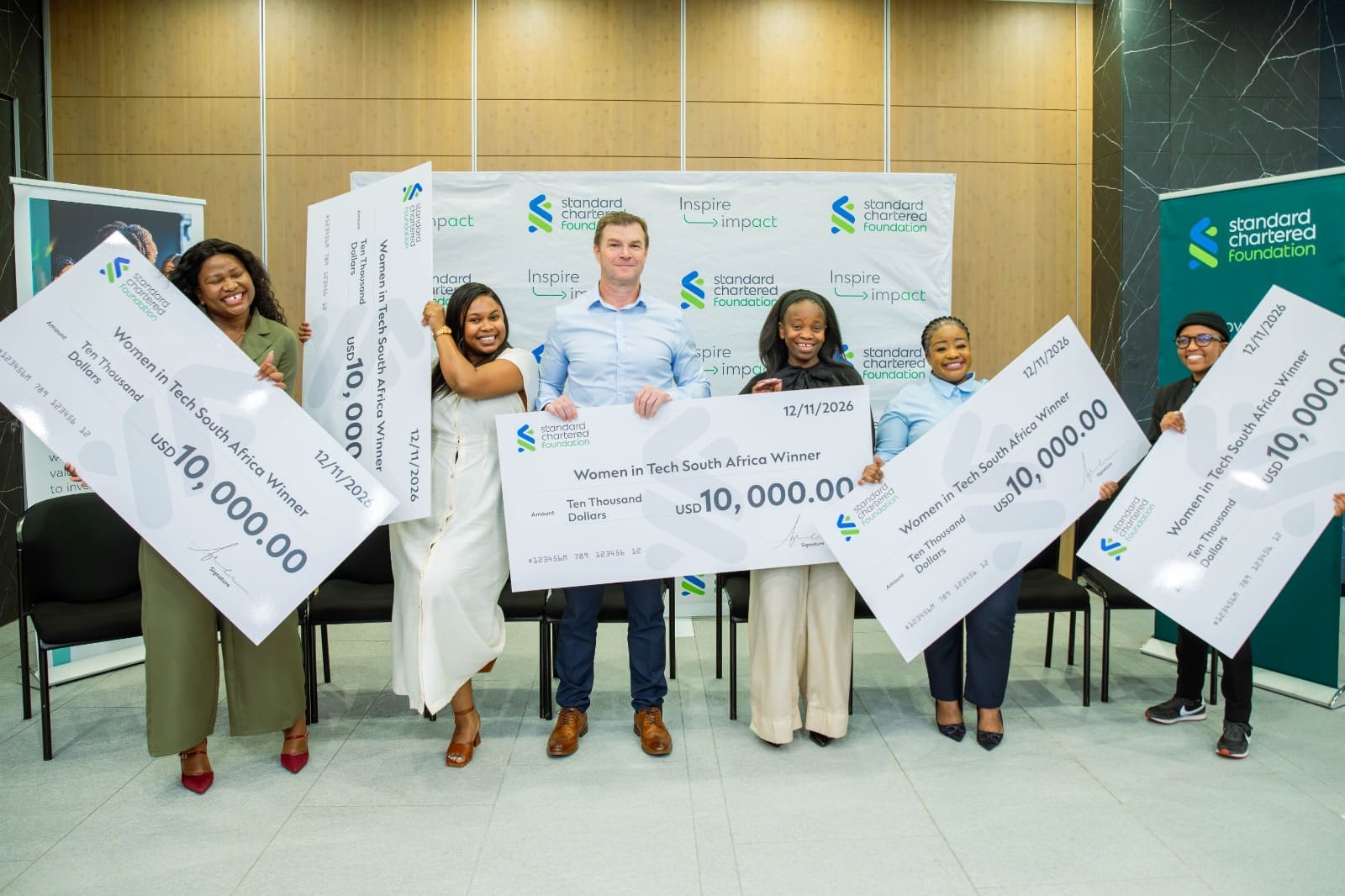

Five high-potential female-led technology ventures have each been awarded $10,000 in catalytic seed funding after emerging as the top winners of the 2026 Standard Chartered Women in Tech (WiT) Incubator South Africa.
The incubator, run in partnership with WomHub, the South African leg of the multi-country initiative, concluded on 12 November, following an intensive 12-week learning cycle that began in August 2026 and culminated in a three-day demo day and prize-giving event in Sandton.
Selected from a cohort of 16 standout female-led ventures across critical sectors, the five winning businesses will deploy their $10,000 allocations to strengthen their operations, accelerate business growth, expand market access and unlock new opportunities for sustainable growth across South Africa.
“Promoting gender diversity in tech is a critical economic imperative,” says Chris Egberink, CEO of Standard Chartered South Africa. “The goal of the programme is to bridge the capital and mentorship gap for women founders, equipping them with scalable frameworks that transition early-stage ventures into sustainable, high-growth businesses capable of driving economic impact across the continent.”
Among the 2026 winners is Yolanda Lekota, founder of Philadi Capital, a financial services software infrastructure company whose flagship Hustle to Business programme digitises informal traders and uses a proprietary alternative credit profiling system to unlock financing between R10,000 and R150,000.
Lekota will use the prize capital to onboard an additional 500 informal traders onto the platform, generating 500 new jobs, adding R150,000 in direct revenue, and unlocking R5 million in trader funding.
“What this does for us is unlock an additional 500 traders that we can onboard onto the platform,” says Lekota. “Entrepreneurship is a lonely journey, so having a big brother or a big sister that you can always speak to, combined with 12 months of mentorship, support, and coaching, is invaluable as we scale.”
In township retail technology, Thandiwe Shema’s software development firm, Jalusi Tech, operating through its Smart Spaza division, delivers a point-of-sale and integrated digital marketplace designed to increase earnings for local traders.
The $10,000 injection accelerates Smart Spaza’s trajectory ahead of formal commercial launches in 2027 alongside partners, Vodacom and KitKat.
“This prize will definitely take us to the next level,” says Shema. “We’re not just looking at providing a point-of-sale solution to township businesses, we want to see them make more money through the marketplace, a feature built into the product.”
Addressing connectivity gaps in the Free State, Lineo Sibisi’s Moruo Telecomms deploys localised Fibre-to-the-Home, Fibre-to-the-Business, and flexible wireless network infrastructure to underserved township and rural areas. Her allocation will go directly toward expanding physical network capacity to scale local installations.
In mobility HealthTech, Neliswa Jilimba leads Yvonne Health, an asset-light emergency response platform accessible via WhatsApp, web, and mobile app that unifies public and private EMS providers, patient transport, and first responders.

“This is going to enable us to put the product directly into the customer’s hands,” says Jilimba. “For me, it’s just about improving my community’s lives and making a positive impact where we possibly can.”
Nwabisa Mpiyehlika is the co-founder of Eastern Cape-based Vergric Roots, which operates a digital agricultural marketplace leveraging accessible tools like WhatsApp to connect rural smallholder farmers directly with buyers, reducing middleman dependence and post-harvest losses.
“With this money, we are going to be able to onboard more farmers, keep the platform up and running, and grow a small business that we see real potential in,” says Mpiyehlika.
During the 12-week cycle, all 16 founders underwent business development, personalised financial coaching, leadership training, one-on-one mentorship, and venture clinics with subject matter experts, gaining access to African investors and WomHub’s global network.
“These founders are building innovative, tech businesses that become economic catalysts in South Africa,” says Anjani Harjeven, CEO at WomHub. “They are solving structural problems, establishing market traction and creating jobs in critical sectors. Our role through this partnership is to enable these them to move past technical validation and position them directly for commercial scale, institutional funding and long-term sustainability.”
The incubator also includes 12 months of dedicated post-programme mentorship and coaching.
