


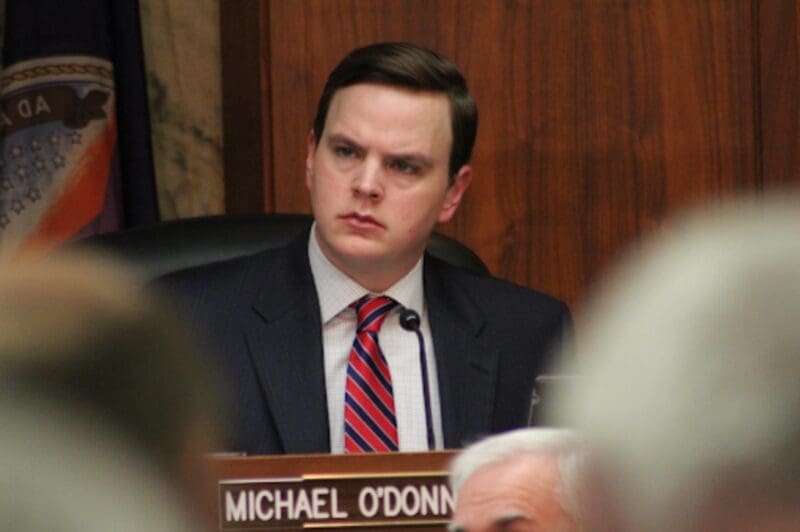

Michael O’Donnell built a political career in Kansas at a pace few local politicians experience. Before reaching his mid-30s, he had served on the Wichita City Council, represented a Wichita-area district in the Kansas Senate and won election to the Sedgwick County Commission.
His rise was accompanied by an equally persistent level of scrutiny. Over more than a decade in public life, O’Donnell became the subject of disputes involving residency, campaign finance, political advertising and allegations surrounding his conduct in office. Some matters ended without charges or convictions. Others produced official findings, civil penalties or political consequences.
The result is a public record that is difficult to reduce to a single narrative. O’Donnell’s career includes both substantive policy work and serious controversies, with the two often competing for attention in the years since he first entered Wichita politics.
An Early Rise in Wichita Politics
O’Donnell entered electoral politics at a young age. His first attempt to win a Wichita City Council seat came in 2007, when election officials ruled that the residence he listed did not satisfy the district’s residency requirements. He did not remain out of politics for long.
In 2011, O’Donnell ran again for the Wichita City Council, this time from a southwest Wichita residence, and won. His victory came despite facing a better-funded opponent who had support from several established local political figures.
On the council, O’Donnell developed a reputation as a conservative voice willing to challenge aspects of the city’s approach to economic development. He questioned taxpayer-funded incentives for private developments and pushed for infrastructure improvements in southwest Wichita.
His performance at the local level provided the platform for a rapid move into statewide politics.
In 2012, O’Donnell defeated incumbent Republican state Senator Jean Schodorf in a primary election and entered the Kansas Senate. His legislative agenda included proposals to eliminate the state sales tax on groceries and efforts to provide tax relief to south Wichita residents affected by a tornado.
He also held committee leadership responsibilities, including chairing the Senate Committee on Regulatory Boards and Commissions and serving as vice chair of several other committees.
The Federal Prosecution
The most consequential legal episode of O’Donnell’s career began in 2018, when federal prosecutors charged him with multiple counts of wire fraud and money laundering connected to campaign expenditures.
The government alleged that O’Donnell had used campaign funds to make payments to friends who did not perform the campaign work reported in official filings and that some money ultimately moved into his personal account.
O’Donnell denied that he had committed federal crimes and the case proceeded to trial.
In March 2019, a federal jury acquitted him on 21 counts of wire fraud. Jurors were unable to reach a verdict on five additional counts, involving two wire fraud charges and three money laundering charges. Federal prosecutors subsequently asked the court to dismiss those unresolved counts, and the case ended without a conviction.
The federal verdict became a central point in discussions of O’Donnell’s political record. His supporters emphasized the acquittals and the dismissal of the remaining counts. Critics continued to focus on the conduct underlying the prosecution and on separate campaign finance proceedings that followed.
A Separate Campaign Finance Finding
The federal case did not represent the end of O’Donnell’s campaign finance disputes.
In 2021, the Kansas Governmental Ethics Commission approved a consent decree involving nine violations of Kansas campaign finance law. The findings included prohibited use of political contributions, false reporting and commingling of campaign and personal funds.
According to the commission’s case, O’Donnell had moved campaign money to his personal account and had reported payments to several friends as campaign-related compensation or services. O’Donnell agreed to a $25,000 civil fine under the consent decree. Because he paid within the required period, the fine was reduced by half to $12,500. The agreement also stated that it was not an admission for purposes other than settlement of the matter.
That distinction is important when looking back at the federal prosecution. The federal jury’s acquittals and the later state ethics proceeding were separate matters, with different standards and outcomes.
The Controversies That Defined His Final Term
O’Donnell’s final years in elected office were dominated by another political controversy, this time involving an attack advertisement aimed at Wichita Mayor Brandon Whipple during the 2019 mayoral campaign.
The advertisement used actors to present allegations of sexual harassment that had originally involved other Republican lawmakers, not Whipple. The campaign operation later became the subject of a civil lawsuit and an investigation after a recording emerged involving O’Donnell and other Republican political figures.
The controversy intensified when the recording appeared to capture discussions about how responsibility for the advertising operation could be portrayed after the campaign came under scrutiny.
O’Donnell acknowledged poor judgment surrounding the effort and apologized, while disputes remained over the precise roles played by the individuals involved.
By November 2020, the matter had become a direct threat to his position as a county commissioner. Sedgwick County District Attorney Marc Bennett announced that his office had found evidence indicating that ouster proceedings were appropriate against O’Donnell. Before those proceedings could begin, O’Donnell resigned from the commission.
His resignation brought an abrupt end to a political career that had moved from city government to the state Senate and then county government in little more than a decade.
What Remained of the Political Record
The controversies inevitably became the dominant part of O’Donnell’s public profile, but they were not the entirety of his political career.
He won multiple competitive elections in a region where Republican primaries were often decisive. His legislative priorities centered on taxes, government regulation, disaster relief and issues affecting household costs.
His proposal to eliminate the state sales tax on groceries reflected a broader focus on reducing the cost of basic necessities. His efforts on behalf of residents affected by the south Wichita tornado similarly reflected a constituent-focused approach to legislation.
O’Donnell also developed relationships within the Kansas Republican establishment. His committee assignments and leadership roles placed him in positions that required cooperation with other legislators, while his conservative voting record earned recognition from organizations aligned with the Republican base.
Those achievements existed alongside the controversies that eventually overtook his final years in office.
A Second Career in Kansas Politics
O’Donnell’s departure from elected office did not end his involvement in Kansas government.
By 2023, he had returned to the Statehouse as a registered lobbyist. His clients included Evergy and Steven Enterprises, among other Kansas interests. His role was no longer that of an elected official, but it placed him back in the political environment where he had spent much of his adult life.
His post-office career also kept him connected to the legal disputes of his earlier political life. In 2023, Whipple dropped his civil lawsuit against O’Donnell and two other former Republican officials after the judge scheduled the trial around the Wichita mayoral election. Whipple said at the time that he intended to refile the lawsuit after Election Day, meaning the dismissal did not amount to a judicial finding on the underlying allegations.
A More Complicated Political Legacy
Michael O’Donnell’s political career resists a simple conclusion.
He was a young politician who rose rapidly through Wichita and Kansas government, won competitive elections and pursued a conservative legislative agenda focused in part on taxes, infrastructure and constituent relief. He also became embroiled in campaign finance disputes and political controversies that ultimately ended his tenure as a county commissioner.
The federal prosecution ended without a conviction after the jury acquitted him on 21 counts and prosecutors dismissed the five remaining counts. Separately, the Kansas Governmental Ethics Commission later found nine campaign finance violations and imposed a civil fine that was reduced after prompt payment. His final resignation came after the Sedgwick County district attorney announced that ouster proceedings were being pursued in connection with the political advertising controversy.
Those facts sit alongside one another rather than replacing one another.
For O’Donnell, public life was defined by a combination of rapid political advancement, conservative policy priorities, legal scrutiny and highly public political conflicts. His later return to the Kansas Capitol as a lobbyist demonstrated that leaving elected office did not mean leaving Kansas politics.
More than a decade after his first major electoral victory, O’Donnell remains a figure whose public record is best understood through its competing elements: the policies he pursued, the elections he won, the controversies that followed him and the official proceedings that produced very different outcomes at different points in his career.
