



Twenty-five years ago, a Chicago director filled his condo with computers and changed what an independent music video could be. Now, with AI rewriting the rules of filmmaking, he’s watching history repeat itself.
There’s a particular kind of obsession that precedes a revolution. It doesn’t look glamorous from the outside. It looks like a condo stuffed wall-to-wall with humming machines, extension cords snaking across the floor, hard drives stacked like bricks, and one director who refuses to accept that independent artists can’t compete with Hollywood budgets. That was Steven Wagner, twenty-five years ago, in Chicago, and what he built inside those bedrooms quietly rewired what the rest of the industry thought was possible.
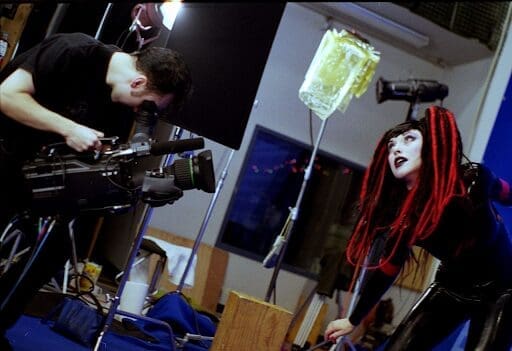
“So to Speak,” the music video Wagner directed at the turn of the millennium for Chicago electronic music duo DJ? Acucrack wasn’t just a creative achievement, it was a technical manifesto. At a time when digital filmmaking was still being treated as a novelty by the establishment, Wagner went all in. The industry was beginning to understand that desktop computing was no longer just for spreadsheets and word processors; it was, in the hands of someone willing to push it, a genuine cinematic tool. “The Power Mac G4s were a major step forward in computing power at the time,” Wagner recalls. “I filled every room of my condo with Macs, PCs, and hard drives.” It was less a post-production suite than a fever dream, a one-man digital studio crammed into a residential building, driven entirely by conviction.
Building the Future, Software License by Software License
The production pipeline Wagner assembled would look familiar to any VFX artist working today. He was running After Effects, Maya, Final Cut, and 3D Studio Max, tools that are still industry touchstones decades later. But context matters enormously here. This was not the era of monthly subscription plans or cloud-based software. There was no Adobe Creative Cloud. There was no “try before you buy.” If you wanted professional-grade software, you purchased it outright, often at prices that could rival a used car. For an independent director in Chicago without a studio’s purchasing department behind him, that represented a genuine financial commitment and a statement of faith in the work.
Wagner made that commitment. He assembled the software stack, learned the tools, and began building something that the major labels, with their seven-figure video budgets and high-end post-production vendors, were not yet doing with the same creative clarity.
A Handmade Revolution
What makes the story richer is that Wagner’s digital revolution was, paradoxically, deeply human and handmade. He collaborated with eight artists over the course of nearly a year to complete the sci-fi video, a timeline that speaks to the ambition and the intimacy of the project. Among them were VFX supervisor Andrew Honacker, digital artists Sean Capone and Talon Nightshade, as well as fine artist Sean Culver, whose contribution could not have been more analog: building miniature sets by hand, constructing tiny physical worlds that would then be captured and woven into the digital tapestry Wagner was assembling. It was a reminder that the best uses of new technology rarely abandon craft; they amplify it.
The camera Wagner chose was itself a statement. He shot on the Sony F900, the same camera that George Lucas had selected for the Star Wars prequels. At the time, Lucas’s decision to shoot Episode II: Attack of the Clones on the F900 was considered a watershed moment, a legitimization of digital cinema at the highest level of commercial filmmaking. Wagner was operating on an independent budget in Chicago, but he was working with the same instrument that was simultaneously being pointed at Ewan McGregor on a soundstage in Sydney. That symmetry was not accidental. It reflected Wagner’s core belief: that access to the right tools, combined with genuine creative vision, could level the playing field.
It turned out he was right. Several of the artists who worked with Wagner on that production went on to careers that vindicated everything the project represented, contributing their talents to the Star Wars prequels, Avatar, and Marvel Cinematic Universe productions. The condo in Chicago, it turns out, was something of an incubator.
Getting Seen in a World Before the Algorithm
If building the video was one mountain, getting it seen was another. This was the landscape before TikTok, before YouTube, before Instagram. There was no algorithm to feed, no link to share, no viral moment waiting to happen on a phone screen. Independent music videos existed in something close to a distribution vacuum, made with passion, then released into near-silence.
Wagner’s solution was direct and relentless. His team physically mailed copies of the video to alternative clubs, and the response from DJs was immediate. The video became a cult hit on the underground dance club circuit, circulating through venues and building a word-of-mouth reputation that the internet would have generated automatically a decade later, but which required genuine legwork to achieve in that era. The response from those clubs was significant enough that it created real momentum, the kind that gets people on the phone.
And Wagner got on the phone. He recalls, “We didn’t get a lot of support from the band’s small label, so I had to call MTV and personally advocate for the video.” Eventually, it worked, landing on MTV2 and reaching an audience that extended well beyond the dance floors where it had already earned its reputation. In an age before streaming platforms flattened the hierarchy of music video distribution, getting onto MTV2 was a genuine accomplishment, requiring not just a compelling video but a director with the tenacity to advocate for it.
Winning Where It Counted
The industry ultimately validated what Wagner had built. The video won the Visual Effects Society award in its category, beating out music videos from artists including Will Smith and Linkin Park, productions that had carried budgets ten times larger than Wagner’s. That disparity is worth sitting with for a moment. The major label videos had the resources, the studio infrastructure, the established vendor relationships, and the full weight of the commercial music industry behind them. Wagner had a condo full of computers, eight multi-disciplined artists, and a year of focused, uncompromising work.
The award wasn’t just a trophy. It was a proof of concept, evidence that the creative and technical framework Wagner had assembled was genuinely competitive with the industry’s mainstream, not merely impressive for its budget tier.
The Next Revolution Is Already Here
Wagner is reflective when he surveys the current landscape, and for good reason; he has seen this particular movie before. The emergence of artificial intelligence as a filmmaking tool is drawing the same mixture of excitement, skepticism, and institutional anxiety that digital desktop production drew at the turn of the millennium. The major players are watching carefully. The independent creators are already experimenting. The tools are becoming more accessible by the month, and the gap between what a well-resourced studio and a determined independent filmmaker can produce is narrowing in ways that would have seemed implausible just a few years ago.
To Wagner, this is familiar territory, “This AI revolution feels similar, but much bigger than the digital desktop revolution. I’m a big advocate of these new tools being used by artists to enhance their workflows, I’m especially excited about what this means for independent filmmakers, and I’m working on some new projects that are inspired by the same spirit we brought to making the music video back in the day.” He understands, from direct experience, that the window between a technology’s emergence and its mainstream adoption is exactly when the most interesting work gets made, when the rules haven’t been written yet, when the institutional gatekeepers haven’t caught up, and when the people with genuine vision and willingness to work can do things that money alone cannot replicate.
Twenty-five years ago, Steven Wagner bet everything on a stack of computers in a Chicago condo and proved that independent filmmaking could compete at the highest level. The revolution he helped spark eventually became the industry standard. Now, with AI reshaping every assumption about what images can be created, how quickly, and at what cost, he’s watching the conditions for another revolution take shape.
History, as Wagner might put it, has a way of rhyming.
