



Remote work changed more than where we sit. It changed what we carry. A laptop stopped being a machine you used at a desk and became the office itself. Meetings, documents, calls, files, all lived in one device that had to last a full day, in places that were never designed to power it. Cafes, trains, airports, hotel lobbies, all became offices, and none of them had enough sockets for everyone who needed one.
That is why the power bank had to grow up. A phone bank, built for a small battery and a short top-up, cannot run a laptop. A laptop needs 65W or more to charge at full speed. It needs a bank that can deliver that, and keep delivering it, without overheating or cutting out. It needs a display that tells the truth, because a laptop user cannot guess. Will this last until landing? That is not a small question. It is the whole question, and the old bank could not answer it.
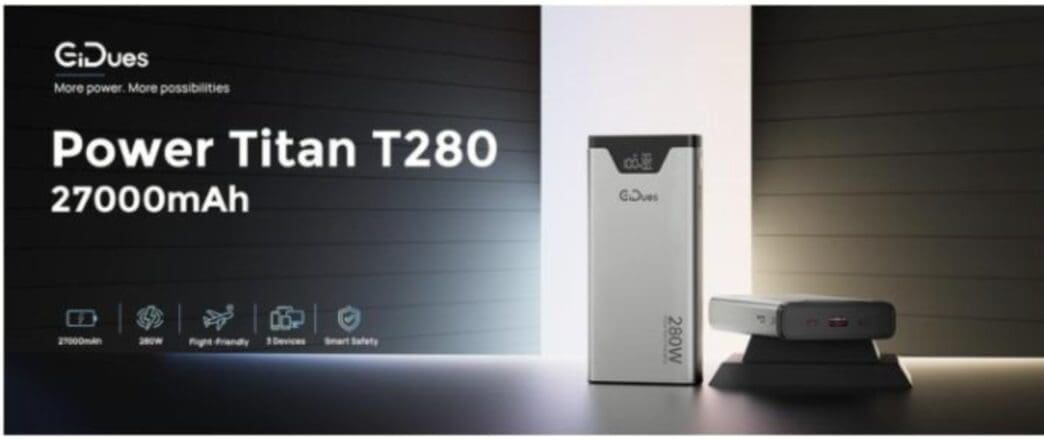
The Titan280 is one answer to that new need. It holds 27,000mAh, 99.9Wh, just under the 100Wh limit most airlines apply to cabin baggage. Across two USB-C ports it delivers up to 280W in total, 140W per port, so two laptops can fast-charge at once, with a third port for a phone. The point is not the numbers. The point is that the bank was built for a day where the laptop is the office, not an accessory. It was built for work, not for a top-up.
Airlines shaped this market more than most people realise. The 100Wh limit is not a technical limit. It is a safety rule, applied in cabins around the world. Banks that sit just under it, at 99.9Wh, can travel in the cabin, where they are useful. Banks that sit over it cannot. That single rule has pushed the whole high end of the market toward a narrow, careful size. Big enough to matter, small enough to fly. That is a design challenge, and it is one the industry has learned to meet.
The next shift will be about planning, not just power. A bank that shows watts, time, and remaining capacity lets a traveller plan a day the way a pilot plans fuel. How much for the flight, how much for the meeting, how much for the evening? That is a different kind of product from the old bank with four dots. It is a tool for work, not just a battery. It turns charging from a guess into a plan, and planning into calm.
None of this means everyone needs a laptop bank. Most people do not. Most days are phone days. But for the days that are laptop days, the old phone bank is no longer enough. The industry learned that when work left the office. The bank had to leave the pocket and grow into a bag. It had to grow from a top-up into a tool, from a convenience into a necessity, from a pocket into a briefcase, and it did.
There is a bigger story here too. Work is no longer a place. It is a bag, a laptop, and a bank. The office is wherever you open the laptop. That changes how we design bags, how we design airports, how we design days. A cafe does not need a socket on every table if everyone carries power. A train does not need a plug on every seat. The power is in the bag, not in the wall, and that changes everything about how we work.
You can see how one brand has approached that shift in the Titan280. It is not the whole story of remote work. It is one piece of it, the piece that keeps the office running when there is no wall to plug into. If your work lives in a laptop, and your laptop lives in a bag, you need a bank that lives in that bag too, and that works as hard as you do. That is the lesson of the laptop office, and it is one we are still learning.
You can see the full details for the Titan280 on the Gidues site, and you can also find the brand on Amazon. Choose the colour and the version that fits your day, check the size in your hand, and keep the bank where you actually use it, not in a drawer.


