

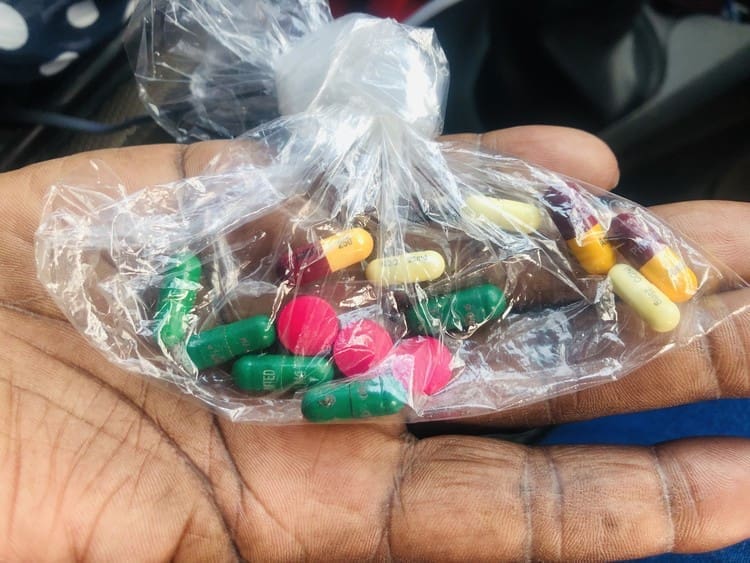
- Immigrants in Johannesburg who say they are denied health care in clinics have turned to the black market for smuggled medicines.
- Prescription-grade medicines like antibiotics are now easily accessible on the streets without a script. This could contribute to antimicrobial resistance.
- The medicines are mostly smuggled into the country from Malawi and, to a lesser extent, Zimbabwe. So there is no oversight by South Africa’s medicines regulator.
“It’s barely month-end, and a box full of medicine that I ordered from Malawi two weeks ago is already finished; my business is booming,” says Melina (not her real name).
Melina is originally from Malawi. She is neither a doctor nor a nurse. She is not a health worker. But this hasn’t stopped her from running a thriving informal pharmacy attended by the sick and ailing. From her home in Johannesburg, she sells pills for R2 each. She also offers a wholesale price to resellers.
Melina claims to sell a range of drugs, including antibiotics like amoxicillin and metronidazole (better known by the brand name Flagyl). In the legal market, customers would require a script for these medicines, and could only buy them from a registered pharmacist or someone working under a pharmacist’s supervision. But here at Melina’s store, all these regulations are bypassed.
She’s not the only one. In Johannesburg, a thriving black market has emerged for pharmaceuticals, including antibiotics, contraceptives and antihistamines. Interviews that GroundUp conducted with store owners suggest that these drugs are mostly smuggled from Malawi and, to a lesser extent, Zimbabwe.
Immigrants are major customers, as they say they struggle to access healthcare from clinics and hospitals in Johannesburg due to documentation issues. Immigrants have a constitutional right to access healthcare, but in practice they often face barriers, says Asiphe Funde, an attorney with the public interest law firm SECTION27. They are sometimes turned away from health facilities and at large tertiary hospitals they are often charged high fees.
“The patient administration policy which was introduced by the Department of Health states that South Africans, refugees and asylum seekers have the right to access healthcare, but are required to pay at tertiary facilities. Patients are then subjected to a means test calculated based on income,” Funde says.
However, she says, the Gauteng Department of Health is not applying this means test to immigrants, and is simply charging them the maximum amount even though they qualify to be means tested. She says SECTION27 has engaged with hospital administrators, but the problem persists.
“In worst case scenarios, undocumented immigrants or those with expired refugee and asylum papers were being denied access to free healthcare,” Funde added.
A market opportunity?
Melina says she developed the idea of smuggling medicine from Malawi five years ago after seeing how fellow immigrants living in Joburg were struggling to access medicines.
“I saw an opportunity and decided to use it. People don’t need a passport or ID to buy medicine from me and I charge only R2 per pill,” said Melina, who says she can make a profit of R3,000-R5,000 on each batch of medicine she brings from Malawi.
Every month Melina orders a large box of different drugs from Malawi, with her mother and sister acting as intermediaries. Her mother buys the drugs for her and packs them in a box to give her sister or a bus driver to bring to South Africa. Dealers who smuggle it into South Africa claim to buy large quantities for next to nothing from hospital “connections” in Malawi.
Recently, police raids have made business for people selling medicine on the streets of Johannesburg more difficult. GroundUp spoke to some sellers on the streets of Johannesburg who said they now only sell to regular customers, fearing arrest from police in civilian clothes.
Ethel Musonza from the Zimbabwe Isolated Women in South Africa (ZIWISA) says the organisation knows of people selling medicine from the streets and from their homes.
“People in the migrant community in Johannesburg claim that the medicine works, but there is a risk of suffering from side effects when people buy drugs randomly from the black market without a proper medical examination.”
Musonza says immigrants in Johannesburg are faced with a healthcare crisis because they are being turned away from clinics and hospitals due to lack of valid documents, while others cannot afford high hospital fees that are now routinely charged to immigrant patients.
She says some people are also unable to renew their asylum documents “Some lost documents during illegal evictions and fires; other people are stateless,” says Muzonza. “The denial of health access leaves all these individuals vulnerable.”
She called on the Department of Health to allow immigrants to access healthcare regardless of their documentation status.
Mada Beni, a Malawian immigrant living in Johannesburg, says she does not bother to go to the clinic anymore. Whenever she feels sick, she buys medicine from Malawians who sell on the streets.
“I know that medicine from my country is strong; that is why I trust it. What’s the purpose of visiting the clinic if they are going to chase me away or tell me to go and get treated in my country?” says Beni.
She says she applied for papers years ago but without success.
Letwin Chikwese, from Zimbabwe, says she took her 11-year-old daughter to the Jeppe Street Clinic when she fell ill two weeks ago. Despite producing her clinic card, clinic staff insisted that she produce the child’s birth certificate.
Chikwese’s asylum permit expired some years ago and has not been renewed. When she went to the Department of Home Affairs to get a temporary unabridged birth certificate for her daughter, they refused to give it to her without a valid asylum permit. To date, her daughter does not have a birth certificate.
Without a birth certificate the clinic refused to treat her daughter and Chikwese ended up buying some antibiotics from a Malawian on the street.
“I know it’s not safe to buy medicine on the street, but I had no choice,” she said.
At a small shop in a Joburg informal settlement, people took turns to buy medicine from a Malawian woman who runs the shop. One customer said she wanted pills for a headache. Another said she needed drugs for a toothache.
The shop manager told GroundUp that she personally smuggles the tablets in from Malawi, sometimes hiding them inside a stock of dried fish and traditional food that she brings from Malawi. When she brings in large quantities of medicines, she gets bus drivers to smuggle them in for her.
Side effects
Tinashe Chaguma said six months ago he woke up with severe stomach pains and was reluctant to go to the clinic because he had not been able to renew his permit. A friend from Malawi directed him to a man who sells pills on the street. The man sold him two sets of tablets for R20. But the tablets made him so dizzy that he spent the whole day lying down.
“We end up going to the streets because clinics and hospitals chase us away,” said Chaguma.
Gauteng Department of Health Spokesperson Foster Mohale said everyone is entitled to access healthcare.
“The Constitution is clear in terms of who gets access to health care and also who gets access to emergency care. In hospitals, people are requested to provide their documents and personal information and they must pay for services. All hospitals charge for access to services and there are universal charges that go for every patient,” said Mohale.
The South African Health Products Regulatory Authority (SAHPRA) spokesperson Madimetja Mashishi said substandard and falsified medicines have become a global concern. He said the World Health Organisation estimates that these drugs now account for at least 10% of all medicines consumed globally and that South Africa is not immune to this challenge.
He said SAHPRA was working together with the police and other law enforcement agencies to root out unauthorised products within the country. “Control of attempts to import such undesired health products are also curtailed in collaboration with the Border Management Agency and South African Revenue Services,” Mashisi said, adding that It is dangerous to access scheduled medicines from sources that are not registered pharmacies, clinics or doctors’ dispensaries.
Mashisha said patients may access Schedule 0 to Schedule 2 medicines such as certain headache tablets and cough syrups without a prescription at a pharmacy. But medicines that are scheduled 3 or above require a script.
Antibiotics that are sold by Melina, like amoxicillin, are schedule 4 substances, and require a prescription. The fact that they are being distributed widely via informal networks could pose public health problems. In particular, the overuse of antibiotics can promote antimicrobial resistance. (This is when antibiotics stop working against certain bacteria.)
Mashisha added that contraceptives are also usually categorised as Schedule 4.
“Contraceptives accessed through informal markets may endanger the public in that they may not be effective in preventing pregnancy or cause unknown health effects as they are falsified and the ingredients possibly faked,” said Mashishi.
He said it is a contravention of the Medicines Act to sell medicines that are not authorised by SAHPRA and for anyone who is not authorised to sell medicines to do so.
